

An improved statistical model has been developed to describe the chemical composition of an evaporating multicomponent- liquid drop and of the mixture of gases surrounding the drop. The model is intended for use in computational simulations of the evaporation and combustion of sprayed liquid fuels, which are typically mixtures of as many as hundreds of different hydrocarbon compounds. Since an exact model providing a detailed account of all of the compounds would be computationally intractable, the present statistical model is an approximation designed to afford results that are accurate enough to contribute to understanding of the simulated physical and chemical phenomena, without imposing an unduly large computational burden.
As in any model of physical and chemical phenomena, some simplifying assumptions are made: A drop is taken to be a sphere of radius R, wherein the liquid has constant density ρ1. Evaporation of the liquid is assumed to occur under thermodynamic equilibrium. The gas surrounding the drop — a mixture comprising a carrier gas plus multicomponent vapor from previously evaporated drops — is assumed to obey the perfect-gas equation of state. The gas is postulated to be quasi-steady with respect to the liquid, in the sense that the characteristic time of the gas is much shorter than that of the liquid. Consistent with what would be done in computations involving a very large number of drops, gradients within the drop are neglected; attention is paid only to volumetrically averaged properties represented by the drop temperature and the mass fractions of the chemical species in the drop. The focus on volumetrically averaged drop properties precludes consideration of phenomena associated with differences among diffusivities of different species.
It is further assumed that the simulated phenomena occur at atmospheric pressure, where solubility of the carrier gas into the liquid is negligible, and that the far field conditions are quiescent. The model includes the applicable equations for the conservation of mass, species, and energy.
The statistical aspect of the model enters through invocation of the concept of continuous thermodynamics, according to which the chemical composition of a fuel is described probabilistically, by use of a probability distribution function (PDF). This concept was summarized in two prior NASA Tech Briefs articles: "Model of Mixing Layer With Multicomponent Evaporating Drops" (NPO-30505), Vol. 28, No. 3 (March 2004), page 55, and "Simulations of Evaporating Multicomponent Fuel Drops" (NPO-30641), Vol. 29, No. 3 (March 2005), page 72. However, the present statistical model differs from the model of the cited prior articles.
In the prior model, the PDF is a single- peaked Gamma distribution, which is a function of the molar weight and of several parameters. However, the prior model does not generate a second peak at the low-molar-weight end of the drop-composition PDF that emerges when condensation of vapor onto drops occurs.
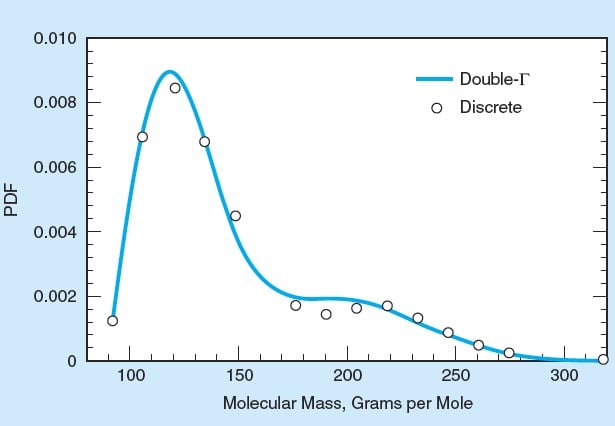
The present model generates the needed second peak. The PDF in the present model is a superposition of two Γ-PDFs and, accordingly, is denoted a double-Γ-PDF. It is a function of the molar weight plus five parameters.
Formally, the calculation prescribed by this model can be reduced to an inverse mapping from (1) the first five distribution moments, which can be calculated by use of the conservation equations, to (2) the five parameters of the double-Γ-PDF. The complexity of the inverse mapping, and the fact that the statistics of a discrete-chemical-species model may not be represented exactly by the double-Γ-PDF, make this calculation only approximate.
In a practical calculation, one makes a further approximation by utilizing only the first four moments and four parameters plus a fifth parameter that is determined empirically. Despite these approximations, extensive tests of the model on both diesel oil and gasoline show that the double-Γ-PDF accurately represents the predictions of the discrete-chemical-species model (see figure). Moreover, the mean and variation of composition at the drop surface as computed by use of the double-Γ-PDF are in excellent agreement with those computed by use of the discrete-chemical-species model: this is an important result because these mean and variance determine the composition of the gas mixture.
This work was done by Kenneth Harstad, Patrick Le Clercq, and Josette Bellan of Caltech for NASA's Jet Propulsion Laboratory. For more information, download the Technical Support Package (free white paper) at www.techbriefs.com/tsp under the Physical Sciences category. NPO-30886
This Brief includes a Technical Support Package (TSP).
Statistical Model of Evaporating Multicomponent Fuel Drops
(reference NPO-30886) is currently available for download from the TSP library.
Don't have an account?
Overview
The document is a Technical Support Package from NASA’s Jet Propulsion Laboratory (JPL) detailing a statistical model for the evaporation of multicomponent fuel drops, identified by NTR Number 30886. This model is significant for simulating many-drop gas-liquid flow, which is crucial in various aerospace applications.
The model was developed by researchers K. G. Harstad, P. C. Le Clercq, and J. Bellan, and is documented in the AIAA Journal, volume 41, issue 10, published in 2003. The research aims to enhance the understanding of how multicomponent fuel drops behave during evaporation, which is essential for optimizing fuel efficiency and performance in aerospace systems.
The Technical Support Package emphasizes the importance of this research under NASA's Commercial Technology Program, which seeks to disseminate aerospace-related developments that have broader technological, scientific, or commercial applications. The document serves as a resource for those interested in the innovative technologies emerging from NASA's research efforts.
For further inquiries or assistance regarding this technology, the document provides contact information for the Innovative Technology Assets Management at JPL, including a mailing address, telephone number, and email. This indicates that JPL is open to collaboration and sharing knowledge with interested parties.
Additionally, the document includes a notice regarding the liability and rights associated with the information provided, clarifying that the U.S. Government does not assume liability for the use of the information contained within the document. It also states that any mention of trade names or manufacturers is for identification purposes only and does not imply official endorsement by NASA.
In summary, this Technical Support Package outlines a significant advancement in the modeling of multicomponent fuel drop evaporation, which has implications for improving aerospace technologies. It highlights NASA's commitment to sharing innovative research and fostering partnerships that can leverage these advancements for broader applications.











