

Stimulated Brillouin Scattering (SBS) in optical fibers can be exploited to obtain frequency conversion with amplification and frequency-selective amplification in photonic signal-transmission and signal-processing systems. SBS has been found to be particularly useful in photonic systems that handle optical carrier signals modulated with relatively narrow-band radio-frequency (RF) signals that are typically of analog origin.
Brillouin scattering is the scattering of photons by phonons. It can occur spontaneously at low optical power levels and can be stimulated by narrow-band optical signals above threshold power levels that can be as low as a few milliwatts in some optical fibers. Because the threshold power for SBS in an optical fiber is proportional to the spectral width of the input optical signal, SBS does little harm in digital communication systems, in which bandwidths are typically large and power levels of the order of microwatts usually suffice to achieve adequate signal-to-noise ratios. However, in analog communication systems, spectral widths are smaller and power levels of the order of milliwatts are usually needed, so that SBS becomes an issue.
SBS is the most sensitive nonlinear optical effect in optical fibers. At a signal power level above the threshold in a given fiber, SBS generates an acoustic grating via the electrostrictive effect, and the grating gives rise to back-scattering of the forward-propagating optical signal. The back-scattering limits the forward-propagating optical power that can be delivered to the output end of the fiber; in other words, the net effect is one of throughput saturation. Thus, heretofore, SBS has been regarded as a nuisance in narrow-band photonic/RF communication systems.
Experiments have shown that when a single-frequency optical signal is launched into an optical fiber, SBS typically occurs with a spectral peak at frequency of the order of a few gigahertz below the signal frequency, and the 6-dB width of the SBS spectrum is typically of the order of 10 MHz. The experiments have also shown that for a given fiber, the SBS peak frequency and spectral width are independent of the signal power. These findings point the way to the use of a single-frequency optical signal as a pump signal in a scheme to achieve frequency-selective amplification, as described next.
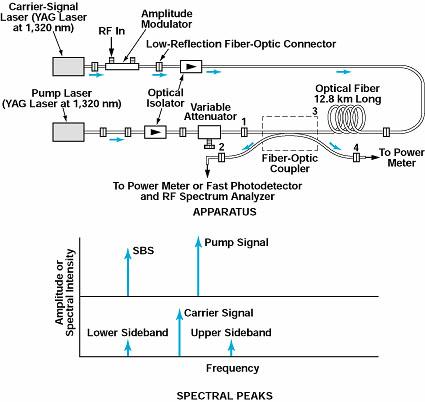
The upper part of the figure schematically illustrates a laboratory SBS amplification apparatus, while the lower part of the figure depicts the spectral peaks present during operation. A pump signal is generated by an yttrium/aluminum/garnet (YAG) laser at a wavelength of 1,320 nm and coupled into one end of a 12.8-km-long optical fiber. Another YAG laser generates a carrier signal; this signal is amplitude-modulated with an RF signal (by use of a LiNbO3 Mach-Zehnder Modulator) and coupled into the other end of the long optical fiber. The apparatus is designed to minimize reflections. The back-scattered optical power is sampled via port 2 of a four-port fiber-optic coupler, while the input (forward-propagating) pump power is sampled via port 4 of the coupler.
The pump or the carrier laser is adjusted so that the frequency of the carrier signal is lower than that of the pump signal by such an amount as to place the lower sideband of the modulated signal at the SBS peak. As a result, the lower sideband joins the back-scattered signal and becomes amplified by the nonlinear SBS effect. The amount of amplification diminishes gradually with departure of frequency from the SBS peak. The carrier and lower sideband are sufficiently distant in frequency from the SBS peak that they are not amplified.
Frequency conversion with amplification can be effected by an apparatus that is similar except that the modulator includes two independent RF input ports with a high degree of mutual isolation. RF modulation is coupled in through one port, while a local-oscillator (LO) signal is coupled in through the other port. The pump and carrier frequencies are adjusted to place the lower LO sideband at the SBS frequency so that the LO signal becomes amplified. The amplified LO signal is then mixed with the RF sidebands to obtain stronger up- and down-converted signals. Optionally, one could choose the frequencies to amplify the lower RF modulation sideband instead of the lower LO sideband, but in that case, the RF-amplification bandwidth would be limited by the SBS bandwidth.
This work was done by Xiaotian Steve Yao of Caltech for NASA's Jet Propulsion Laboratory. For further information, access the Technical Support Package (TSP) free on-line at www.techbriefs.com under the Electronic Components & Circuits category, or circle no. 153on the TSPOrder Card in this issue to receive a copy by mail ($5 charge).
In accordance with Public Law 96-517, the contractor has elected to retain title to this invention. Inquiries concerning rights for its commercial use should be addressed to
Technology Reporting Office
JPL
Mail Stop 122-116
4800 Oak Grove Drive
Pasadena, CA 91109
(818) 354-2240
Refer to NPO-20091 , volume and number of this NASA Tech Briefs issue, and the page number.
This Brief includes a Technical Support Package (TSP).
Exploiting Brillouin Scattering in Analog Signal Processing
(reference NPO20091) is currently available for download from the TSP library.
Don't have an account?
Overview
The document is a NASA Technical Support Package detailing advancements in analog signal processing through the exploitation of Brillouin scattering, specifically focusing on its application in photonic systems. Authored by Xiaotian Steve Yao from the Jet Propulsion Laboratory (JPL), the report outlines the challenges faced in photonic RF systems, particularly high insertion loss and limitations imposed by Brillouin scattering on optical power efficiency.
The primary innovation presented is the use of selective sideband amplification in the optical domain, which significantly enhances the gain of photonic analog systems. By leveraging Brillouin scattering, the report describes a method to selectively amplify the sidebands of RF modulation, effectively mitigating the high insertion loss typically associated with photonic RF systems. This approach not only improves the efficiency of signal transmission but also enables agile frequency tunability, allowing for more versatile applications in communication technologies.
The document emphasizes the technical disclosure of the problem that motivated this research: the inherent limitations of photonic RF systems due to high insertion loss and the detrimental effects of Brillouin scattering. The proposed solution involves utilizing Brillouin amplification to achieve RF mixing with gain, thereby transforming a previously harmful phenomenon into a beneficial one for signal processing.
The report also includes a technical overview of the experimental results, indicating that gains exceeding 40 dB can be achieved for weaker input signals, showcasing the effectiveness of the proposed method. This significant gain is illustrated through comparisons of amplified RF power for varying input RF powers.
In summary, the document presents a novel approach to enhancing photonic RF systems by exploiting Brillouin scattering for selective amplification. It highlights the potential for improved signal processing capabilities, which could have far-reaching implications for communication technologies, particularly in space applications where efficient signal transmission is critical. The work represents a significant step forward in the field of photonic analog signal processing, offering a promising solution to longstanding challenges in the domain.











