

The Single Mode Acquisition Code (SMAC) computer program mathematically models the optical, mechanical, and electronic dynamics of high-finesse, long-baseline, multiple-cavity optical interferometers like those used in gravity-wave detectors. Dynamical situations that can be simulated include those that involve noise and/or multiple modulation frequencies and side-bands. SMAC includes components for modeling the dynamics of cavity-control servomechanisms, electronic closed-loop servo control subsystems, and synchronous-detection electronic circuitry. Nonlinear time-domain models are incorporated for use in design- ing and testing lock-acquisition controllers. Once lock has been achieved, small-amplitude transfer functions represent cavity signals adequately. SMAC provides a graphical user interface for defining problems and controlling execution with respect to the problems. SMAC also provides extensive pre- and post-processing support.
This program was written by Laura Needels, David Redding, and Lisa Sievers of Caltech for NASA's Jet Propulsion Laboratory. For further information, access the Technical Support Package (TSP) free on· line at www.nasatech.com under the Computer Software category, or circle no. 115 on the TSP Order Card in this issue to receive a copy by mail ($5 charge).
This software is available for commercial licensing. Please contact Don Hart of the California Institute of Technology at (818) 393-3425. Refer to NPO-20122.
This Brief includes a Technical Support Package (TSP).
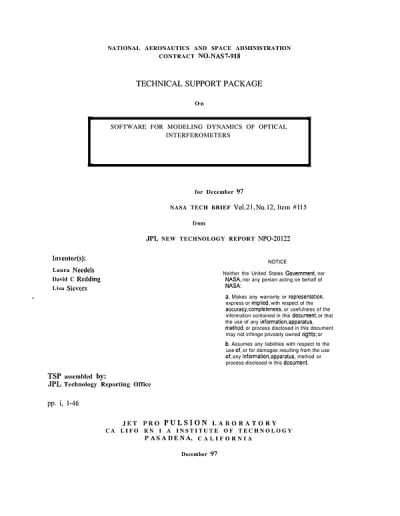
Software for modeling dynamics of optical interferometers
(reference NPO-20122) is currently available for download from the TSP library.
Don't have an account?
Overview
The document is a technical support package from NASA's Jet Propulsion Laboratory (JPL), detailing the Single Mode Acquisition Code (SMAC), a software tool designed for modeling the dynamics of optical interferometers. This software is particularly relevant for applications in gravity-wave detection, where precise measurements and modeling are crucial.
The SMAC program allows users to simulate various dynamical scenarios involving high-finesse optical interferometers. It is equipped with advanced modeling capabilities that enable the analysis of complex interactions within the interferometer setup. The software is designed to be user-friendly, featuring a graphical user interface (GUI) that simplifies the process of defining problems and executing simulations.
The document outlines the structure of the GUI, providing detailed descriptions of the menus and parameters available to users. It includes helpful hints for navigating the interface, emphasizing the importance of not destroying windows and the color-coded buttons that guide users through different functions. For instance, green buttons lead to the next menu, blue buttons represent parameters, red buttons are for special functions like saving or loading configurations, and magenta buttons return users to the cavity parameter menu.
Additionally, the document includes a disclaimer stating that neither the United States Government nor NASA makes any warranties regarding the accuracy or completeness of the information provided. It also clarifies that they do not assume any liabilities for damages resulting from the use of the information or methods disclosed.
The SMAC software is a significant tool for researchers and engineers working in fields that require precise modeling of optical systems. By facilitating the simulation of interferometer dynamics, it aids in the development and testing of technologies that could enhance our understanding of gravitational waves and other phenomena in astrophysics.
Overall, this technical support package serves as both a user manual and a promotional document for the SMAC software, highlighting its capabilities, user interface, and the potential applications in scientific research. For those interested in commercial licensing or further inquiries, contact information is provided, encouraging engagement with the technology developed by JPL.







