

A method of computational filtering enables the removal of distortions from flight-test data. The method is built upon and adapts the methods of wavelet-transform analysis to the particular test data. Although this method does not depend on the type of test data or other data to be analyzed, the initial application was to aeroelastic-flight-test data (e.g., accelerometer readings) generated with the help of structural-vibration-excitation systems on the F/A-I8 Systems Research Aircraft (SRA) and the High Alpha Research Vehicle (HARV). Such excitation systems are often essential for enabling system-identification algorithm to resolve stability trends from noisy measurements, inasmuch as atmospheric turbulence generally does not provide excitation of the type needed for determining vibration-mode characteristics.
In processing flight flutter data, one attempts to analyze the characteristics of the data in terms of times, shapes, amplitudes, frequencies, and durations of events in the data. Such analyses have traditionally been performed by use of classical Fourier techniques. However, Fourier techniques are suspect in the presence of the inherently transient nature of in-flight aeroelastic dynamics; this is because the basic Fourier-analysis assumptions of infinite duration and at least local periodicity make it impossible to represent adequately the intermittency, modulation (amplitude, phase, or frequency), non-periodicity, non-stationarity, time-variance, and/ or nonlinearity in the data.
Wavelets are versatile harmonic-analysis tools that combine both time and frequency representations into localized waveform. Given a segment of experimental data, the wavelet transform is constructed by convolving a selected series of local waveforms with the data to identify correlated features or patterns in the signal represented by the data. The result is a set of wavelet coefficients that can be interpreted as multidimensional correlation coefficients. Feature of shape, size, and location are naturally characterized by these waveforms and related coefficients.
The salient features of the original signal are reconstructed by exploiting the redundancy of the wavelets in the continuous wavelet transform (CWT). Unwanted time-frequency components are removed from the data by masking; that is, by setting the corresponding wavelet coefficients to zero. This procedure is followed to filter unwanted distortions and extract desired features from input (e.g., vibrational-excitation) and output (e.g., structural-vibrational-response) data. Extraction of features by this procedure offers advantage over traditional band-pa s-filtering and thresholding technique in that it results in the removal of unwanted features while leaving desired signal components intact.
Inasmuch as the F/ A-I8 structural excitations are essentially short-time sinusoids, a wavelet basis function could be expected to represent the characteristics of the excitation data. The Morlet wavelet was chosen as the basis function because of its clear interpretation in the frequency domain (Gaussian window) and time domain (locally periodic wave-form) for the analysis of vibration data.
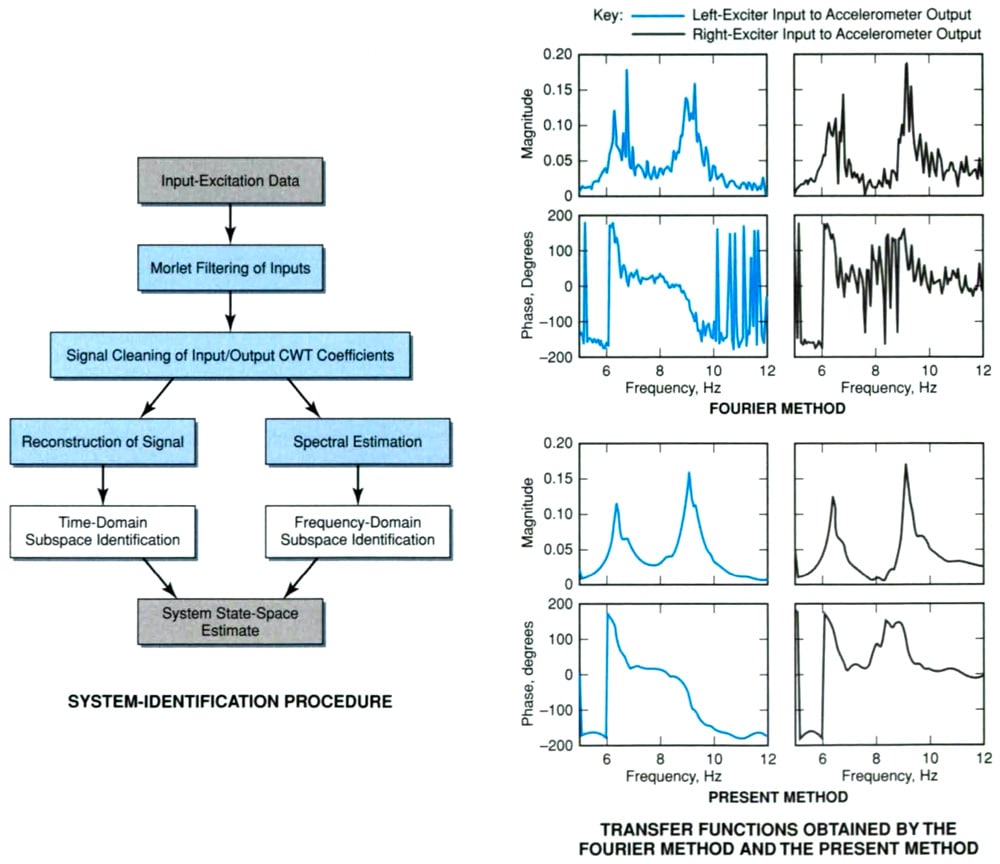
Transfer functions are used in structural dynamics to acquire state-space representations of the system modal dynamic, to determine stability estimates with standard methods, and to predict flutter boundaries with more advanced techniques. Traditional Fourier-transform methods involve averaging, windowing, and other procedures that often disguise important features in data. The pre ent method includes a recipe to circumvent this deficiency by utilizing a wavelet-based feature-extraction filter to estimate cleaner transfer functions based on localization in frequency and time. The left part of Figure 1 schematically depicts a system-identification procedure (including a procedure for constructing transfer functions) according to the present method.
The right part of Figure 1 presents an example of how the results achievable by use of the Morlet filter surpass those achievable by standard Fourier techniques. The Morlet processing affords an obvious improvement for identifying modal peaks in the presence of noise and in establishing well-defined phase response. Identification scheme used to extract modal data, state-space representation, and stability boundaries will perform better when the Morlet-filtering procedure is incorporated into them.
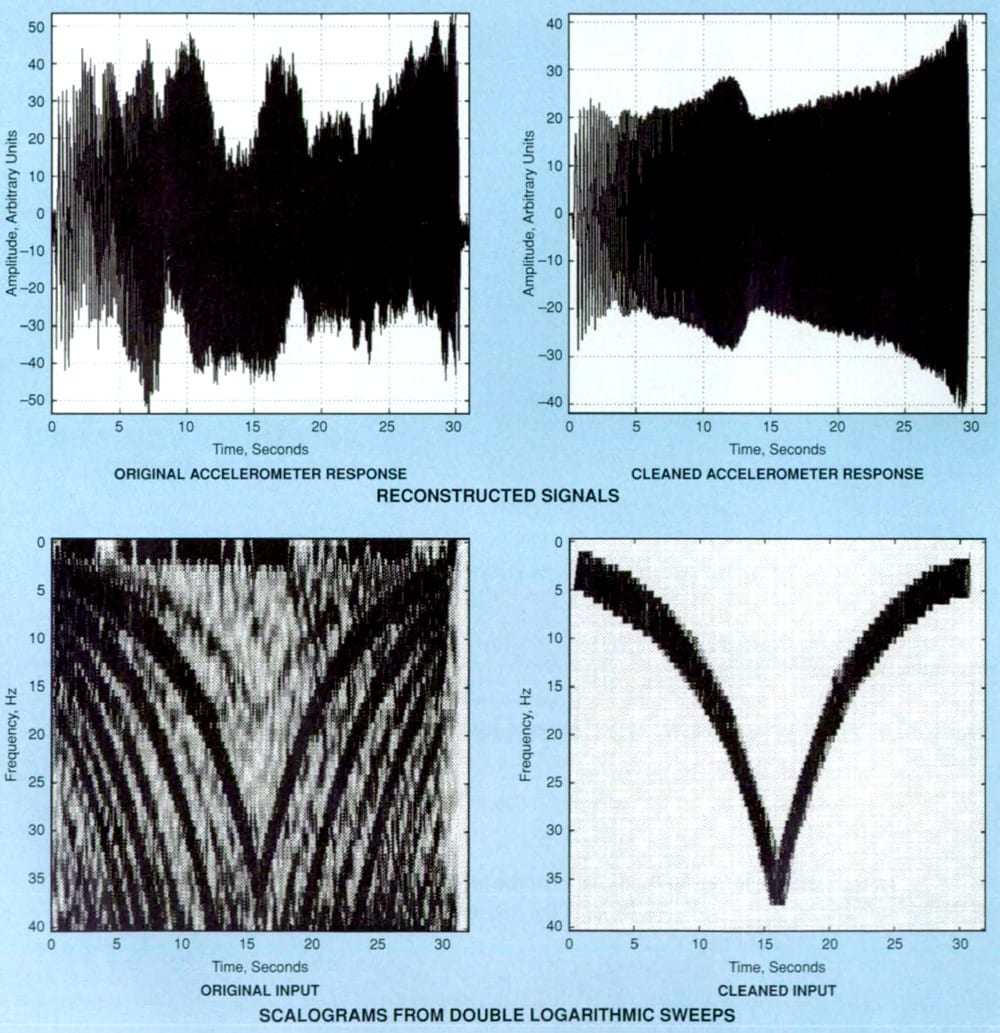
In reconstructing a signal, one uses the redundancy of the wavelets to estimate a time signal best approximated by the CWT. The real Morlet transform assures a reconstruction in phase with the original signal. The top part of Figure 2 presents an example of a reconstructed original signal and a reconstructed, cleaned version of the signal.
An example of filtering the undesired features of more-complicated input/output signal pairs in the time-frequency representation involves the use of a double logarithmic sweep from an excitation system. The bottom part of Figure 2 contains planar scalogram (map of CWT coefficients) that pertain to this example. Harmonics from train-gauge input measurements can be detected readily in the left scalogram. The presence of these harmonics indicates nonlinear exciter-vane response from rotating slotted cylinder at the wing tip . Such nonlinearity is deemed undesirable for subsequent analysis by linear state-space identification methods. Therefore, the input signal is processed by (a) extracting the desired time-frequency map from the left scalogram, yielding the right scalogram, then (b) reconstruct- ing the time-domain input signal from the data represented by the right scalogram.
This work was done by Martin Brenner of Dryden Flight Research Center and Eric Feron of Massachusetts Institute of Technology. For further information, access the Technical Support Package (TSP) free on· line at www.nasatech.com under the Mathematics and Information Sciences category, or circle no. 154 on the TSP Order Card in this issue to receive a copy by mail ($5 charge). DRC-96-76
This Brief includes a Technical Support Package (TSP).
Wavelet analysis of flight-test data on aeroelasticity
(reference DRC-96-76) is currently available for download from the TSP library.
Don't have an account?
Overview
The document titled "Wavelet Analyses of F/A-18 Aeroelastic and Aeroservoelastic Flight Test Data," authored by Martin J. Brenner and published as NASA Technical Memorandum 4793 in April 1997, presents a comprehensive study on the application of wavelet transform techniques to analyze flight test data from the F/A-18 aircraft. The primary focus is on addressing the limitations of traditional Fourier analysis in capturing the transient and complex nature of aeroelastic dynamics during flight.
The introduction outlines the challenges faced in analyzing flight flutter data, which is characterized by its timing, shape, amplitude, frequency, and duration. Classical Fourier methods are deemed inadequate due to their assumptions of periodicity and stationarity, which do not align with the inherently transient and non-linear characteristics of flight data. As a result, the document advocates for the use of wavelet transforms, which provide a more versatile approach by combining time and frequency representations into localized waveforms.
The paper details the methodology of wavelet analysis, particularly emphasizing the Morlet wavelet as the chosen basis function. This approach allows for the identification of correlated features and patterns within the flight data, leading to a more accurate representation of the underlying dynamics. The wavelet transform convolves selected local waveforms with the experimental data, resulting in a set of wavelet coefficients that serve as multidimensional correlation coefficients, effectively characterizing features of shape, size, and location.
Additionally, the document describes a novel filtering procedure designed to remove distortions from aeroelastic and aeroservoelastic flight data. This procedure builds upon wavelet transform methods, enhancing the clarity and reliability of the data analysis. The results demonstrate that wavelet analysis can significantly improve the understanding of stability trends and modal characteristics in flight data, which are crucial for ensuring safety and performance in aerospace applications.
In conclusion, the study highlights the advantages of wavelet analysis over traditional Fourier techniques in the context of flight test data. By providing a more accurate and detailed representation of transient phenomena, wavelet transforms offer valuable insights into the complex dynamics of the F/A-18 aircraft, ultimately contributing to advancements in aerospace engineering and safety.











