


The modern world runs on battery power. The world’s most critical industries are widely adopting battery-powered systems to achieve decarbonization goals, energy independence, and mobility. Still, like any technology, battery performance and business success depend on how well they’re managed.
As an example, since 2021, battery-related defects causing at least five confirmed fires have forced General Motors to recall 142,000 Chevrolet Bolt EVs. As a result, the manufacturing giant was hit with significant downtime, as well as financial and reputational damages. GM later confirmed that the Bolt recall was caused by a cell-manufacturing issue.
While fire risks cannot be entirely eliminated, there are mechanisms that can dramatically reduce battery safety risks and their impact on business. That’s where state of charge (SoC) and state of health (SoH) estimation algorithms for battery management systems (BMS) come in. These intelligent diagnostics don’t just monitor battery safety, they provide the actionable insights needed to manage risk and extend a system’s operational life. The more accurate SoC and SoH data is, the greater control engineers have over battery behavior, reliability, and cost efficiency.
Understanding the SoC and SoH Parameters
SoC and SoH algorithms are used in battery management systems to monitor the battery state of charge and overall state of health.
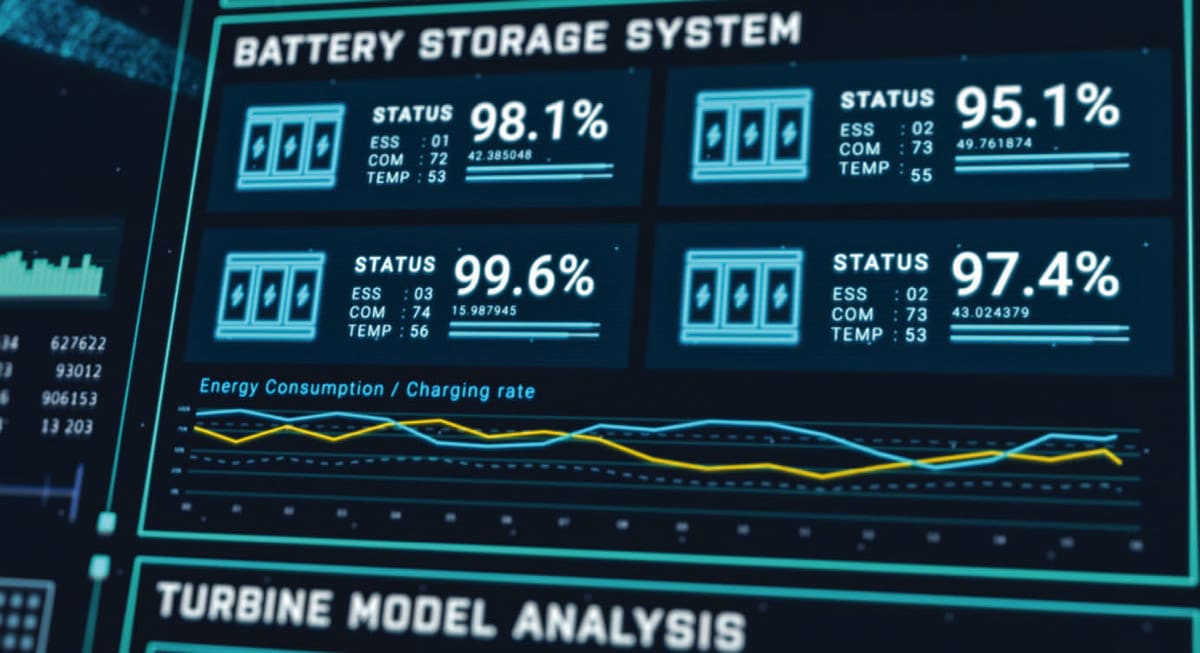
State of charge (SoC) indicates how much usable energy remains in a battery compared to its maximum capacity. It’s typically expressed as a percentage, indicating how much usable energy remains. Reliable SoC measurement supports effective energy management, enhances safety and prevents harmful charging or discharging conditions.
State of health (SoH), on the other hand, reflects the overall condition of a battery compared to its original performance. It considers factors like capacity loss, internal resistance, and cycle degradation to estimate how much useful life remains. SoH helps operators make informed decisions about maintenance, replacement, and system reliability over time.
Together, SoC and SoH are core metrics that allow a BMS to monitor, protect, and optimize battery performance throughout its lifecycle. Thus, the more precisely SoC and SoH are estimated, the clearer the picture of battery capacity, and the greater the control over your product’s reliability.
The Link Between Accurate Estimation and Battery Longevity
When SoC and SoH estimations are accurate, batteries operate within their ideal electrochemical range, resulting in a longer service life, improved user satisfaction and system ROI. Errors in SoC and SoH estimation lead to the underutilization of battery capacity and accelerated degradation, as well as increased safety risks.
Accurate SoC and SoH estimations directly foster battery longevity by enabling smarter, safer, and more efficient operation throughout the battery’s lifecycle. Here’s how:
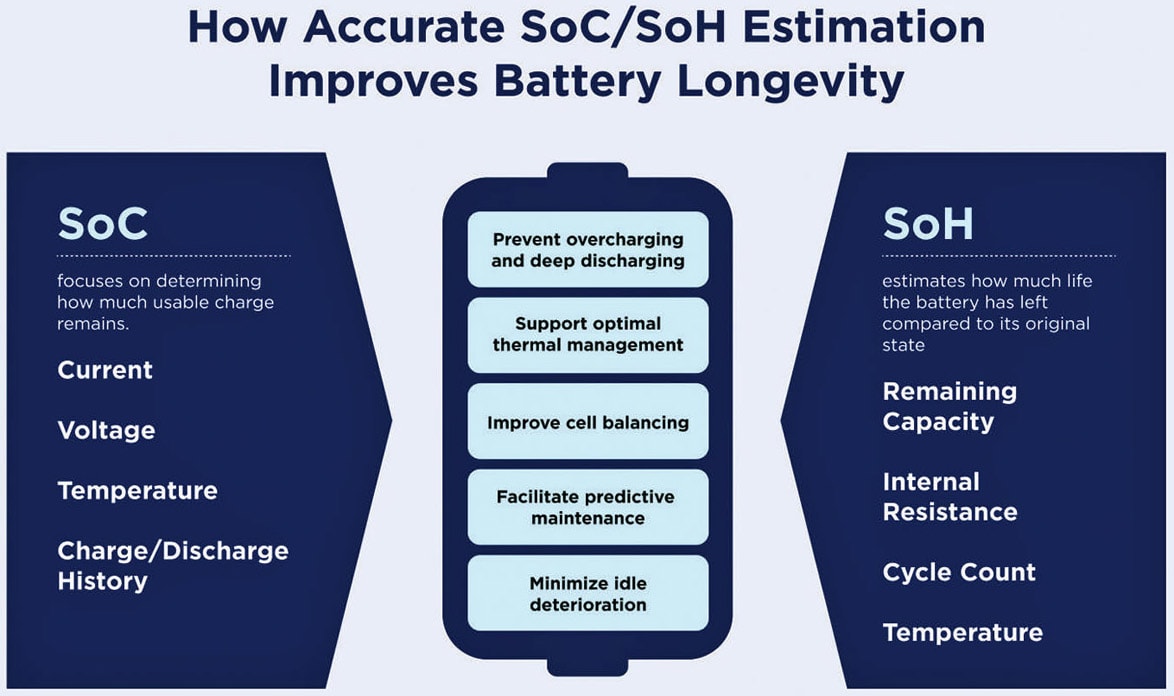
1. Prevent overcharging and deep discharging
One of the most critical functions of SoC/SoH estimation is safeguarding batteries from overcharging and deep discharging, two conditions that significantly accelerate battery degradation and compromise safety. Overcharging pushes the cell voltage beyond its design limit, increasing the risk of electrolyte decomposition, heat generation and even thermal runaway. On the other hand, allowing a battery to undergo deep discharge may result in an irreversible decline in its capacity.
By providing a precise, real-time picture of the battery’s available energy, accurate SoC/SoH algorithms ensure that charging protocols operate within safe voltage thresholds, extending the battery’s lifespan while reducing the risk of sudden failures or safety events.
2. Support optimal thermal management
Temperature is one of the most influential factors affecting battery performance, safety, and longevity. Insufficient cooling decreases charging efficiency and battery capacity. Inadequate heating cycles lead to electrolyte decomposition, reduce battery cycle life, and increase thermal runaway risk.
Reliable SoC and SoH estimations enable the BMS to accurately monitor thermal controls based on the battery’s true state of charge and load profile. This precision minimizes thermal stress, prevents hot spots, and reduces the frequency of extreme temperature fluctuations.
3. Improve cell balancing
Accurate SoC estimation is essential for effective cell balancing, which is one of the most critical functions in managing multi-cell battery packs. In any battery system, individual cells naturally diverge in capacity, resistance and charge acceptance over time. Without precise SoC data for each cell, the BMS may overcharge stronger cells or undercharge weaker ones, leading to imbalances that degrade performance and accelerate aging.
Precise SoC estimation ensures harmonization of charging and discharging operations across the entire battery pack, minimizing stress on any single cell. This promotes equal aging across all cells, reducing the risk of premature failures and prolonging the overall lifespan of the battery pack.
4. Facilitate predictive maintenance
Predictive maintenance strategies in battery-powered systems also benefit from the accuracy of SoH estimation. Rather than reacting to battery failures, predictive maintenance leverages real-time degradation patterns to forecast when a battery or individual cell is likely to underperform or fail.
Precise monitoring of capacity fade, internal resistance increase, and charge retention loss allows the BMS to flag anomalies long before they become critical. This early warning enables operators to schedule targeted maintenance, replace only the affected components, and avoid sudden downtime or catastrophic failure. At the same time, it prevents unnecessary replacements of healthy batteries, reducing waste and operational costs.
5. Minimize idle deterioration
Even in idle conditions, batteries remain susceptible to deterioration. This issue is especially relevant in seasonal equipment, backup systems, and logistics reserves. If not properly managed, batteries can reach a deep discharge state, causing irreversible damage to their cell chemistry. Conversely, storing batteries at full charge accelerates electrolyte breakdown and increases the risk of swelling or leakage.
Accurate SoC monitoring during storage plays a crucial role in minimizing idle deterioration by helping maintain the battery within an ideal charge window, typically between 40 percent and 60 percent. With reliable SoC estimation, storage management systems can track charge status in real-time, trigger top-off cycles when needed, and ensure batteries stay within safe limits. This not only preserves longterm health but also ensures that stored batteries remain ready for deployment without requiring premature replacements.
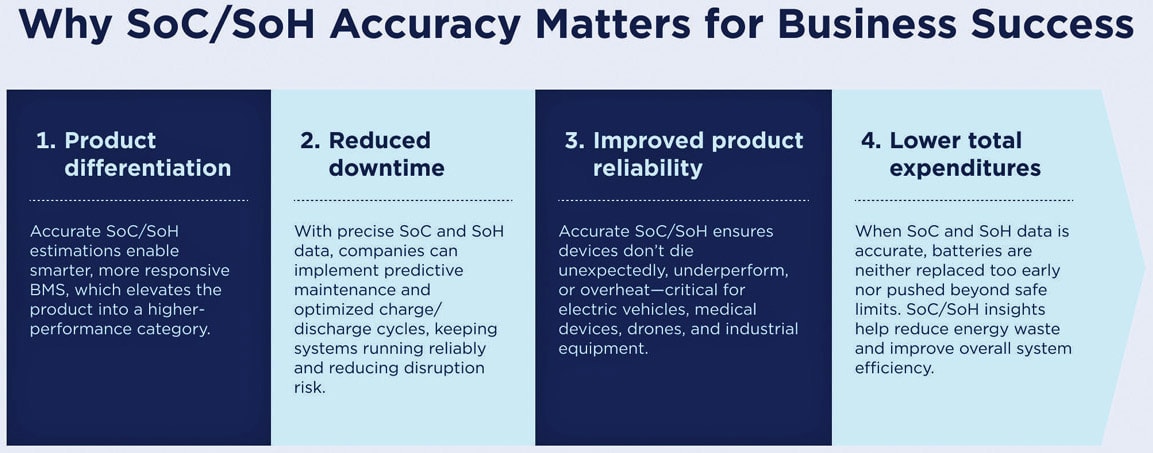
Why SoC/SoH Estimation Accuracy Matters for Business Success
In industries where reliability is non-ne-gotiable, inaccurate SoC/SoH estimations hinder both safety and economic efficiency. As a result, businesses face premature cutoffs, range anxiety, reduced performance, unexpected failures, and increased warranty costs.
In technical terms, the more accurate the SoC and SoH parameters are, the better the understanding of the device capacity is. In business terms, better battery data today means longer battery life and lower costs tomorrow. For businesses, accurate SoC/SoH means:
Product differentiation: Accurate SoC/SoH estimations enable smarter, more responsive BMS, which elevates the product into a higher-performance category. From EVs to medical devices, customers are increasingly looking for reliable runtime estimates, longer lifespans and predictive maintenance capabilities. Businesses that integrate advanced SoC/SoH diagnostics into their products can market them as intelligent, future-ready solutions, which adds to the product’s brand value.
Reduced downtime: Inaccurate battery status estimates can lead to unexpected shutdowns, interrupted operations, or unnecessary replacements, and thereby, hurt productivity. In any business, unplanned downtime leads to logistical chaos and lost revenue. With precise SoC and SoH data, companies can implement predictive maintenance and optimized charge/discharge cycles, keeping systems running reliably and reducing disruption risk.
Lower total expenditures: When SoC and SoH data is accurate, batteries are neither replaced too early nor pushed beyond safe limits. This results in maximized usable life, fewer warranty claims and a significant drop in service costs over time. Moreover, optimized thermal management and adaptive charging driven by SoC/SoH insights reduce energy waste and improve overall system efficiency. For companies overseeing hundreds or thousands of battery-operated devices, extending battery lifespan by just 10 percent can result in significant long-term cost reductions.
The Future of SoC/SoH Estimation
To understand the future of SoC/SoH algorithms, it’s essential to first consider the broader trends in battery technology and the BMS.
The move to wireless BMS drives demand for custom SoC/SoH algorithms
One of the major trends is the shift toward wireless BMS. In this context, imagine an EV or device where multiple batteries are placed in different locations. These batteries communicate with a central microcontroller (MCU) or processing unit via wireless protocols, with each battery operating under different conditions. This results in unique current profiles, exposure to varied temperatures, and different electrochemical effects. Consequently, traditional one-size-fits-all SoC algorithms are insufficient. The future lies in developing custom SoC/SoH estimation algorithms tailored to each battery’s specific operating environment and chemistry.
Typically, SoC algorithms are designed for a specific battery chemistry. However, with increasing variability in battery use, especially in wireless BMS setups, personalization becomes essential. In situations where a battery regularly faces high currents and heat, streamlining the algorithm for quicker execution, despite higher resource demands, can be more effective. In contrast, certain situations demand more complex algorithms to uphold reliability. Personalization in SoC will not only make estimations more accurate but also more efficient and robust.
As wireless BMS adoption grows, the need for maximum personalization will become a key factor. Devices are performing more functions than ever, increasing the variety and complexity of battery behavior. Consequently, we will see a wider range of current profiles, environmental effects, and battery responses. These dynamics will require adaptive, case-specific SoC and SoH algorithms to ensure accurate estimation and safe, stable device operation.
Emergence of new battery chemistries might simplify SoC/SoH estimations
Another critical trend is the emergence of new battery chemistries. While lithium-based batteries remain dominant today, alternative chemistries are being developed and gaining traction. One notable example is solid-state batteries, which differ significantly from the traditional liquid electrolyte-based designs. These will likely introduce new electrochemical behaviors, requiring entirely new control strategies.
The existing algorithms, such as those based on the Kalman Filter, may not be suitable for these new types. Therefore, the industry must reconsider how to model and estimate internal battery states in the future. In some cases, solid-state batteries might simplify SoC estimation, but they will still demand novel algorithmic approaches.
Personalization becomes key as battery safety, lifespan, and sustainability take central stage
Lastly, topics like battery durability, safety, and environmental sustainability will remain central. As devices become more powerful and battery-dependent, ensuring long lifecycle, safe operation, and minimal environmental impact will become even more important. These challenges will be further complicated by new chemistries, evolving BMS architectures, and the increasing functionality of battery-powered devices.
Using standard algorithms across all scenarios will no longer be feasible. Instead, businesses will benefit from developing custom SoC and SoH algorithms aligned with their specific product requirements. A company that knows its device’s usage patterns, current profiles and environmental conditions can design a tailored algorithm that ensures reliable, safe and long-lasting performance. These custom solutions can be cost-effective and offer better performance than generic methods, making them highly relevant in the future battery ecosystem.
This article was written by Volodymyr Andrushchak, Data Science Team lead, Lemberg Solutions (Hamburg, Germany). For more information, visit here .











