

Solar photovoltaic cells would be designed to exploit photonic-bandgap (PBG) materials to enhance their energy- conversion efficiencies, according to a proposal. Whereas the energy-conversion efficiencies of currently available solar cells are typically less than 30 percent, it has been estimated that the energy- conversion efficiencies of the proposed cells could be about 50 percent or possibly even greater.
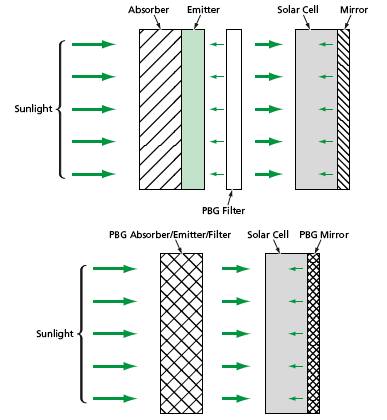
The approach involves a thermophotovoltaic principle in addition to the use of PBG materials. The basic idea is to tailor the wavelength- and direction-dependent emissivity of one or more PBG material(s) such that as much as possible of the wavelength-mismatched portion of the incident broad-band solar power would be absorbed — the absorbed power would cause heating, and the resulting thermal radiation would be funneled into a narrow band corresponding to the bandgap of the semiconductor material of a solar cell. Recent experiments unrelated to the development of solar cells have shown that as much as half of the thermal power could be thus re-routed into the bandgap.
The figure depicts two of many conceivable configurations for implementing the proposal. In one configuration, the incident solar radiation would be intercepted by an absorber and absorbed energy would be re-radiated by an emitter. A filter behind the emitter would allow primarily bandgap-energy photons to pass through and would reflect most other photons back into the absorber, helping to keep the absorber hot. A mirror at the rear surface of the solar cell would reflect any remaining nonbandgap- energy photons back to the absorber. The filter would be made of a PBG material: the advantage to be gained by using a PBG filter instead of a traditional optical filter is that a PBG structure could be designed to modify the wavelength distribution of thermal radiation from a conventional blackbody distribution to reduce or increase the spectral power densities at selected wavelengths.
In the other configuration, the functions of the absorber and filter would be combined in a single monolithic PBG absorber/emitter that could comprise, for example, thin absorbing layers alternating with thin non-absorbing, wavelength- selective layers. Optionally, the mirror behind the solar cell could also be made of a PBG material.
This work was done by Jonathan Dowling and Hwang Lee of Caltech for NASA’s Jet Propulsion Laboratory. For further information, access the Technical Support Package (TSP) free on-line at www.techbriefs.com/tsp under the Physical Sciences category.
In accordance with Public Law 96-517, the contractor has elected to retain title to this invention. Inquiries concerning rights for its commercial use should be addressed to:
Innovative Technology Assets Management
JPL
Mail Stop 202-233
4800 Oak Grove Drive
Pasadena, CA 91109-8099
(818) 354-2240
E-mail:
Refer to NPO-40662, volume and number of this NASA Tech Briefs issue, and the page number.
This Brief includes a Technical Support Package (TSP).
High-Efficiency Solar Cells Using Photonic-Bandgap Materials
(reference NPO-40662) is currently available for download from the TSP library.
Don't have an account?
Overview
The document titled "High-Efficiency Solar Cells Using Photonic-Bandgap Materials" from NASA's Jet Propulsion Laboratory discusses advancements in solar energy conversion efficiency through the use of photonic band-gap (PBG) materials. The primary focus is on addressing the inefficiencies in conventional solar cells, which arise from the mismatch between the broad spectrum of solar radiation and the narrow band of wavelengths that correspond to the energy gap of semiconductor materials.
The authors, Jonathan P. Dowling and Hwang Lee, propose a method to enhance solar energy conversion by engineering PBG materials to re-emit solar radiation specifically at frequencies that align with the semiconductor energy gap. This targeted emission helps to minimize power loss caused by photons with wavelengths that are either too high or too low compared to the semiconductor's band gap. The document cites experimental work conducted by teams at Sandia Labs and Ion Corporation in collaboration with NASA's Jet Propulsion Laboratory, which demonstrated that up to 50% of thermal energy can be effectively rerouted to optimize conversion at the semiconductor gap energy.
The document also references the theoretical foundations laid by Dowling and others, which support the practical applications of PBG materials in solar energy systems. The authors highlight that by concentrating the broadband blackbody emission into a narrow peak, the PBG structures can be tailored to emit at specific wavelengths, thus improving the efficiency of thermal-photovoltaic (TPV) solar energy conversion.
Additionally, the document includes a discussion on the radiant power derived from these materials, referencing Planck’s law to explain the thermal emission characteristics. The findings suggest that the engineering of PBG materials not only enhances the efficiency of solar cells but also opens avenues for further research and development in the field of solar energy technology.
In summary, this technical support package outlines a promising approach to improving solar energy conversion efficiency through the innovative use of photonic band-gap materials, potentially leading to more effective and sustainable solar energy solutions. The research represents a significant step forward in addressing the challenges faced by traditional solar energy systems.









