

A software system generates sequences of commands for the operation of a robotic vehicle. The system was adapted to control Rocky 7, a semiautonomous instrumented vehicle of the "rover" type used in scientific exploration of Mars. The software system was developed by integrating two software systems reported in previous NASA Tech Briefs articles: Web Interface for Telescience (WITS) and Automated Scheduling and Planning Environment (ASPEN). WITS provides a high-level graphical interface, through which a user can specify scientific activities and locations by referencing to images of the environment of the robotic vehicle. ASPEN accepts the scientific goals specified by use of WITS, then reasons about the low-level activities and resources needed to attain these goals. ASPEN then generates an executable sequence of commands to perform the requested scientific observations; these include commands to travel to and/or between specified locations in order to arrive at locations where observations are to be performed. In generating the commands, ASPEN enforces flight rules and detects and resolves conflicts over resources by reordering scientific observations, adding required activities, and/or deleting low-priority observations. The further development of this software system is likely to include installation of the software in the rover itself to enable the rover to schedule its own activities, and thus to behave more autonomously.
This parogram was written by Gregg Rabideau, Steve Chien, Paul Backes, Gene Chalfant, and Tara Estlin of Caltech and Kam Tso of IA Tech, Inc., for NASA's Jet Propulsion Laboratory. For further information, access the Technical Support Package (TSP) free on-line at www.nasatech.com/tsp under the Software category.
This software is available for commercial licensing. Please contact Don Hart of the California Institute of Technology at (818) 393-3425. Refer to NPO-20574.
This Brief includes a Technical Support Package (TSP).
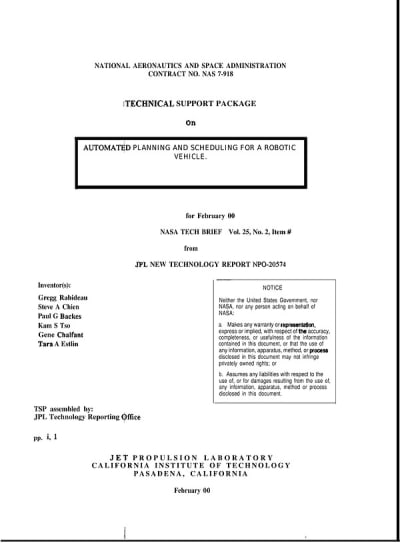
Automated planning and scheduling for a robotic vehicle
(reference NPO-20574) is currently available for download from the TSP library.
Don't have an account?
Overview
The document outlines a technical support package from NASA detailing the development of a software system designed for the automated planning and scheduling of a robotic vehicle, specifically the Rocky 7 rover, which is utilized in scientific exploration of Mars. The software integrates two previously established systems: the Web Interface for TeleScience (WITS) and the Automated Scheduling and Planning Environment (ASPEN).
WITS serves as a high-level graphical interface that allows users to specify scientific activities and locations by referencing images of the rover's environment. This user-friendly interface enables scientists to easily communicate their goals for the rover's mission. Once the scientific objectives are defined through WITS, ASPEN takes over to process these goals. It reasons about the low-level activities and resources necessary to achieve the specified objectives, generating an executable sequence of commands for the rover. This includes commands for navigation to various locations where scientific observations are to be conducted.
The software system is designed to enforce flight rules and manage resource conflicts by reordering observations, adding necessary activities, or removing lower-priority tasks. This capability enhances the rover's operational efficiency and reduces the workload on mission control, ultimately lowering operational costs.
The document also highlights the advantages of this software system, such as providing immediate feedback on the feasibility of scientific requests, explaining why certain requests may be impossible, and enabling faster turnaround times between downlink and uplink communications. The system is capable of generating or repairing command sequences in a matter of minutes, which is crucial for the dynamic environment of space exploration.
Future developments for this software include the potential installation of the system directly onto the rover, allowing it to autonomously schedule its own activities and operate with greater independence. This advancement would mark a significant step toward enhancing the autonomy of robotic vehicles in space exploration.
The document credits the development team, which includes members from Caltech and IA Tech, Inc., and notes that the software is available for commercial licensing. It emphasizes that the work was conducted under contract with NASA at the Jet Propulsion Laboratory, California Institute of Technology.









