

A report describes Martian landing balls, which are under development for use in delivering scientific payloads to Mars. Martian landing balls are related to other soft-landing devices that resemble beach balls and that have been described in several previous NASA Tech Briefs articles. They are also related to the Zorb (or equivalent) — a commercial recreational device that looks like a large, transparent beach-ball/tire hybrid with a central volume that is open to the atmosphere and that accommodates a human rider. In a Mar-tian landing ball, the central volume contains a rigid cylinder that carries the payload. The cylinder is surrounded (except for small openings) by an approximately spherical airbag. In the intended use, Martian landing balls would be dropped from slowly descending solar-heated balloons. It has been estimated that a Martian landing ball with a mass of 2 kg could deliver a 10-kg payload with a landing acceleration of less than 50× normal Earth gravitation (less than about 490 m/s2). Once on the Martian surface, the airbag could be deflated; alternatively, the airbag could be kept inflated to take advantage of the wind to blow the payload to a desired location.
This work was done by Jack Jones, Andre Yavrouian, and Tim Connors of Caltech for NASA's Jet Propulsion Laboratory. To obtain a copy of the report, "Martian Landing Ball," access the Technical Support Package (TSP) free on-line at www.nasatech.com/tsp under the Mechanics category.
NPO-20977
This Brief includes a Technical Support Package (TSP).
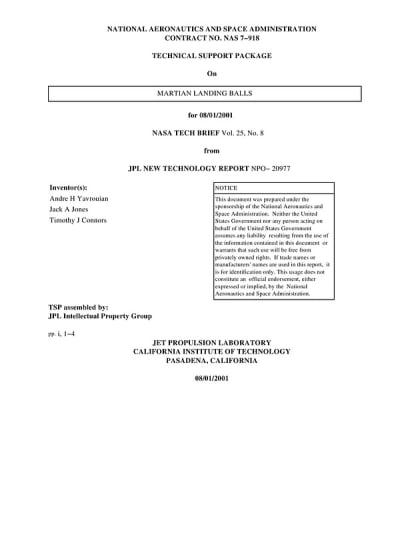
Martian Landing Balls
(reference NPO-20977) is currently available for download from the TSP library.
Don't have an account?
Overview
The document discusses the development of Martian landing balls, innovative soft-landing devices designed for delivering scientific payloads to Mars. These landing balls are similar in appearance to beach balls and are related to other soft-landing technologies previously described in NASA Tech Briefs. They also draw inspiration from recreational devices like the Zorb, which is a large, transparent hybrid of a beach ball and tire that accommodates a human rider.
The design of the Martian landing ball features a central rigid cylinder that carries the payload, surrounded by a spherical airbag. This configuration is intended to provide a safe landing mechanism for payloads on the Martian surface. The landing balls would be deployed from slowly descending solar-heated balloons, allowing for a controlled descent.
The document highlights the estimated capabilities of the Martian landing balls, noting that a 2 kg landing ball could deliver a 10 kg payload while ensuring a landing acceleration of less than 50 times that of normal Earth gravity (approximately less than 490 m/s²). This is crucial for protecting sensitive scientific instruments during landing.
Once the landing ball reaches the Martian surface, the airbag can either be deflated or kept inflated. If kept inflated, it could utilize Martian winds to transport the payload to a desired location, enhancing the flexibility of payload deployment.
The work on Martian landing balls was conducted by a team from the California Institute of Technology (Caltech) for NASA’s Jet Propulsion Laboratory, specifically by inventors Andre H. Yavrouian, Jack A. Jones, and Timothy J. Connors. The document serves as a technical support package and is part of NASA's ongoing efforts to develop advanced technologies for space exploration.
Overall, the Martian landing balls represent a significant advancement in landing technology, potentially improving the efficiency and safety of delivering scientific instruments to Mars, thereby facilitating further exploration and research on the planet. The document emphasizes the innovative nature of this technology and its potential impact on future Mars missions.










