The AMM Automated Mission Planner computer program was developed to save time and money by automating much of the planning of the Second RADARSAT Antarctic Mapping Mission (AMM), which was scheduled to take place at the time of writing this article. The planning problem for this and other RADARSAT missions is to select several hundred synthetic-aperture-radar (SAR) swaths that satisfy scientific objectives, which include coverage of a specified ground area. The selection is subject to constraints associated with the choice of downlink opportunities and with RADARSAT operation. These constraints interact in complex ways that make it difficult to design schedules manually. The software takes a set of SAR swaths and automatically generates a locally optimal downlink schedule and identifies violations of operational constraints; in so doing, the software frees the mission planner to concentrate on selecting swaths that satisfy scientific objectives. Mission-planning time has thus been reduced from years to weeks.
This program was written by Barbara Engelhardt, Steve Chien, Russell Knight, Benjamin Smith, Darren Mutz, Robert Sherwood, Gregg Rabideau, and John Crawford of Caltech for NASA's Jet Propulsion Laboratory. For further information, access the Technical Support Package (TSP) free on-line at www.nasatech.com/tsp under the Software category.
This software is available for commercial licensing. Please contact Don Hart of the California Institute of Technology at (818) 393-3425. Refer to NPO-21092.
This Brief includes a Technical Support Package (TSP).
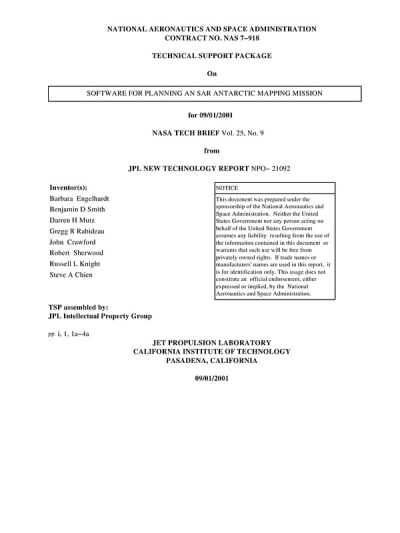
Software for Planning an SAR Antartic Mapping Mission
(reference NPO-21092) is currently available for download from the TSP library.
Don't have an account?
Overview
The document is a technical support package prepared by the Jet Propulsion Laboratory (JPL) under contract with the National Aeronautics and Space Administration (NASA). It focuses on software developed for planning a Synthetic Aperture Radar (SAR) Antarctic mapping mission, specifically the Second RADARSAT Antarctic Mapping Mission. The software, known as the Automated Mission Planner (AMP), aims to enhance the efficiency of mission planning by automating the selection of SAR swaths, which are critical for mapping and monitoring the Antarctic region.
The document outlines the contributions of several inventors, including Barbara Engelhardt, Benjamin D. Smith, and others, who played a key role in the development of this technology. It emphasizes the importance of this software in reducing the time required for mission planning, which has historically taken years, down to just weeks. This significant reduction in planning time allows mission planners to concentrate more on scientific objectives rather than the complexities of scheduling.
The document also includes a notice stating that the information contained within is provided without any warranty or liability from the U.S. Government or individuals acting on its behalf. It clarifies that any mention of specific commercial products or manufacturers does not imply endorsement by the U.S. Government or JPL.
Additionally, the document contains sections on system architecture, status, acknowledgments, and references, indicating a structured approach to presenting the information. The abstract and introduction sections provide a brief overview of the project and its goals, while the acknowledgment section likely recognizes contributions from various stakeholders involved in the project.
Overall, this technical support package serves as a comprehensive resource for understanding the development and application of the Automated Mission Planner software, highlighting its role in advancing Antarctic mapping missions and improving the efficiency of planning processes in space exploration. The document is a testament to the collaborative efforts of scientists and engineers at JPL and NASA in leveraging technology to achieve significant scientific objectives in challenging environments like Antarctica.