

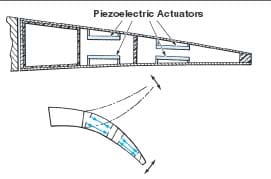
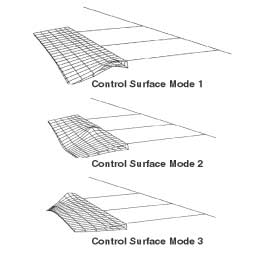
An active-control surface modal (ACSM) device has been developed as an improved means of alleviating buffet of an aircraft. The ACSM device is a "smart" actuator system that includes an array of antagonistic piezoelectric actuators installed within a rudder or other aircraft control surface (see Figure 1). These actuators are used to deform the control surface in what amounts to controlled vibration modes (see Figure 2), the frequencies and mode shapes being chosen to affect unsteady aerodynamic damping to suppress the dynamic effects of buffet.
Prior to the development of the present ACSM, both passive and active methods of alleviating buffet were considered. The passive methods included the use of fences and other modifications to minimize the strengths of shed vortices. Active methods included, variously, the use of hydraulic or piezoelectric actuators to superimpose, upon control motions, oscillations of the affected control surfaces about their hinges to affect aerodynamic damping. The two major shortcomings of this prior active method are the following: (1) For a given aircraft, the flight-control system and the buffet-load-alleviation control system must use the same degree(s) of freedom of the same control surface(s), so that the availability of the control surface(s) for each role (flight control or alleviation of buffet) is reduced. (2) Because it is difficult to make a massive control surface oscillate about its hinge at a high frequency, operation is limited to relatively low frequencies.
The use of piezoelectric actuators in an ACSM device to deform a control surface (in contradistinction to trying to make the control surface oscillate about its hinge) makes it possible to use modal frequencies that are high enough to encompass the frequency spectrum of buffet, gusts, and flutter. Although the ACSM is an integral part of the rudder or other control surface, it can be actuated according to control laws independent of those of flight-control system; hence, the control surface can respond to flight-control commands as well as the dynamic buffet-load-alleviation signals.
This work was done by K. Appa and J. Ausman of Appa Technology Initiatives, K. S. Khot of the Air Force Research Laboratory, and Martin Brenner of Dryden Flight Research Center. For further information, access the Technical Support Package (TSP) free on-line at www.nasatech.com/tsp under the Mechanics category.
DRC-01-25
This Brief includes a Technical Support Package (TSP).
"Smart" Actuators for Alleviating Buffet of Aircraft
(reference DRC-01-25) is currently available for download from the TSP library.
Don't have an account?
Overview
The document titled "Smart Actuators for Alleviating Buffet of Aircraft" (DRC-01-25) is a technical support package from NASA that discusses advancements in smart actuation systems designed to mitigate buffet-induced structural fatigue in aircraft. Buffet is a turbulent airflow phenomenon that occurs due to separated flow behind aerodynamic surfaces, leading to fluctuating pressures that can severely impact aircraft tails, particularly in high-performance military aircraft like the F-14, F-15, F-18, and F-22. This phenomenon can result in significant structural fatigue, increased life cycle costs, and reduced aircraft readiness.
The document outlines both passive and active methods for buffet load control, emphasizing the effectiveness of active control systems. It details the Active Control Surface Modal (ACSM) device, which utilizes piezoelectric actuators to manage tail vibrations and stresses. The ACSM device has demonstrated impressive results, including a 72% reduction in root mean square (rms) stress and an eight-fold enhancement in fatigue life for vertical tails. The device operates in both open loop and closed loop configurations, with feedback signals from accelerometers at the tail's leading and trailing edges to optimize actuator performance.
Figures included in the document illustrate the actuator imposed rudder modes, power requirements, and the performance of the ACSM device at 30,000 feet altitude. The peak-to-peak actuator stimuli were recorded at 44 V, 94 V, and 156 V, with a total maximum power consumption of only 182 watts. Preliminary analyses indicate a 60 to 80 percent reduction in peak stress, showcasing the potential for significant cost savings in aircraft maintenance and increased operational readiness.
The document concludes by suggesting further evaluation of the ACSM technology in actual flight conditions to validate its effectiveness and facilitate its transition into practical applications. The advancements presented in this document are expected to contribute to the development of more resilient aircraft structures, ultimately enhancing safety and performance in both civil and military aviation. The information is part of NASA's Commercial Technology Program, aimed at disseminating aerospace-related developments with broader technological and commercial implications.











