

A mathematical model has been developed to predict the behavior of an isolated drop of a first fluid surrounded by a second fluid, under quiescent conditions at supercritical temperature and pressure. The model has been specialized to represent the behavior of a drop of liquid oxygen surrounded by hydrogen under supercritical conditions like those encountered in a rocket-engine combustion chamber. According to plans, this model will eventually be combined with other models to form a comprehensive model for the behavior (including combustion) of hydrogen and oxygen in a rocket-engine combustion chamber.
None of the related conventional mathematical models of the behavior of oxygen could represent the complex phenomena that occur in a rocket-engine combustion chamber. The conventional models are based, variously, on empirical correlations or on physics under subcritical conditions. The common weakness of the conventional models is failure to represent the physics under supercritical conditions.
The present model incorporates physics from first principles. It is based on fluctuation theory that incorporates equations for the conservation of momentum, mass for each molecular species, and enthalpy. The advantage of the theory is that it inherently accounts for nonequilibrium processes and naturally leads to the most general fluid-dynamical equations in which the heat flux and the partial molar fluxes are related to thermodynamic quantities (e.g., temperatures and chemical potentials). The relationships among these quantities are expressed using transport (diffusion)-matrix formulation. This formulation includes the Soret effect (transport of species due to thermal gradients) and the Dufour effect (transport of heat due to gradients in concentrations of species). The conservation equations are coupled with a law of kinetics for mass release, with equations of state, and transport coefficients that are accurate over the subcritical and adjacent supercritical ranges for both fluid oxygen and hydrogen.
The Soret and Dufour effects, along with thermodynamic nonequilibrium effects, are not taken into account in the conventional models. The inclusion of these effects in the present model results in modifications of length scales for heat and mass transfer, with important consequences for designing combustion chambers.
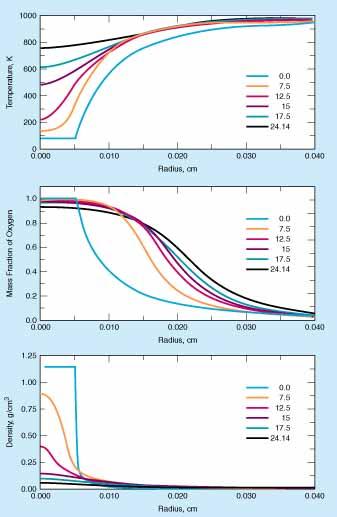
Numerical results obtained using this model show that under supercritical conditions, the behavior of the liquid-oxygen/hydrogen system is one of slow diffusion. The temperature profile relaxes fastest, followed by the density profile and then by the mass-fraction profile (see figure). An effective Lewis number estimated according to the theory described in the following article is found to be about 40 times the traditional Lewis number. Parametric studies reveal that gradients increase with increasing drop size, increasing pressure, or decreasing temperature; the practical consequence of this finding is that increased turbulence is needed to mix the hydrogen and oxygen at increased pressure.
This work was done by Josette Bellan and Kenneth Harstad of Caltech forNASA's Jet Propulsion Laboratory. For further information, access the Technical Support Package (TSP) free on-line at www.techbriefs.com under the Physical Sciences category. NPO-20220
This Brief includes a Technical Support Package (TSP).
Model of a drop of O2 surrounded by a H2 at a high pressure
(reference NPO20220) is currently available for download from the TSP library.
Don't have an account?
Overview
The document is a technical support package from NASA's Jet Propulsion Laboratory (JPL), detailing a sophisticated model of a drop of liquid oxygen (O₂) surrounded by hydrogen (H₂) at high pressure. This model is significant for its application in understanding combustion processes in rocket-engine combustion chambers, particularly under supercritical conditions.
The study emphasizes the importance of accurately modeling not only the conservation equations, equation of state (EOS), and transport properties but also the interface processes that occur between the liquid oxygen and hydrogen. This comprehensive approach addresses the complexities that older models failed to capture, thereby enhancing the predictive capabilities of combustion behavior in high-pressure environments.
The document outlines the innovative aspects of the model, which is based on first principles and fluctuation theory. By integrating these advanced theoretical frameworks, the model provides a more accurate representation of the interactions between the liquid and gaseous phases, which is crucial for optimizing rocket engine performance and safety.
Additionally, the document includes disclaimers regarding the information presented, clarifying that neither the United States Government nor NASA makes any warranties about the accuracy or completeness of the information. It also states that the work was conducted under contract with NASA, highlighting the collaborative nature of the research.
Figures and data presented in the document illustrate the model's predictions and the behavior of the O₂ and H₂ system under various conditions. These visual aids support the theoretical findings and provide a clearer understanding of the phenomena being studied.
Overall, this technical support package represents a significant advancement in the modeling of combustion processes, with implications for future space exploration and rocket technology. By addressing the limitations of previous models and incorporating complex phenomena, the research contributes valuable insights that can lead to improved designs and efficiencies in aerospace applications.











