39
-1
840
30
Briefs: Mechanical & Fluid Systems
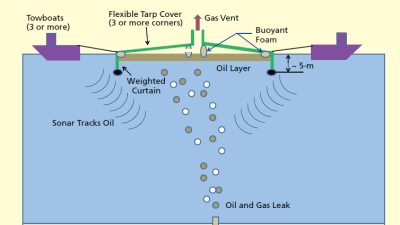
Previous oil containment booms have an open top that allows natural gas to escape, and have significant oil leakage due to wave action. Also, a subsea pyramid oil trap exists, but cannot move relative to...
Briefs: Mechanical & Fluid Systems
Instrument Package Manipulation Through the Generation and Use of an Attenuated-Fluent Gas Fold
This document discusses a technique that provides a means for suspending large, awkward loads, instrument packages, components, and machinery in a stable, controlled, and precise manner. In the baseplate of the test machine, a pattern of grooves and...
Briefs: Mechanical & Fluid Systems
Magnetic Interface for Segmented Mirror Assembly
Newly developed magnetic devices are used to create an interface between adjacent mirror segments so that once assembled, aligned, and phased, the multiple segments will behave functionally equivalent to a monolithic aperture mirror. One embodiment might be a kinematic interface that is reversible so...
Briefs: Mechanical & Fluid Systems
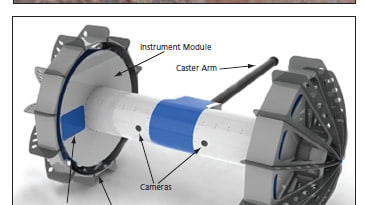
To be able to conduct science investigations on highly sloped and challenging terrains, it is necessary to deploy science payloads to such locations and collect and process in...
Briefs: Mechanical & Fluid Systems
Transpiration-Cooled Spacecraft-Insulation-Repair Fasteners
Transpiration-cooled fasteners are proposed that operate like an open-loop heat pipe (self-tapping screws, bolts, and spikes) for use in on-orbit repair of thermal-insulation of a space shuttle or other spacecraft. By limiting the temperature rise of such a fastener and of the adjacent...
Briefs: Mechanical & Fluid Systems
A non-actuated tool has been developed for preparing regolith for in situ measurement by smoothing uneven surfaces and excavating fresher subsurface material for planetary exploration. The STAMP tool...

Briefs: Mechanical & Fluid Systems
Implementation of a Non-Metallic Barrier in an Electric Motor
Electric motors that run in pure oxygen must be sealed, or “canned,” for safety reasons to prevent the oxygen from entering into the electrical portion of the motor. The current canning process involves designing a metallic barrier around the rotor to provide the separation. This...
Briefs: Mechanical & Fluid Systems
MicroProbe Small Unmanned Aerial System
The MicroProbe unmanned aerial system (UAS) concept incorporates twin electric motors mounted on the vehicle wing, thus enabling an aerodynamically and environmentally clean nose area for atmospheric sensors. A payload bay is also incorporated in the fuselage to accommodate remote sensing instruments.
Briefs: Mechanical & Fluid Systems
The addition of the Multi-Mission Radioisotope Thermoelectric Generator (MMRTG) to the Mars Science Laboratory (MSL) Rover requires an...

Briefs: Mechanical & Fluid Systems
This apparatus distributes dust (typical of the Martian surface) in a uniform fashion on the surface of multiple samples simultaneously. The primary innovation is...

Briefs: Mechanical & Fluid Systems
The landing scheme for NASA’s next-generation Mars rover will encompass a novel landing technique (see figure). The rover will be lowered from a rocket-powered descent stage and then placed onto the surface while...

Briefs: Mechanical & Fluid Systems
Graph Theory Roots of Spatial Operators for Kinematics and Dynamics
Spatial operators have been used to analyze the dynamics of robotic multibody systems and to develop novel computational dynamics algorithms. Mass matrix factorization, inversion, diagonalization, and linearization are among several new insights obtained using such operators. While...
Briefs: Mechanical & Fluid Systems
Spacesuit Soft Upper Torso Sizing Systems
The passive sizing system consists of a series of low-profile pulleys attached to the front and back of the shoulder bearings on a spacesuit soft upper torso (SUT), textile cord or stainless steel cable, and a modified commercial ratchet mechanism. The cord/cable is routed through the pulleys and attached...
Briefs: Mechanical & Fluid Systems
Space Mirror Alignment System
An optical alignment mirror mechanism (AMM) has been developed with angular positioning accuracy of ±0.2 arcsec. This requires the mirror’s linear positioning actuators to have positioning resolutions of ±112 nm to enable the mirror to meet the angular tip/tilt accuracy requirement. Demonstrated capabilities are...
Briefs: Mechanical & Fluid Systems
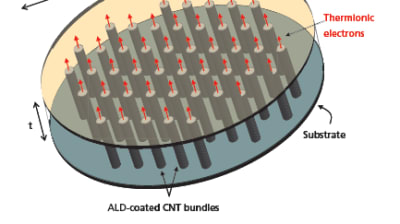
A unit thermionic power cell (TPC) concept has been developed that converts natural heat found in high-temperature environments (460 to 700 ºC) into electrical power...
Briefs: Mechanical & Fluid Systems
Pressure Regulator With Internal Ejector Circulation Pump, Flow and Pressure Measurement Porting, and Fuel Cell System Integration Options
An advanced reactant pressure regulator with an internal ejector reactant circulation pump has been developed to support NASA’s future fuel cell power systems needs. These needs include reliable and safe...
Briefs: Mechanical & Fluid Systems
Two-Stage Centrifugal Fan
Fan designs are often constrained by envelope, rotational speed, weight, and power. Aerodynamic performance and motor electrical performance are heavily influenced by rotational speed. The fan used in this work is at a practical limit for rotational speed due to motor performance characteristics, and there is no more space...
Briefs: Mechanical & Fluid Systems
Combined Structural and Trajectory Control of Variable-Geometry Planetary Entry Systems
Some of the key challenges of planetary entry are to dissipate the large kinetic energy of the entry vehicle and to land with precision. Past missions to Mars were based on unguided entry, where entry vehicles carried payloads of less than 0.6 T and landed...
Briefs: Mechanical & Fluid Systems
Crush Test Abuse Stand
The purpose of this system is to simulate an internal short on battery cells by causing deformation (a crushing force) in a cell without penetration. This is performed by activating a hydraulic cylinder on one side of a blast wall with a hydraulic pump located on the other. The operator can control the rate of the crush by...
Briefs: Mechanical & Fluid Systems
Force Limit System
The Force Limit System (FLS) was developed to protect test specimens from inadvertent overload. The load limit value is fully adjustable by the operator and works independently of the test system control as a mechanical (nonelectrical) device.
Briefs: Mechanical & Fluid Systems
Active Response Gravity Offload System
The Active Response Gravity Offload System (ARGOS) provides the ability to simulate with one system the gravity effect of planets, moons, comets, asteroids, and microgravity, where the gravity is less than Earth’s gravity. The system works by providing a constant force offload through an overhead hoist...
Briefs: Mechanical & Fluid Systems
Compact, Two- Sided Structural Cold Plate Configuration
In two-sided structural cold plates, typically there is a structural member, such as a honeycomb panel, that provides the structural strength for the cold plates that cool equipment. The cold plates are located on either side of the structural member and thus need to have the cooling fluid...
Briefs: Mechanical & Fluid Systems
Levitated Duct Fan (LDF) Aircraft Auxiliary Generator
This generator concept includes a novel stator and rotor architecture made from composite material with blades attached to the outer rotating shell of a ducted fan drum rotor, a non-contact support system between the stator and rotor using magnetic fields to provide levitation, and an integrated...
Briefs: Mechanical & Fluid Systems
AN Fitting Reconditioning Tool
A tool was developed to repair or replace AN fittings on the shuttle external tank (ET). (The AN thread is a type of fitting used to connect flexible hoses and rigid metal tubing that carry fluid. It is a U.S. military-derived specification agreed upon by the Army and Navy, hence AN.) The tool is used on a drill and...
Briefs: Mechanical & Fluid Systems
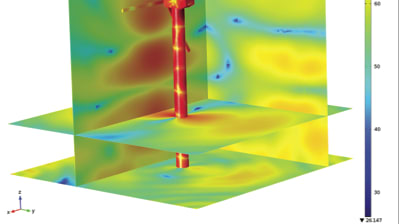
Noise from wind farms falls into two categories: aerodynamic noise is created by the blades of a turbine swishing through the air, while mechanical noise is associated with the machinery housed in the nacelle of a...
Briefs: Mechanical & Fluid Systems
Draper Station Analysis Tool
Draper Station Analysis Tool (DSAT) is a computer program, built on commercially available software, for simulating and analyzing complex dynamic systems. Heretofore used in designing and verifying guidance, navigation, and control systems of the International Space Station, DSAT has a modular architecture that lends...
Briefs: Mechanical & Fluid Systems
Common Bolted Joint Analysis Tool
Common Bolted Joint Analysis Tool (comBAT) is an Excel/VB-based bolted joint analysis/optimization program that lays out a systematic foundation for an inexperienced or seasoned analyst to determine fastener size, material, and assembly torque for a given design. Analysts are able to perform numerous “what-if”...
Briefs: Mechanical & Fluid Systems
Commercial Modular Aero-Propulsion System Simulation 40k
The Commercial Modular Aero-Propulsion System Simulation 40k (C-MAPSS40k) software package is a nonlinear dynamic simulation of a 40,000-pound (≈178-kN) thrust class commercial turbofan engine, written in the MAT-LAB/Simulink environment. The model has been tuned to capture the behavior of...
Briefs: Mechanical & Fluid Systems
Miniature, Variable-Speed Control Moment Gyroscope
The Miniature Variable-Speed Control Moment Gyroscope (MVS-CMG) was designed for small satellites (mass from less than 1 kg up to 500 kg). Currently available CMGs are too large and heavy, and available miniature CMGs do not provide sufficient control authority for use on practical satellites. This...
Top Stories
 Blog: Power

My Opinion: We Need More Power Soon — Is Nuclear the Answer?
 Blog: AR/AI

Aerial Microrobots That Can Match a Bumblebee's Speed
 News: Energy

 Blog: Electronics & Computers

Turning Edible Fungi into Organic Memristors
 Blog: Robotics, Automation & Control

Microscopic Swimming Machines that Can Sense, Respond to Surroundings
 INSIDER: Sensors/Data Acquisition

Webcasts
 Upcoming Webinars: Power

Hydrogen Engines Are Heating Up for Heavy Duty
 Upcoming Webinars: Electronics & Computers

Advantages of Smart Power Distribution Unit Design for Automotive...
 Upcoming Webinars: Transportation

Quiet, Please: NVH Improvement Opportunities in the Early Design...
 Upcoming Webinars: Sensors/Data Acquisition

From Spreadsheets to Insights: Fast Data Analysis Without Complex...
 Upcoming Webinars: Energy

Battery Abuse Testing: Pushing to Failure
 Upcoming Webinars: AR/AI