34
-1
30
30
Briefs: Imaging
Southwest Research Institute has developed off-road autonomous driving tools with a focus on stealth for the military and agility for space and agriculture clients. The vision-based system pairs stereo cameras with novel algorithms, eliminating the need for LiDAR and active sensors. Read on to learn more.

Briefs: Imaging
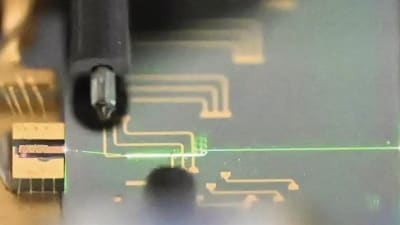
In a newly published paper in the journal Science, researcher Qiushi Guo demonstrated a novel approach for creating high-performance, ultrafast lasers on nanophotonic chips. His work centers on miniaturizing mode-lock lasers. Read on to learn more.
Briefs: Photonics/Optics
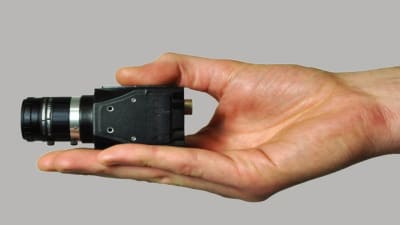
The palm-sized light field camera could improve autonomous driving, classification of recycled materials, and remote sensing. Read on to learn more about it.
Briefs: Imaging
The camera mimics the involuntary movements of the human eye to create sharper, more accurate images for robots, smartphones, and other image-capturing devices. Read on to learn more about it.

Briefs: Lighting
This innovative camera technology represents a significant advance in object detection, offering numerous potential applications across various industries. Read on to learn more.
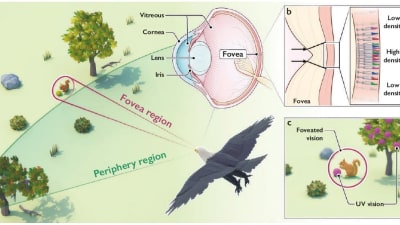
Briefs: Software
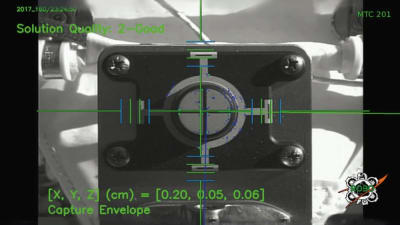
Innovators at NASA’s Johnson Space Center (JSC) have developed computer vision software that derives target posture determinations quickly and then instructs an operator how to properly align a robotic end-effector with a target that they are trying to grapple.
Briefs: Electronics & Computers
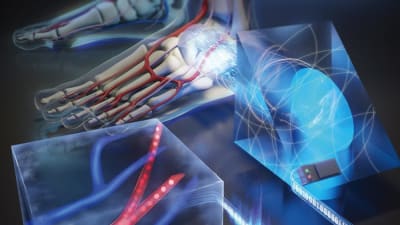
There are times when scientific progress comes in the form of discovering something completely new. Other times, progress boils down to doing something better, faster, or more easily. New research from the lab of Caltech’s Lihong Wang, the Bren Professor of Medical Engineering and Electrical Engineering, is the latter. Read on to learn more.
Briefs: Imaging
Mimicking the easy, instantaneous image processing power of the human eye, Penn State electrical engineering researchers created a metasurface, an optical element akin to a glass slide that uses tiny nanostructures, placed at different angles to control light.
Briefs: Robotics, Automation & Control
Researchers from Japan have developed DPPFA–Net, an innovative network that overcomes challenges related to occlusion and noise introduced by adverse weather.

Briefs: Imaging
Robots and cameras of the future could be made of liquid crystals, thanks to a new discovery that significantly expands the potential of the chemicals already common in computer displays and digital watches. The findings are a simple and inexpensive way to manipulate the molecular properties of liquid crystals with light exposure.

Briefs: Software
By using artificial intelligence, researchers are developing a system that can automatically identify buildings after disasters and make an initial determination of whether they are damaged and how serious that damage might be.

Briefs: Photonics/Optics
The NIST camera is made up of grids of ultrathin electrical wires, cooled to near absolute zero, in which current moves with no resistance until a wire is struck by a photon. In these superconducting-nanowire cameras, the energy imparted by even a single photon can be detected because it shuts down the superconductivity at a particular location (pixel) on the grid. Combining all the locations and intensities of all the photons makes up an image.

Briefs: Photonics/Optics
An international team of researchers reports on a compact high-brightness mid-IR-driven source combining a gas-filled anti-resonant-ring photonic crystal fiber with a novel nonlinear-crystal. The tabletop source provides a seven-octave coherent spectrum from 340 nm–40,000 nm with spectral brightness 2–5 orders of magnitude higher than one of the brightest synchrotron facilities.

Briefs: Communications
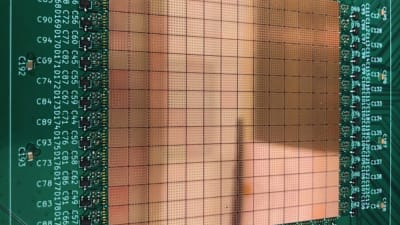
Researchers have created a device that enables them to electronically steer and focus a beam of terahertz electromagnetic energy with extreme precision. This opens the door to high-resolution, real-time imaging devices that are hundredths the size of other radar systems and more robust than other optical systems.
Briefs: Photonics/Optics
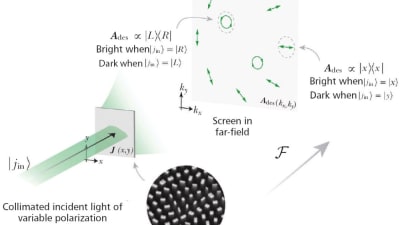
Researchers at SEAS have uncovered hidden potential in metasurfaces and demonstrated optical devices that manipulate light’s polarization state with an unprecedented degree of control. Read on to learn more.
Briefs: Imaging
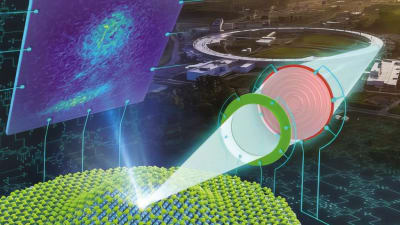
Researchers at the U.S. Department of Energy’s (DOE) Argonne National Laboratory have developed an autonomous, or self-driving, microscopy technique. It uses AI to selectively target points of interest for scanning. Read on to learn more.
Briefs: Photonics/Optics
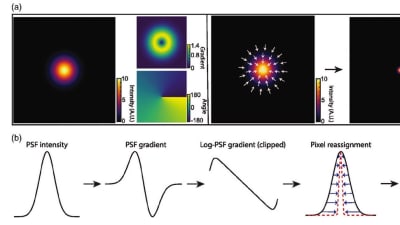
Researchers at Boston University recently developed a novel deblurring algorithm that improves the resolution of images with photon intensity conservation and local linearity.
Briefs: Photonics/Optics
MIT researchers have developed a camera-based touch sensor that is long, curved, and shaped like a human finger. Their device provides high-resolution tactile sensing over a large area. The sensor, called the GelSight Svelte, uses two mirrors to reflect and refract light.

Briefs: Imaging
To further shrink electronic devices and to lower energy consumption, the semiconductor industry is interested in using 2D materials but manufacturers need a quick and accurate method for detecting defects in these materials to determine if the material is suitable for device manufacture.

Briefs: Imaging
Imagine being able to snap a picture of extremely fast events on the order of a picosecond.
Briefs: Weapons Systems
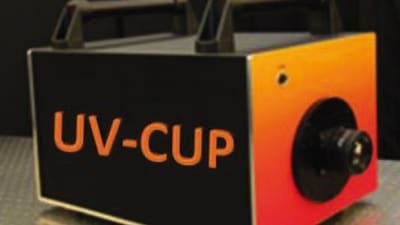
Researcher are finding ways to estimate a target location when light gets deflected by a disordered structure.
Briefs: Photonics/Optics
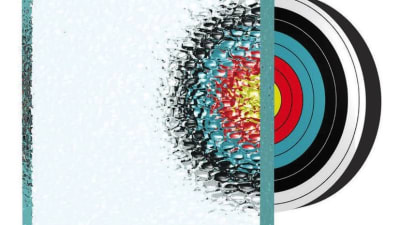
Processes and structures within the body that are normally hidden from the eye can be made visible through medical imaging. Scientists use imaging to investigate...
Briefs: Photonics/Optics
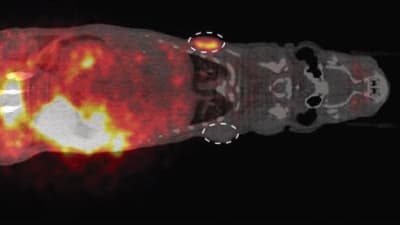
Researchers have developed the world’s smallest LED. It enables the conversion of existing mobile phone cameras into high-resolution microscopes. Smaller than the wavelength of light, the new LED was used to build the world’s smallest holographic microscope.
Briefs: Test & Measurement
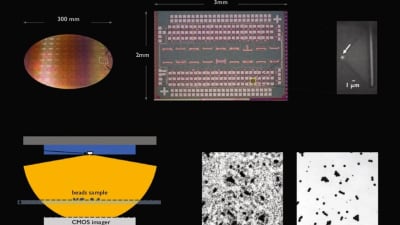
Prompted by conversations regarding soft robotics, a research group has developed a design for a new sensor using 3D electrodes inspired by the folding patterns used in origami, able to measure a strain range of up to three times higher than a typical sensor.
Briefs: Medical
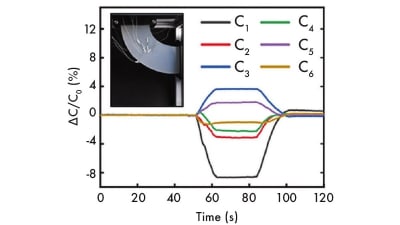
The tool shows promise for imaging brain activity in 3D with high speed and contrast.
Briefs: RF & Microwave Electronics
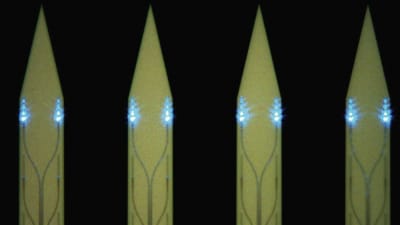
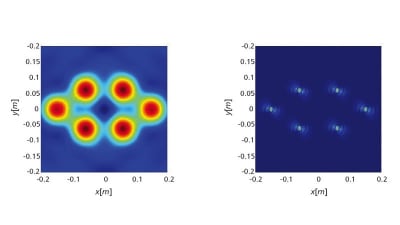
A team has introduced a new method for taking high-res images of fast-moving and rotating objects in space, such as satellites or debris in low-Earth orbit.
Briefs: Photonics/Optics
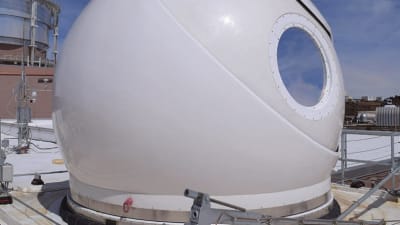
The Laser Communications Relay Demonstration (LCRD) will usher in a new era of laser communications.
Briefs: Photonics/Optics
Innovators at NASA Langley Research Center have developed a multi-spectral imaging pyrometer utilizing tunable optics. The system uses a conventional infrared imaging camera as the basis.

Briefs: Lighting
A research team has developed a 3D imaging sensor that has an extremely high angular resolution — it can distinguish points of an object separated by an angular distance, of as little as 0.0018°. The sensor operates on a unique angle-to-color conversion principle.

Top Stories
 Blog: Lighting

A Stretchable OLED that Can Maintain Most of Its Luminescence
 Blog: Energy

Batteries that Can Withstand the Cold
 INSIDER: Energy

Advancing All-Solid-State Batteries
 Quiz: Energy

 Blog: Physical Sciences

 Blog: Materials

Webcasts
 Upcoming Webinars: Test & Measurement

From Spreadsheets to Insights: Fast Data Analysis Without Complex...
 Upcoming Webinars: Electronics & Computers

Cooling a New Generation of Aerospace and Defense Embedded...
 Upcoming Webinars: Test & Measurement

Beyond AI-Copy-Paste Engineering: Advanced AI-Integration Success...
 Upcoming Webinars: Automotive

Battery Abuse Testing: Pushing to Failure
 Upcoming Webinars: Internet of Things

A FREE Two-Day Event Dedicated to Connected Mobility
 Upcoming Webinars: Test & Measurement

Choosing the Right N-Port Strategy: Multiport VNAs vs. Switch...