34
-1
60
30
Briefs: Electronics & Computers
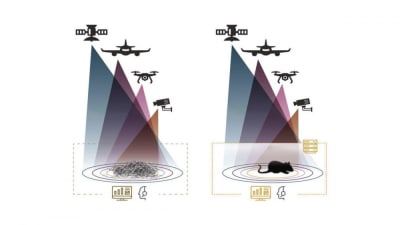
A new patented software system can find the curves of motion in streaming video and images from satellites, drones, and far-range security cameras and turn them into signals to find and track moving objects as small as one pixel.
Briefs: Manufacturing & Prototyping
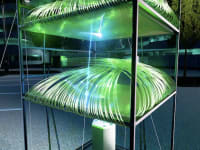
Researchers have created a new technology to assemble matter in 3D. Their concept uses multiple acoustic holograms to generate pressure fields with which solid particles, gel beads, and even biological cells can be printed.

Briefs: Aerospace
Advanced technology plays a vital role in search and rescue operations after natural disasters such as earthquakes. Thermal imaging equipment and sensitive listening devices are deployed to seek out signs of life.

Briefs: Photonics/Optics
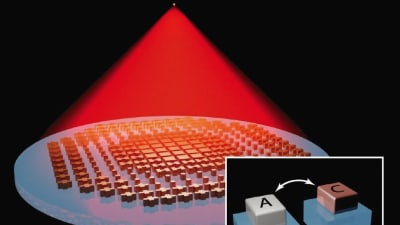
A novel nanostructure produces uniquely shaped light.
Briefs: Lighting
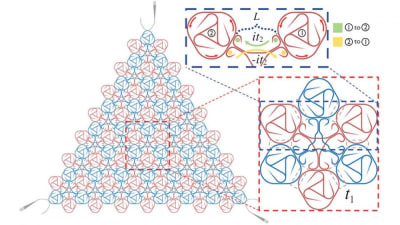
A wavelength of visible light is about 1,000 times larger than an electron, so the way the two affect each other is limited by that disparity. Now, researchers have come up with a way to make...

Briefs: Imaging
Inspired by the human finger, MIT researchers have developed a robotic hand that uses high-resolution touch sensing to accurately identify an object after grasping it just one time.
Briefs: Test & Measurement
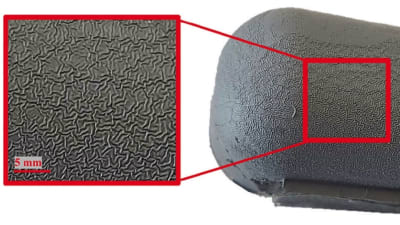
The "AOM" performs complex observations with ten observation modes and 175 strategies.
Briefs: Imaging
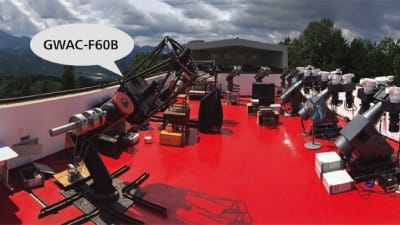
Researchers are tapping into dynamically controlled LEDs to create a simple illumination system for 3D imaging.
Briefs: AR/AI
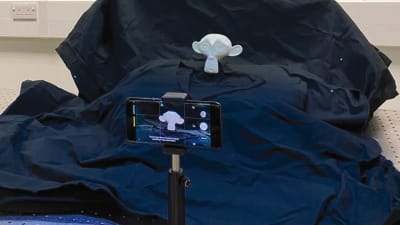
Scientists used a novel analysis technique — called coherent correlation imaging (CCI) — to image the evolution of magnetic domains in time and space without any previous knowledge.

Briefs: Imaging
Using a new fabrication method, researchers developed a single-lens telescope and captured clear images of the lunar surface — achieving greater resolution of objects and much farther imaging distance than previous metalenses.

Briefs: Photonics/Optics
Computing using light can potentially provide lower latency and reduced power consumption, benefiting from the parallelism of optical systems.

Briefs: Imaging
Vision sensing systems are needed to improve operations in many industrial applications, where they can be arranged to detect the presence, position, and other characteristics of objects and products.

Briefs: Test & Measurement
Engineers have developed a modeling and manufacturing technique that generates unique verification tools which simulate cracks in metals within X-ray setup part-testing geometries.

Briefs: Test & Measurement
NASA's NEID tool delivered its first batch of data on the nearest and best-studied star, our Sun.

Briefs: Imaging
A team at Johannes Gutenberg University Mainz has recently been assessing the potential for using a small, portable observation drone in remote regions.

Briefs: Aerospace
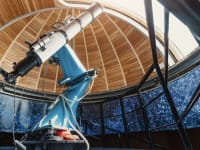
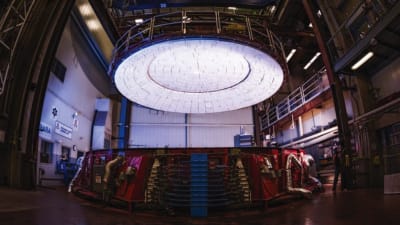
Nearly 20 tons of extremely pure borosilicate glass made by Ohara Corporation in Japan are becoming a honeycomb mirror measuring 27.6 feet across.
Briefs: Photonics/Optics
The design may enable miniature zoom lenses for drones, cellphones, or night-vision goggles.
Briefs: Imaging
Scientists have developed a new characterization tool that allowed them to gain unique insight into a possible alternative material for solar cells.

Briefs: Imaging
Combining high-speed camera and interferometer technology enables the detection of electrical pulses travelling through nerve cells.
Briefs: Photonics/Optics
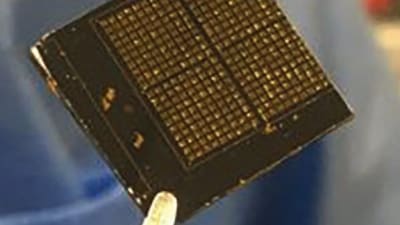
Researchers at University of Central Florida have developed an artificial intelligence device that mimics the retina of the eye.
Briefs: RF & Microwave Electronics
Concept Development for Advanced Spaceborne Synthetic Aperture Radar
Spaceborne Synthetic Aperture Radar (SAR) can globally monitor dynamic processes on the Earth’s Surface. The last SAR to be developed and deployed by NASA was in the year 2000.
Briefs: RF & Microwave Electronics
Traditional time-of-flight LiDAR has many drawbacks that make it difficult to use in many 3D vision applications.

Briefs: Lighting Technology
The imaging system tested in NASA wind tunnels can reduce or eliminate shadows that occur when using many existing BOS and photogrammetric measurement systems.

Briefs: Imaging
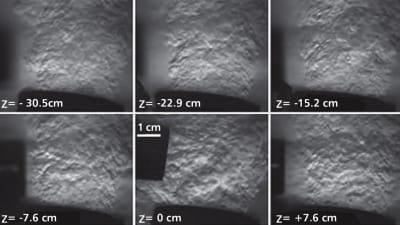
The assembly can simply be mounted in front of a camera to enable focusing schlieren imaging capability.
Briefs: Research Lab
The new microscope is called a hybrid open-top light-sheet (OTLS) microscope.

Briefs: Sensors/Data Acquisition
Using state-of-the-art indium phosphide transistors and a basic computer and mirrors, researchers were able to produce images of concealed bodies.

Briefs: Imaging
The sensor works by detecting variations in microgravity using the principles of quantum physics, which is based on manipulating nature at the sub-molecular level.

Briefs: Imaging
The design produces a compact, efficient, long-lifetime laser transmitter as needed for use in space, while also having potential applications as an airborne or ground-based wind measurement tool.

Briefs: Energy
A group of scientists led by the U.S. Department of Energy’s Argonne National Laboratory has created a new method for improving the resolution of hard X-ray nanotomography.
Top Stories
 Blog: Lighting

A Stretchable OLED that Can Maintain Most of Its Luminescence
 Blog: Energy

Batteries that Can Withstand the Cold
 INSIDER: Energy

Advancing All-Solid-State Batteries
 Quiz: Energy

 Blog: Physical Sciences

 Blog: Materials

Webcasts
 Upcoming Webinars: Test & Measurement

From Spreadsheets to Insights: Fast Data Analysis Without Complex...
 Upcoming Webinars: Electronics & Computers

Cooling a New Generation of Aerospace and Defense Embedded...
 Upcoming Webinars: Test & Measurement

Beyond AI-Copy-Paste Engineering: Advanced AI-Integration Success...
 Upcoming Webinars: Automotive

Battery Abuse Testing: Pushing to Failure
 Upcoming Webinars: Internet of Things

A FREE Two-Day Event Dedicated to Connected Mobility
 Upcoming Webinars: Test & Measurement

Choosing the Right N-Port Strategy: Multiport VNAs vs. Switch...