34
-1
0
30
Briefs: Information Technology
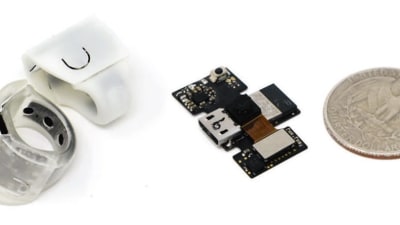
University of Washington researchers have developed IRIS, a smart ring that allows users to control smart devices by aiming the ring’s small camera at the device and clicking a built-in button. The prototype Bluetooth ring sends an image of the selected device to the user’s phone, which controls the device. Read on to learn more.
Briefs: Robotics, Automation & Control
Researchers at the University of California San Diego have developed a soft robotic skin that enables vine robots that are just a few millimeters wide to navigate convoluted paths and fragile environments. Read on to learn more.

Briefs: Imaging
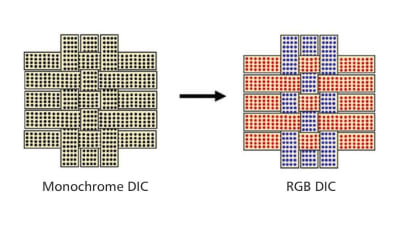
Innovators at NASA Johnson Space Center have developed a technology that can isolate a single direction of tensile strain in biaxially woven material. This is accomplished using traditional digital image correlation (DIC) techniques in combination with custom red-green-blue (RGB) color filtering software. Read on to learn more.
Briefs: RF & Microwave Electronics
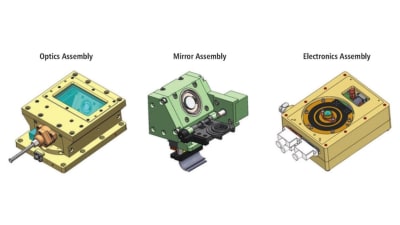
NASA Goddard Space Flight Center has developed a Space Qualified Rover LiDAR (SQRLi) system that will improve rover sensing capabilities in a small, lightweight package. The new SQRLi package is developed to survive the hazardous space environment and provide valuable image data during planetary and lunar rover exploration. Read on to learn more about it.
Briefs: Software
Northwestern engineers have developed a new system for full-body motion capture — and it doesn’t require specialized rooms, expensive equipment, bulky cameras, or an array of sensors. Instead, it requires a simple mobile device. Read on to learn more.

Briefs: Electronics & Computers
Maksym Kovalenko and his team have proposed a novel solution that allows them to utilize every photon of light for color recognition. For nearly a decade, they have been researching perovskite-based image sensors. In a new study published in Nature, they show that their new technology works. Read on to learn more.

Briefs: Sensors/Data Acquisition
Plans are underway to create more powerful particle accelerators, whose collisions will unleash large subatomic storms. How will researchers sift through the chaos? Read on to find out.

Briefs: Software
Researchers have provided a new open-source algorithm called Conditional Variational Diffusion Model (CVDM). Based on generative AI, this model improves the quality of images by reconstructing them from randomness. In addition, the CVDM is computationally less expensive than established diffusion models — and it can be easily adapted for a variety of applications. Read on to learn more.

Briefs: Imaging
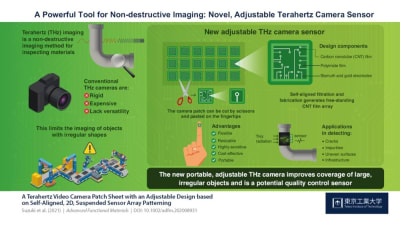
A team of researchers from Tokyo Tech, led by Associate Professor Yukio Kawano, has designed a flexible and free-standing THz sensor array that can be used to image blind ends of irregularly shaped objects. Read on to learn more about it.
Briefs: Imaging
Metabolic imaging is a noninvasive method that enables clinicians and scientists to study living cells using laser light, which can help them assess disease progression and treatment responses. But light scatters when it shines into biological tissue, limiting how deeply it can penetrate and hampering the resolution of captured images. Now, MIT researchers have developed a new technique that more than doubles the usual depth limit of metabolic imaging. Read on to learn more.

Briefs: Electronics & Computers
Engineers at NASA Langley Research Center have developed a cutting-edge thermal inspection technology that enhances defect detection on low-emissivity surfaces by eliminating false readings caused by infrared reflections. Read on to learn more.

Briefs: Lighting
A new computer vision technique developed by MIT engineers significantly speeds up the characterization of newly synthesized electronic materials. The technique automatically analyzes images of printed semiconducting samples and quickly estimates two key electronic properties for each sample. Read on to learn more.

Briefs: RF & Microwave Electronics
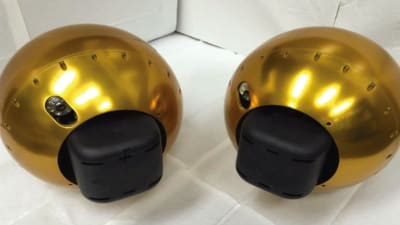
Innovators at NASA Johnson Space Center have developed a robotic system whose primary structural platform, or “orb,” can be injected into a pipe network and perform reconnaissance of piping infrastructure and other interior volumes. When deployed, this technology uses throttled fluid flow from a companion device for passive propulsion. Read on to learn more.
Briefs: Imaging
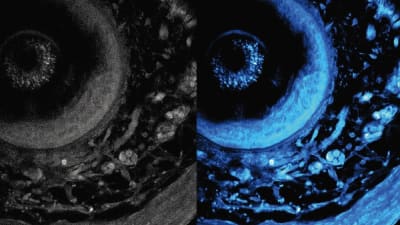
Metabolic imaging is a noninvasive method that enables clinicians and scientists to study living cells using laser light, which can help them assess disease progression and treatment responses. But light scatters when it shines into biological tissue, limiting how deeply it can penetrate and hampering the resolution of captured images. Now, MIT researchers have developed a new technique that more than doubles the usual depth limit of metabolic imaging. Read on to learn more.
Briefs: Medical
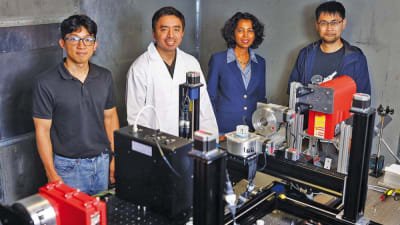
New technology developed by researchers at the University of Houston could revolutionize medical imaging and lead to faster, more precise and more cost-effective alternatives to traditional diagnostic methods. Read on to learn more.
Briefs: Robotics, Automation & Control
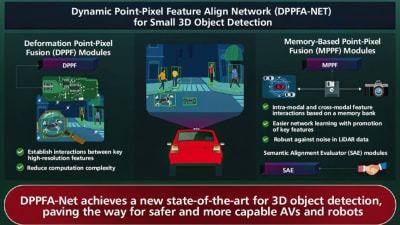
Scientists have developed multi-modal 3D object detection methods that combine 3D LiDAR data with 2D RGB images taken by standard cameras. While the fusion of 2D images and 3D LiDAR data leads to more accurate 3D detection results, it still faces its own set of challenges, with accurate detection of small objects remaining difficult. Read on to learn more about it.
Briefs: Photonics/Optics
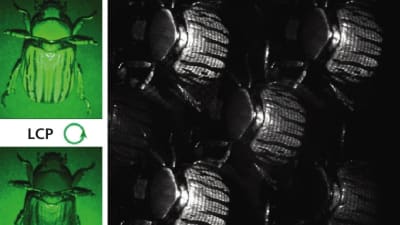
Researchers at the Harvard John A. Paulson School of Engineering and Applied Sciences have developed a compact, single-shot polarization imaging system that can provide a complete picture of polarization. Read on to learn more about it.
Briefs: Imaging
Daniel Gehrig and Davide Scaramuzza from the Department of Informatics at the University of Zurich have combined a novel bio-inspired camera with AI to develop a system that can detect obstacles around a car much quicker than current systems and using less computational power. Read on to learn more about the study, which is published in Nature.

Videos: Manned Systems
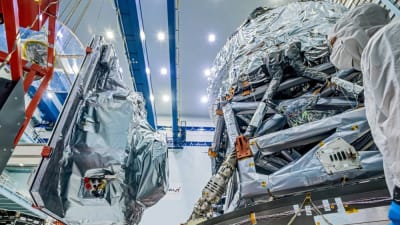
In this video, we provide an overview of the Nancy Grace Roman Space Telescope’s mission, capabilities and timeline to launch.
Briefs: Photonics/Optics
Researchers have made it possible to expand tissue twentyfold in a single step. This simple, inexpensive method could pave the way for nearly any biology lab to perform nanoscale imaging. Read on to learn more.

Briefs: AR/AI
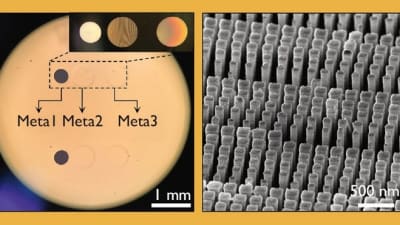
Researchers have developed an optical design technology that dramatically reduces the volume of cameras with a folded lens system utilizing “metasurfaces,” a next-generation nano-optical device. Read on to learn more.
Briefs: Imaging
A team from the University of Barcelona and the Universitat Oberta de Catalunya has designed a methodology that facilitates the recognition of QR codes in these physical environments, where reading is more complicated. Read on to learn more.

Briefs: Imaging
A team led by University of Maryland computer scientists invented a camera mechanism that improves how robots see and react to the world around them. Inspired by how the human eye works, their innovative camera system mimics the tiny involuntary movements used by the eye to maintain clear and stable vision over time. Read on to learn more.

Briefs: Photonics/Optics
A team of scientists has developed an ultrafast imaging technique, called femtosecond laser sheet-compressed ultrafast photography, that can compile videos of incredibly transient details. Read on to learn more about it.

Briefs: Imaging
Butterflies can see more of the world than humans, including more colors and the field oscillation direction, or polarization, of light. Other species, like the mantis shrimp, can sense an even wider spectrum of light, as well as the circular polarization, or spinning states, of light waves. Inspired by these abilities in the animal kingdom, researchers have developed an ultrathin optical element known as a metasurface, which can attach to a conventional camera and encode the spectral and polarization data of images captured in a snapshot or video through tiny, antenna-like nano-structures that tailor light properties.

Briefs: Materials
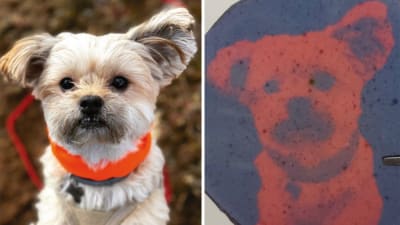
Imagine if physicians could capture 3D projections of medical scans, suspending them inside an acrylic cube to create a hand-held reproduction of a patient’s heart, brain, kidneys, or other organs. Then, when the visit is done, a quick blast of heat erases the projection, and the cube is ready for the next scan. A new report by researchers at Dartmouth and Southern Methodist University outlines a technical breakthrough that could enable such scenarios, and others, with widespread utility. Read on to learn more.
Briefs: Imaging
Researchers have developed a new way to map water on land in the tropics. Called the UC Berkeley Random Walk Algorithm WaterMask, this advanced monitoring technology uses L-band microwaves from the Cyclone Global Navigation Satellite System to “see” water hidden beneath visual barriers, like tree canopies and clouds. Read on to learn more.

Briefs: Imaging
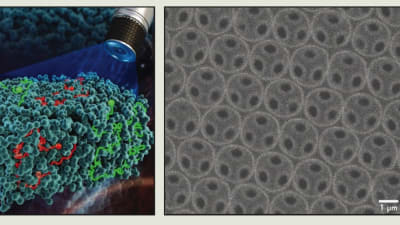
If the outside of clothing or a vehicle were covered with the coating, an infrared camera would have a harder time distinguishing what is underneath. Read on to learn what this means.

Briefs: Motion Control
The “nanoswimmers” could be used to remediate contaminated soil, improve water filtration, or even deliver drugs to targeted areas of the body.
Top Stories
 Blog: Lighting

A Stretchable OLED that Can Maintain Most of Its Luminescence
 Blog: Design

Batteries that Can Withstand the Cold
 INSIDER: Energy

Advancing All-Solid-State Batteries
 Quiz: Energy

 Blog: Data Acquisition

 Blog: Materials

Webcasts
 On-Demand Webinars: Test & Measurement

From Spreadsheets to Insights: Fast Data Analysis Without Complex Programming
 Upcoming Webinars: Aerospace

Cooling a New Generation of Aerospace and Defense Embedded...
 Upcoming Webinars: Test & Measurement

Beyond AI-Copy-Paste Engineering: Advanced AI-Integration Success...
 Upcoming Webinars: Energy

Battery Abuse Testing: Pushing to Failure
 Upcoming Webinars: Connectivity

A FREE Two-Day Event Dedicated to Connected Mobility
 Upcoming Webinars: Test & Measurement

Choosing the Right N-Port Strategy: Multiport VNAs vs. Switch...