
Stories
36,38
0
930
30
Briefs: Energy
A Calcium Rechargeable Battery with Long Cycle Life
A research group has developed a prototype calcium (Ca) metal rechargeable battery capable of 500 cycles of repeated charge-discharge – the benchmark for practical use.
Briefs: Manufacturing & Prototyping
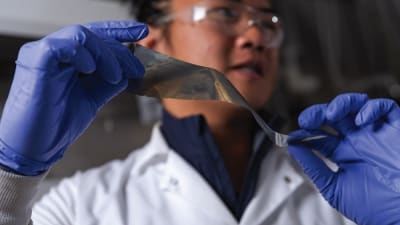
The future of wearable technology just got a big boost thanks to a team of University of Houston researchers who designed, developed, and delivered a successful prototype of a fully stretchable fabric-based lithium-ion (Li-ion) battery.

Briefs: Energy
Scientists at Rice University’s George R. Brown School of Engineering have developed a readily scalable method to optimize prelithiation, a process that helps mitigate lithium loss and improves battery life cycles by coating silicon anodes with stabilized lithium metal particles.

Briefs: Green Design & Manufacturing
A team of researchers is using aluminum foil to create batteries with higher energy density and greater stability. The team’s new battery system could enable EVs to run longer on a single charge and would be cheaper to manufacture – all while having a positive impact on the environment.
Articles: Semiconductors & ICs
As the automotive sector continues to transition to a significant portion of their portfolio being electric, they must either build the needed test facilities to support this transition or update their current facilities.

Articles: Power
PFIB-SEM is a valuable technique that neatly complements other analytical and imaging methods, providing high-resolution 2D and 3D information for larger areas, as compared to traditional gallium FIB-SEM.

Blog: Medical
A new potential path toward greener ways to make chemicals: By adapting hydrogen fuel cell technologies, which are already used to power some EVs, laptops, and cell phones.

INSIDER: Medical
New soft-bodied robots that can be controlled by a simple magnetic field are well suited to work in confined spaces. The robots, formed from rubbery magnetic spirals, can be programmed to walk, crawl,...

Blog: Electronics & Computers
In the digital-design-engineering world, at the foundation of innovation in advanced manufacturing, AI’s “deep learning” has the potential to transform how the world makes products — in highly positive ways.

INSIDER: Electronics & Computers
The Big Data revolution has strained the capabilities of state-of-the-art electronic hardware, challenging engineers to rethink almost every aspect of the microchip. With ever...

Podcasts: Materials
A hemostatic gel technology that rapidly controls bleeding could transform wound care.

Blog: Sensors/Data Acquisition
Researchers developed a prototype for the Li-ion battery, which could lead to stretchy electronics or even clothes that monitor health.

INSIDER: Robotics, Automation & Control
A new type of ferroelectric polymer that is exceptionally good at converting electrical energy into mechanical strain holds promise as a high-performance motion controller or...

Q&A: Manufacturing & Prototyping
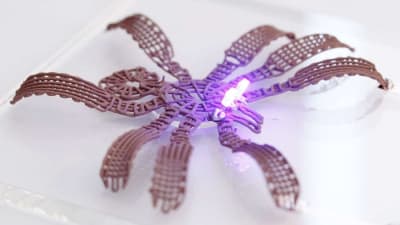
Professor Michael Dickey, of North Carolina State University, and his team have developed a unique process that allows you to print 3D metal objects that have good electric and thermal conductivity as well as good structural properties.
Blog: Manufacturing & Prototyping
The new method paves the way to creating large-scale arrays of optical components and could be used to rapidly manufacture micro-LED displays.

Quiz: Manned Systems
How much do you know about eVTOLs? Test yourself with this quiz.

Special Reports: Medical

Medical Manufacturing & Outsourcing - August 2023
New 3D printing technique is a game-changer for medical device testing…automated 3D scanning speeds part inspection…how to eliminate PCB static in medical electronics. Read about these and...Products: Manufacturing & Prototyping
See the product of the month: InnoPhase IoT, Inc.'s Talaria TWOTM Ultra-low power (ULP) Wi-Fi optimized market-ready solution for cloud-connected IP video IoT devices.

Products: Internet of Things
See the new products on the market, including Clean-in-Place Utilities and Automated Reporting Analytics software, radar-level sensors, power ultrasonic transducers, and more.

Briefs: Photonics/Optics
3D nanometer-scale metamaterial structures hold promise for advanced optical isolators.

Briefs: Materials
A wavelength of visible light is about 1,000 times larger than an electron, so the way the two affect each other is limited by that disparity. Now, researchers have come up with a way to make...

Briefs: Robotics, Automation & Control
Researchers have demonstrated a caterpillar-like soft robot that can move forward, backward, and even dip under narrow spaces. Its movement is driven by a novel pattern of silver nanowires.

Briefs: Manufacturing & Prototyping
An international team of scientists is developing an inkable nanomaterial that they say could one day become a spray-on electronic component for ultra-thin, lightweight, and bendable displays and devices.
Briefs: Materials
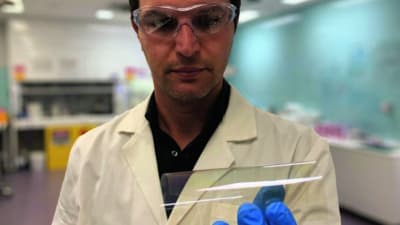
There’s still more to explore with REFLEX, but this process could open new possibilities for new materials and microstructures across fields from electronics to optics to biomedical engineering.

Briefs: Materials
Bending 2D Nanomaterial Could Benefit Future Technologies
Rice University’s Boris Yakobson and collaborators uncovered a property of ferroelectric 2D materials that could be exploited as a feature in future devices.
Briefs: AR/AI
A new smart material is activated by both heat and electricity, making it the first ever to respond to two different stimuli. The work paves the way for a wide variety of potential applications, including clothing that warms up while you walk.

Briefs: Packaging & Sterilization
Next-generation sutures can deliver drugs, prevent infections, and monitor wounds.

Articles: Materials
Toyota Research Institute of North America has developed a simulation-driven generative design method and applied it to the design of flow field microchannel plates, which direct the movement of fluid reactants in microreactors like hydrogen — oxygen fuel cells.

Articles: Robotics, Automation & Control
Machine vision dates back to the beginning of the modern industrial robot age in the 1980s. Augmenting cobots with vision allows them to perform with higher precision, flexibility, and intelligence. However, integration is not a one-size-fits-all process.

Top Stories
 Blog: Robotics, Automation & Control

Aerial Microrobots That Can Match a Bumblebee's Speed
 Blog: Electronics & Computers

Turning Edible Fungi into Organic Memristors
 Blog: Manufacturing & Prototyping

Revolutionizing the Production of Semiconductor Chips
 News: Energy

 INSIDER: Electronics & Computers

World’s Smallest Programmable, Autonomous Robots
 INSIDER: Manufacturing & Prototyping

Webcasts
 On-Demand Webinars: Power

E/E Architecture Redefined: Building Smarter, Safer, and Scalable Vehicles
 Upcoming Webinars: Energy

Hydrogen Engines Are Heating Up for Heavy Duty
 Upcoming Webinars: Electronics & Computers

Advantages of Smart Power Distribution Unit Design for Automotive...
 Upcoming Webinars: Automotive

Quiet, Please: NVH Improvement Opportunities in the Early Design...
 Upcoming Webinars: Power

A FREE Two-Day Event Dedicated to Connected Mobility
 Podcasts: Defense

How Sift's Unified Observability Platform Accelerates Drone Innovation