Stories
51
167
0
900
30
Briefs: Materials
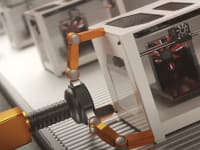
A new method of linking materials with unique mechanical properties could enable robots made of robots.

INSIDER: Robotics, Automation & Control
The Tethered permanently shadowed Region EXplorer (T-REX) rover, designed and built by a team of Michigan Technological University students – is designed to provide reliable power and data to other...

Question of the Week: Robotics, Automation & Control
Will Robotics and Automation Lead to a Greater Appreciation of Nature?
Our lead INSIDER story today focused on the environmental impacts of robotics and automation.
Blog: Sensors/Data Acquisition
A survey of over 170 experts assessed the opportunities and challenges that drones, robots, and autonomous systems could have for urban nature and green spaces.

Question of the Week: Robotics, Automation & Control
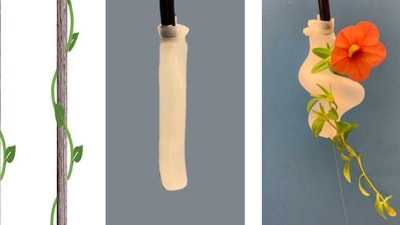
Would You Use a 'Twining' Robotic Gripper?
Our lead INSIDER story today focused on a twining robotic gripper that its inventor says is especially effective at grabbing thin objects like pencils, paintbrushes, and even a straightened paperclip.
Facility Focus: Software
Stanford University’s School of Engineering has been at the forefront of innovation for nearly a century

Blog: Robotics, Automation & Control
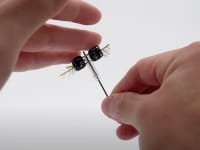
As engineering professor Mable Fok saw how the pole beans in her garden wrapped tightly around any objects nearby, she had an idea:
What if a robotic gripper could do the same thing?
INSIDER: Robotics, Automation & Control
USC researchers have developed a method that could allow robots to learn complicated new tasks, like setting a table or driving a car, from observing a small number of demonstrations.

INSIDER: Robotics, Automation & Control
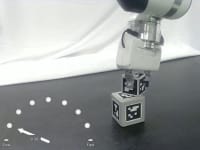
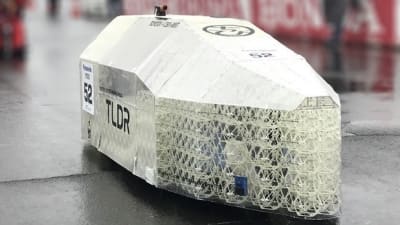
Scientists from the U.S. Army and MIT created a new way to link materials with unique mechanical properties, opening up the possibility of future military robots made of robots. The method unifies...
Question of the Week: Sensors/Data Acquisition
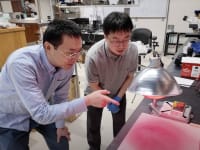
Could ‘Smellicopters’ Someday Support Search-and-Rescue?
Our second INSIDER story today highlights an innovative combination of autonomous drones and live moth antennae: The “Smellicopter.”
INSIDER: Motion Control
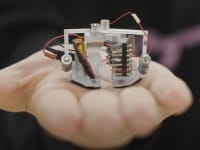
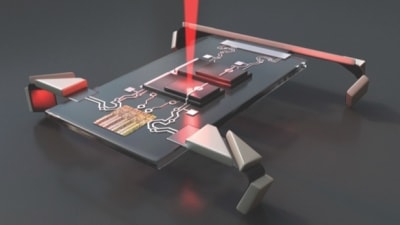
A Cornell University team has created microscopic robots that incorporate semiconductor components, allowing them to be controlled – and made to walk – with standard electronic signals. The...
Blog: RF & Microwave Electronics
UW doctoral student Melanie Anderson explains how to make an autonomous 'Smellicopter' to navigate toward smells.

Articles: Unmanned Systems
A panel of experts explains how robots are playing a larger role in manufacturing.

Articles: Robotics, Automation & Control
Jacobs' scientists are helping to make contract-tracing apps, emergency-use ventilators, and even squid-bots.
Briefs: Motion Control
Applications include retractable covers and awnings, camera booms, and spacecraft and astronaut positioning.

Briefs: Sensors/Data Acquisition
This lightweight, portable garment is designed for active shoulder and elbow positioning.
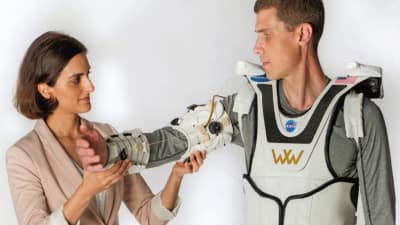
Articles: Materials
Robotic exoskeletons, a breath-test for cancer, and plastic-eating enzymes are Products of Tomorrow.

Briefs: Motion Control
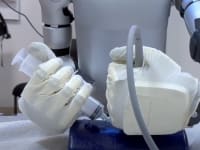
These hands, with a large grasping force, enable safer human-robot interactions.

Briefs: Mechanical & Fluid Systems
Kirigami balloons could be used in shape-changing actuators for soft robots, minimally invasive surgical devices, and macro structures for space exploration.

Briefs: Sensors/Data Acquisition
The mobile system could reduce healthcare workers’ exposure to the COVID-19 virus.
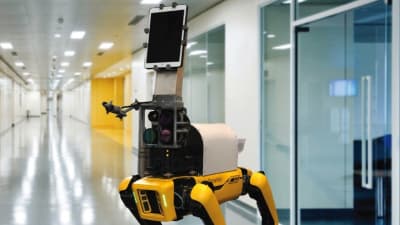
Briefs: Aerospace
This system can be used for long-range or high-payload deliveries as well as search and rescue.

Briefs: Sensors/Data Acquisition
This robotic finger has a highly precise sense of touch over a complex, multi-curved surface.
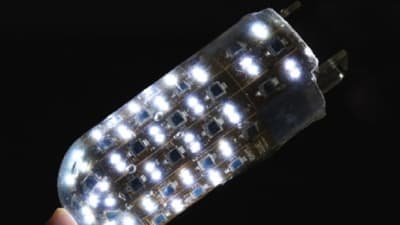
Briefs: Robotics, Automation & Control
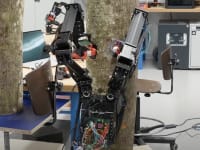
The robot’s extendable appendage can wind through tight spaces and then lift heavy loads.

Briefs: Robotics, Automation & Control
This method enables users to control their robotic fingers precisely enough to gently land on fragile surfaces.
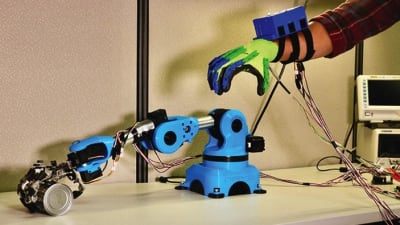
Articles: Weapons Systems
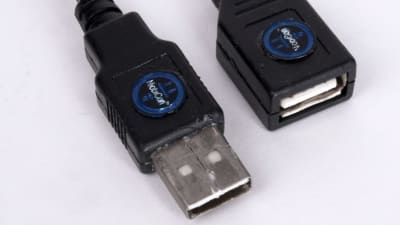
The NiobiCon™ underwater connector will not short out, corrode, or cause an electrical shock if touched while powered in harsh environments like saltwater.
Briefs: Sensors/Data Acquisition
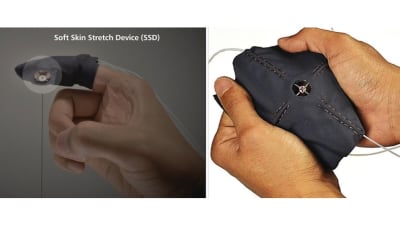
The soft, wearable device simulates the sense of touch and has wide potential in medical and industrial applications.
Briefs: Communications
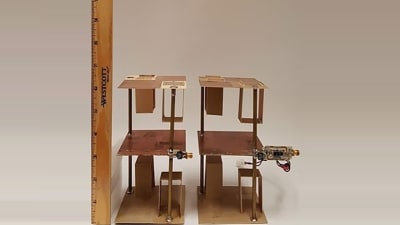
A low-frequency antenna with enhanced bandwidth will enable robust networking among compact, mobile robots.
INSIDER: Robotics, Automation & Control
An invention similar to an elephant’s trunk has potential benefits for many industries where handling delicate objects is essential. UNSW Sydney developed a soft fabric robotic gripper that...

INSIDER: Imaging
Researchers at Tokyo Institute of Technology (Tokyo Tech) working in collaboration with colleagues at Carnegie Mellon University, the University of St Andrews and the University of...

Top Stories
 Blog: Lighting

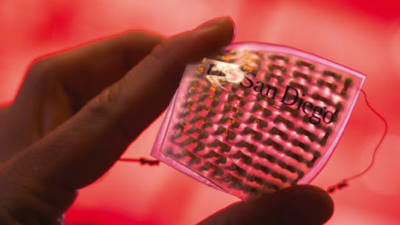
A Stretchable OLED that Can Maintain Most of Its Luminescence
 News: Energy

 INSIDER: Energy

Advancing All-Solid-State Batteries
 Blog: Energy

My Opinion: We Need More Power Soon — Is Nuclear the Answer?
 Blog: Robotics, Automation & Control

Aerial Microrobots That Can Match a Bumblebee's Speed
 Blog: Communications

Microscopic Swimming Machines that Can Sense, Respond to Surroundings
Webcasts
 Upcoming Webinars: Transportation

Advantages of Smart Power Distribution Unit Design for Automotive...
 Upcoming Webinars: Unmanned Systems

Quiet, Please: NVH Improvement Opportunities in the Early Design...
 Upcoming Webinars: Test & Measurement

From Spreadsheets to Insights: Fast Data Analysis Without Complex...
 Upcoming Webinars: Aerospace

Cooling a New Generation of Aerospace and Defense Embedded...
 Upcoming Webinars: AR/AI

Beyond AI-Copy-Paste Engineering: Advanced AI-Integration Success...
 Upcoming Webinars: Test & Measurement