Stories
6,36,37,43,46,48,50,56,58,59,60
7,8,36,110,131,134,135,138,139,141,142,144,145,151,152,201,202
-1
750
30
INSIDER: Robotics, Automation & Control
BB-8 of Star Wars fame is known for its adorable beeps, dome-shaped head, and spherical body. But fighting alongside the Resistance is just one of its many talents. As this spherical robot...

INSIDER: Aerospace
Justin Werfel, Senior Research Fellow in Robotics at the Harvard John A. Paulson School of Engineering and Applied Sciences (SEAS), is leading a team tasked with developing...
INSIDER: Medical
The lungs are one of the most difficult organs for physicians to navigate. They have a dense network of blood vessels, bronchi, and other critical anatomical structures that makes...
NASA Spinoff: Design
Additive manufacturing is allowing NASA to deliver payload services and launch services at a better price point.

5 Ws: Manufacturing & Prototyping
A light sail developed by Cornell’s Space Systems Design Studio (SSDS) could one day propel small spacecraft through interstellar realms.

Articles: Robotics, Automation & Control
In the U.S., women make up 14 percent of the engineering workforce. The number of female engineers across the globe is on the rise but compared to male engineers it is still much lower.

Articles: Manned Systems
What are the challenges for women in aerospace and what more can be done to increase the number of women in the STEM workforce? Tech Briefs interviewed Audrey Schaffer, Vice President of Strategy and Policy, Slingshot Aerospace, who has made significant strides in the aerospace industry.

Articles: Physical Sciences
Significant progress in industry, especially in manufacturing and material science, is expected to be driven by quantum computing. Using sophisticated simulations and optimization techniques, the technology promises to accelerate the discovery of new substances and improve production procedures.

Briefs: Electronics & Computers
The nanoscale electronic parts in devices like smartphones are solid, static objects that once designed and built cannot transform into anything else. But a team from University of California Irvine has reported the discovery of nanoscale devices that can transform into many different shapes and sizes even though they exist in solid states.

Briefs: Medical
Researchers at The Ohio State University have fabricated the first wearable sensor designed to detect and monitor muscle atrophy. This new study published in the journal IEEE Transactions on Biomedical Engineering suggests that an electromagnetic sensor made out of conductive “e-threads” could be used as an alternative to frequent monitoring using MRI.

Briefs: Manned Systems
NASA’s Ames Research Center has developed a novel closed-form solution to model wing flutter aerodynamics for any aircraft wing (within a certain thickness regime and without camber). This closed-form solution can be readily extended to wing sections with camber.
Briefs: Defense
Northrop Grumman Corporation is developing AN/APG-85, an advanced Active Electronically Scanned Array (AESA) radar for the F-35 Lightning II.

Briefs: Propulsion
A Sustainable Engine with Reduced Assembly Costs
Boom Supersonic, the company building supersonic planes, is developing Symphony, a new propulsion system designed and optimized for its Overture supersonic airliner.
Briefs: Aerospace
Engineers at NASA’s Kennedy Space Center and Sidus Space developed a novel interlocking paver system enabling the robotic construction of high-stability vertical takeoff and landing pads.
Briefs: Electronics & Computers
Meet Air-Guardian: A system developed by researchers at the MIT Computer Science and Artificial Intelligence Laboratory (CSAIL). As modern pilots grapple with an onslaught of information from multiple monitors, especially during critical moments, Air-Guardian acts as a proactive co-pilot; a partnership between human and machine, rooted in understanding attention.

Briefs: Motion Control
A technique enables manufacturing of minuscule robots by interlocking multiple materials in a complex way.

Briefs: Software
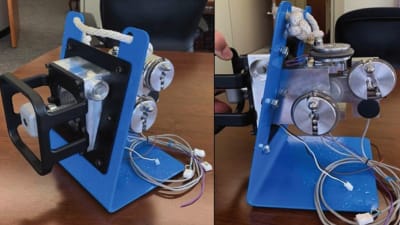
Innovators at NASA’s Johnson Space Center have designed a circumferential scissor spring mechanism, that when incorporated into a hand controller, improves the restorative force to a control stick’s neutral position. The design also provides for operation on a more linear portion of the spring’s force deflection curve, yielding better feedback to the user.
INSIDER: Materials
A common carbon compound is enabling remarkable performance enhancements when mixed in just the right proportion with copper to make electrical wires. It’s a phenomenon that defies...

Podcasts: Unmanned Systems
Jeffrey Starr, Chief Marketing Officer, D-Fend Solutions, is the guest on this episode of Season 1 of the Aerospace & Defense Technology podcast.

Blog: Research Lab
With all the chatter these days about AI, it’s important to really understand what it is and how to use it. A project at the SLAC National Accelerator Laboratory is exploring how operators and an AI automated control system interact.

INSIDER: Motion Control
Researchers at Lawrence Livermore National Laboratory have furthered a new type of soft material that can change shape in response to light, a discovery that could advance “soft...

INSIDER: Mechanical & Fluid Systems
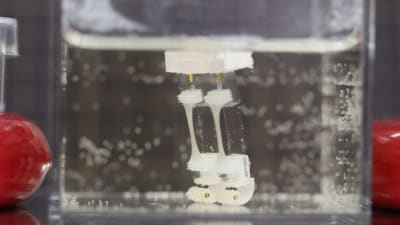
Compared to robots, human bodies are more flexible, capable of fine movements, and can efficiently convert energy into movement. Drawing inspiration from human gait, researchers...
INSIDER: Materials
Scientists have created the world’s first working nanoscale electromotor, according to research published in the journal Nature Nanotechnology. The science team designed a turbine engineered from DNA...

Podcasts: Medical
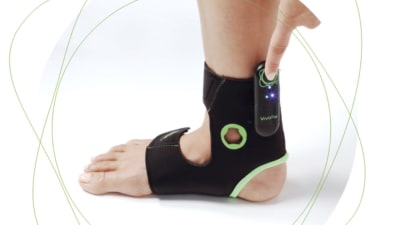
An at home, non-invasive for urge urinary incontinence and urinary urgency without the need for surgery, implants, or drugs demonstrated to potential of wearable neuromodulation.
Podcasts: Aerospace
Tom Driscoll, CTO and Founder, Echodyne, is the guest on this episode of Season 1 of the Aerospace & Defense Technology podcast.

Application Briefs: Aerospace
Insaco manufactured custom tooling to meet the unique part specifications for NASA’s DISSIPATION mission, which will enable better understanding of how the energy imparted by solar winds into the atmosphere is dispersed.
Podcasts: Wearables
Medical-grade wearables can increase patient engagement and gather robust data for clinical trials.

Podcasts: Unmanned Systems
This is the second half of our two-part podcast interview with Michael O’Hara, C-UAS Mission Manager, Northrop Grumman on the Aerospace & Defense Technology podcast.

Special Reports: Electronics & Computers

Test & Measurement - February 2024
From advanced fighter aircraft to future fleets of driverless cars, innovative test technologies are enabling major performance, quality, and cost improvements. Read about these and other applications in a new...Top Stories
 Blog: Power

My Opinion: We Need More Power Soon — Is Nuclear the Answer?
 Blog: AR/AI
Aerial Microrobots That Can Match a Bumblebee's Speed
 News: Energy

 Blog: Electronics & Computers

Turning Edible Fungi into Organic Memristors
 Blog: Robotics, Automation & Control

Microscopic Swimming Machines that Can Sense, Respond to Surroundings
 INSIDER: Sensors/Data Acquisition
Webcasts
 Upcoming Webinars: Energy

Hydrogen Engines Are Heating Up for Heavy Duty
 Upcoming Webinars: Transportation

Advantages of Smart Power Distribution Unit Design for Automotive...
 Upcoming Webinars: Automotive

Quiet, Please: NVH Improvement Opportunities in the Early Design...
 Upcoming Webinars: Test & Measurement

From Spreadsheets to Insights: Fast Data Analysis Without Complex...
 Upcoming Webinars: Power

Battery Abuse Testing: Pushing to Failure
 Upcoming Webinars: Internet of Things