42
-1
0
30
Briefs: Manufacturing & Prototyping
A new study from NC State University combines three-dimensional embroidery techniques with machine learning to create a fabric-based sensor that can control electronic devices through touch. Read on to learn more.

Briefs: Software
A new system that brings together real-world sensing and virtual reality would make it easier for building maintenance personnel to identify and fix issues in commercial buildings that are in operation. The system was developed by computer scientists at the University of California San Diego and Carnegie Mellon University. Read on to learn more.

Briefs: Software
Mechanical engineering researchers in the Harvard John A. Paulson School of Engineering and Applied Sciences think there’s another way to design robots: Programming intended functions directly into a robot’s physical structure, allowing the robot to react to its surroundings without the need for extensive on-board electronics. Read on to learn more.

Briefs: Robotics, Automation & Control
Robots may soon have a new way to communicate with people. Not through words or screens, but with light and images projected directly onto the world around them. University of South Florida's Zhao Han is developing technology that could transform how people interact with robots in both emergencies and everyday life. Read on to learn more.

Briefs: Imaging
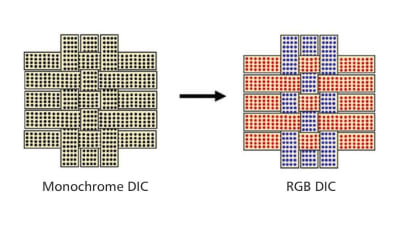
Innovators at NASA Johnson Space Center have developed a technology that can isolate a single direction of tensile strain in biaxially woven material. This is accomplished using traditional digital image correlation (DIC) techniques in combination with custom red-green-blue (RGB) color filtering software. Read on to learn more.
Briefs: Information Technology
Researchers have successfully demonstrated the U.K.’s first long-distance ultra-secure transfer of data over a quantum communications network, including the U.K.’s first long-distance quantum-secured video call. Read on to learn more.

Briefs: Software
Researchers have created a simulation model to analyze how coastal management activities meant to protect barrier islands from sea-level rise can disrupt the natural processes that are keeping barrier islands above water. Read on to learn more about it.

Briefs: Manufacturing & Prototyping
Finding the next groundbreaking polymer is always a challenge, but now Georgia Tech researchers are using artificial intelligence (AI) to shape and transform the future of the field. Read on to learn more.
Briefs: Information Technology
NASA has developed a new technology to track the status of, and changes to, enterprise level programmatic operations. Read on to learn more about it.

Briefs: Software
Researchers from MIT and NVIDIA Research have developed a novel algorithm that dramatically speeds up a robot’s planning process. Their approach enables a robot to “think ahead” by evaluating thousands of possible solutions in parallel and then refining the best ones to meet the constraints of the robot and its environment. Read on to learn more.

Briefs: Software
Northwestern engineers have developed a new system for full-body motion capture — and it doesn’t require specialized rooms, expensive equipment, bulky cameras, or an array of sensors. Instead, it requires a simple mobile device. Read on to learn more.

Briefs: Software
Researchers have provided a new open-source algorithm called Conditional Variational Diffusion Model (CVDM). Based on generative AI, this model improves the quality of images by reconstructing them from randomness. In addition, the CVDM is computationally less expensive than established diffusion models — and it can be easily adapted for a variety of applications. Read on to learn more.

Briefs: Software
A research team from Japan has fabricated a flexible multimodal wearable sensor patch and developed edge computing software that is capable of detecting arrhythmia, coughs, and falls in volunteers. Read on to learn more about the sensor, which uses a smartphone as the edge computing device.

Briefs: Photonics/Optics
Engineers at the University of California San Diego have achieved a long-sought milestone in photonics: creating tiny optical devices that are both highly sensitive and durable — two qualities that have long been considered fundamentally incompatible. Read on to learn more.
Briefs: Software
A research team led by scientists at Lawrence Berkeley National Laboratory (Berkeley Lab) has developed a new fabrication technique that could improve noise robustness in superconducting qubits, a key technology for enabling large-scale quantum computers. Read on to learn more.

Briefs: Lighting
A new computer vision technique developed by MIT engineers significantly speeds up the characterization of newly synthesized electronic materials. The technique automatically analyzes images of printed semiconducting samples and quickly estimates two key electronic properties for each sample. Read on to learn more.

Briefs: Software
A human clearing junk out of an attic can often guess the contents of a box simply by picking it up and giving it a shake, without the need to see what’s inside. Researchers from MIT, Amazon Robotics, and the University of British Columbia have taught robots to do something similar. Read on to learn more.

Briefs: Software
Researchers from MIT and NVIDIA Research have developed a novel algorithm that dramatically speeds up a robot’s planning process. Their approach enables a robot to “think ahead” by evaluating thousands of possible solutions in parallel and then refining the best ones to meet the constraints of the robot and its environment. Read on to learn more.
Briefs: AR/AI
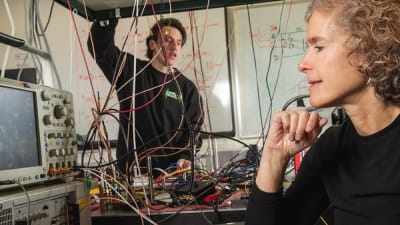
Artificial intelligence systems promise transformative advancements, yet their growth has been limited by energy inefficiencies and bottlenecks in data transfer. Researchers at Columbia Engineering have unveiled a groundbreaking solution: a 3D photonic-electronic platform that achieves unprecedented energy efficiency and bandwidth density, paving the way for next-generation AI hardware. Read on to learn more.
Briefs: Software
Computer scientists have invented a highly effective, yet incredibly simple, algorithm to decide which items to toss from a web cache to make room for new ones. Known as SIEVE, the new open-source algorithm holds the potential to transform the management of web traffic on a large scale. Read on to learn more.

Briefs: Software
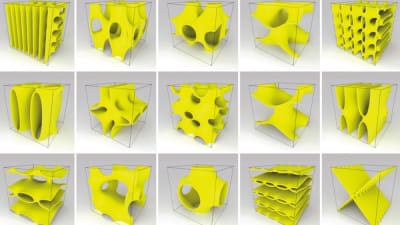
Researchers from MIT and the Institute of Science and Technology Austria have developed a computational technique that makes it easier to quickly design a metamaterial cell from smaller building blocks like interconnected beams or thin plates, and then evaluate the resulting metamaterial’s properties. Read on to learn more.
Briefs: Green Design & Manufacturing
Southwest Research Institute is working to expand software normally used to model electrolytes and predict corrosion and turn it into a tool that can help determine whether ice-covered worlds have the right conditions for microbial life. Read on to learn more.

Briefs: Software
A team of MIT engineers has developed a training method for multiagent systems that can guarantee their safe operation in crowded environments. Read on to learn more about it.

Briefs: Software
A new study, published in the journal Results in Engineering, introduced a meticulously designed dataset aimed at enhancing the performance of 6D pose estimation algorithms. Read on to learn more.

Briefs: RF & Microwave Electronics
Innovators at NASA Johnson Space Center have developed an adaptable RFID system that optimizes transmission for priority data as targets move in and out of passive coverage areas. The method extends the range, and reduces data latency, of ultra-low power battery-assisted passive RFID sensor tags. Read on to learn more.

Briefs: Sensors/Data Acquisition
The technology has the potential for many applications including enhancing pilot training for peak performance and alertness, developing software, training programs, and services for well-being and healthcare, as well as revolutionize the gaming industry by creating interactive video games. Read on to learn more.

Briefs: Robotics, Automation & Control
A team has programmed a robotic spacecraft simulator with what it calls s-FEAST: Safe Fault Estimation via Active Sensing Tree Search. Read on to learn more.

Briefs: Software
This advance could enable quantum computers that use programmable optical qubits or “spin-photon qubits” to connect quantum nodes across a remote network. It could also advance a quantum internet that is not only more secure but could also transmit more data than current optical-fiber information technologies. Read on to learn more.
Briefs: AR/AI
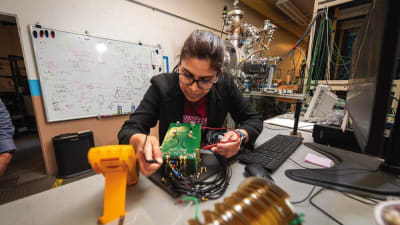
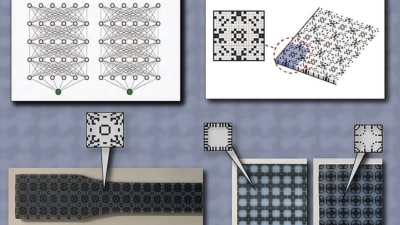
A team at MIT has moved beyond traditional trial-and-error methods to create materials with extraordinary performance through computational design. Their new system integrates physical experiments, physics-based simulations, and neural networks to navigate the discrepancies often found between theoretical models and practical results. Read on to learn more.
Top Stories
 Blog: Lighting

A Stretchable OLED that Can Maintain Most of Its Luminescence
 Blog: Energy

Batteries that Can Withstand the Cold
 INSIDER: Energy

Advancing All-Solid-State Batteries
 Blog: Power

My Opinion: We Need More Power Soon — Is Nuclear the Answer?
 Quiz: Power

 Blog: Data Acquisition

Webcasts
 Upcoming Webinars: Test & Measurement

From Spreadsheets to Insights: Fast Data Analysis Without Complex...
 Upcoming Webinars: Aerospace

Cooling a New Generation of Aerospace and Defense Embedded...
 Upcoming Webinars: Sensors/Data Acquisition

Beyond AI-Copy-Paste Engineering: Advanced AI-Integration Success...
 Upcoming Webinars: Energy

Battery Abuse Testing: Pushing to Failure
 Upcoming Webinars: Power

A FREE Two-Day Event Dedicated to Connected Mobility
 Upcoming Webinars: RF & Microwave Electronics

Choosing the Right N-Port Strategy: Multiport VNAs vs. Switch...