

An instrumentation system has been developed for studying interactions between a glacier or ice sheet and the underlying rock and/or soil. Prior borehole imaging systems have been used in well-drilling and mineral-exploration applications and for studying relatively thin valley glaciers, but have not been used for studying thick ice sheets like those of Antarctica.
The system includes a cylindrical imaging probe that is lowered into a hole that has been bored through the ice to the ice/bedrock interface by use of an established hot-water-jet technique. The images acquired by the cameras yield information on the movement of the ice relative to the bedrock and on visible features of the lower structure of the ice sheet, including ice layers formed at different times, bubbles, and mineralogical inclusions. At the time of reporting the information for this article, the system was just deployed in two boreholes on the Amery ice shelf in East Antarctica and after successful 2000–2001 deployments in 4 boreholes at Ice Stream C, West Antarctica, and in 2002 at Black Rapids Glacier, Alaska.
The probe is designed to operate at temperatures from –40 to +40 °C and to withstand the cold, wet, high-pressure [130- atm (13.20-MPa)] environment at the bottom of a water-filled borehole in ice as deep as 1.6 km. A current version is being outfitted to service 2.4-km-deep boreholes at the Rutford Ice Stream in West Antarctica. The probe (see figure) contains a side-looking charge-coupled-device (CCD) camera that generates both a real-time analog video signal and a sequence of still-image data, and contains a digital videotape recorder. The probe also contains a downward-looking CCD analog video camera, plus halogen lamps to illuminate the fields of view of both cameras. The analog video outputs of the cameras are converted to optical signals that are transmitted to a surface station via optical fibers in a cable. Electric power is supplied to the probe through wires in the cable at a potential of 170 VDC. A DC-to-DC converter steps the supply down to 12 VDC for the lights, cameras, and image-data-transmission circuitry. Heat generated by dissipation of electric power in the probe is removed simply by conduction through the probe housing to the adjacent water and ice.
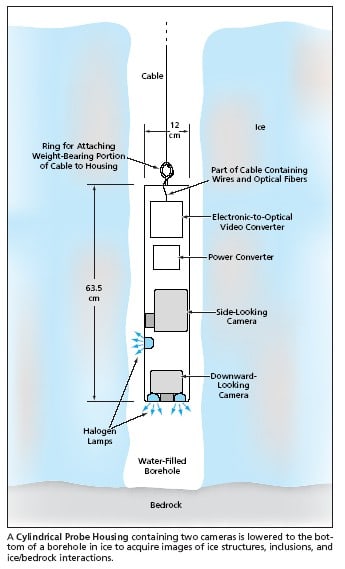 One of the new, creative, and very important attributes of this system is its ability to provide the scientist/operator with direct real-time imaging of the ice in front of the cameras. This allows real-time interaction of a knowledgeable observer and control over when to stop to study further, as well as the two way command and control that lets one zoom/focus into the ice structure to get “internal” versus wall-structure views at a 100- to 200-mm scale.
The probe is lowered into the borehole by using the cable as a tether. The cable is 1.6 km long and is wound on a spool about 0.9 m in diameter. The spool is rotated by a three-phase AC motor to pay out or pull in the cable at a speed of about 1 m/s. In addition to the wires for transmitting power and the optical fibers for transmitting data, the cable contains strengthening members and includes a waterproof cover. The cable, the spool, the motor, and a sled on which the spool and motor are mounted have a total mass of 180 kg. Other equipment in the surface station includes the following: two video monitors that display the current video feeds from each camera; two digital video tape recorders that digitize the incoming analog video images and store the resulting data for subsequent analysis; and a computer that is used to control the operation of the probe and, after image data have been acquired, to digitally manipulate the images and analyze their contents.
All the image data are time-tagged to enable detailed correlations of images during post factum analysis. To assist an operator in subsequently locating unique image features, the realtime video display contains subwindows that indicate depth and time. The highest-quality digital images are recorded by a digital videotape recorder within the side-looking camera. The videotape is removed from the probe after the probe has been returned to the surface station. Time tagging provides a direct correlation between these taped images and the ones recorded in the surface station.
This work was done by Alberto Behar, Frank Carsey, Arthur Lane, and Herman Engelhardt of Caltech for NASA’s Jet Propulsion Laboratory. For further information, access the Technical Support Package (TSP) free on-line at www.techbriefs.com/tsp under the Physical Sciences category. NPO-40500
This Brief includes a Technical Support Package (TSP).

Ice-Borehole Probe
(reference NPO-40500) is currently available for download from the TSP library.
Don't have an account?
Overview
The document is a Technical Support Package for the Ice-Borehole Probe, developed by NASA's Jet Propulsion Laboratory (JPL) as part of the Commercial Technology Program. It focuses on the exploration of the basal regime of ice sheets and glaciers, which has gained attention due to its implications for climate change, ice dynamics, and subglacial ecosystems.
The introduction emphasizes the challenges of observational work in the basal regime, including high pressures, difficult access, and the complications of drilling into ice. The Ice-Borehole Probe is designed to address these challenges by employing an in situ deployment strategy that captures video records of the ice sheet adjacent to hot-water drilled holes. This method minimizes the alteration of the ice environment, allowing for the collection of visual data on the interaction between the ice sheet and its bed, which consists of a mix of wet and frozen materials.
The document outlines the technical specifications of the probe, including its power, structure, waterproofing, and support systems. The probe weighs approximately 180 kg and utilizes optical fiber lines for data transfer and wires for power transmission. The ground station, which includes a high-resolution video monitor and digital tape recorders, is responsible for displaying and storing the images captured by the probe.
The document also highlights the significance of the probe's deployment, as it marks the first time video images have been returned from beneath the West Antarctic Ice Sheet. This groundbreaking work contributes to the understanding of long-term climate change and the geological processes occurring beneath ice sheets.
In addition to the Ice-Borehole Probe, the document mentions related projects, such as the JPL Cryobot and the Lo’ihi Underwater Thermal Vent Probe, showcasing JPL's commitment to advancing technology for scientific exploration in extreme environments.
Overall, the Technical Support Package serves as a comprehensive overview of the Ice-Borehole Probe's design, deployment, and the scientific objectives it aims to achieve, emphasizing its potential impact on climate research and our understanding of subglacial environments.











