

A Raman-scattering-suppressing input/output coupling scheme has been devised for a whispering-gallery-mode optical resonator that is used as a four-wave-mixing device to effect an all-optical parametric oscillator. Raman scattering is undesired in such a device because (1) it is a nonlinear process that competes with the desired nonlinear four-wave conversion process involved in optical parametric oscillation and (2) as such, it reduces the power of the desired oscillation and contributes to output noise.
An all-optical parametric oscillator potentially offers the advantages of a narrow output spectral peak with a low overall noise floor. Often, undesirably, the threshold power for Raman scattering is lower than that for optical parametric oscillation, partly because phase matching is not a necessary precondition for Raman scattering. On the other hand, phase matching is necessary for four-wave mixing, in which pump power in fundamental modes of the resonator is converted to only fundamental modes of a different frequency. Some of the pump laser power needed for optical parametric oscillation can be Raman-scattered to non-fundamental modes of the resonator. The resonance quality factors (Q values) of these non-fundamental modes are not reduced by the presence of input and output fiber-optic couplers designed according to a prior coupling scheme, and the threshold power levels of both competing nonlinear processes decrease with increasing Q values. Moreover, when the pump power reaches the Raman-scattering threshold, the Q values of the pump modes decrease, with consequent increase in the oscillator output noise. For these reasons, it is highly desirable to utilize a modified coupling scheme to suppress the Raman modes without significantly suppressing the fundamental modes.
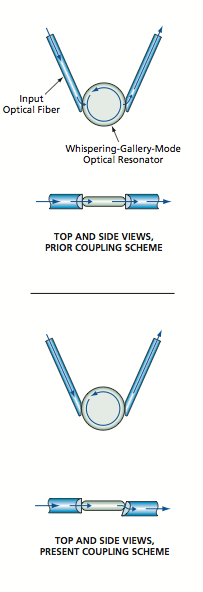
The essence of the present input/output coupling scheme is to reduce output loading of the desired resonator modes while increasing output loading of the undesired ones. The figure illustrates the prior and present coupling schemes. In the prior scheme, the input and output couplers are both positioned and oriented to effect coupling to the fundamental modes of the resonator. The Q of the fundamental modes is reduced by this coupling — especially by output coupling to the load. In the present scheme, the input coupler is still positioned and oriented to effect coupling to the fundamental modes, but the output coupler is tilted to greatly reduce coupling to the fundamental modes without reducing coupling to the Raman modes. As a result, the Q values of the fundamental modes are increased while the output loading reduces the Q values (and thereby increases the threshold power) of the Raman modes.
This work was done by Anatoliy Savchenkov, Lute Maleki, Andrey Matsko, and Enrico Rubiola of Caltech for NASA’s Jet Propulsion Laboratory.
In accordance with Public Law 96-517, the contractor has elected to retain title to this invention. Inquiries concerning rights for its commercial use should be addressed to:
Innovative Technology Assets Management
JPL
Mail Stop 202-233
4800 Oak Grove Drive
Pasadena, CA 91109-8099
(818) 354-2240
E-mail: This email address is being protected from spambots. You need JavaScript enabled to view it.
Refer to NPO-44471
This Brief includes a Technical Support Package (TSP).
Raman-Suppressing Coupling for Optical Parametric Oscillator
(reference NPO-44471) is currently available for download from the TSP library.
Don't have an account?
Overview
The document titled "Raman-Suppressing Coupling for Optical Parametric Oscillator" discusses advancements in nonlinear all-optical parametric oscillators, particularly focusing on their application in aerospace technology by NASA. These oscillators are compact devices characterized by a low noise floor and narrow emission lines, making them suitable for various applications, including those at NASA's Jet Propulsion Laboratory.
A significant challenge in the operation of these oscillators is the phenomenon of Raman scattering, which can degrade performance by lowering the optical quality factor (Q-factor) of the pumping mode. This degradation occurs because Raman scattering can initiate in nonfundamental modes without the need for phase matching, leading to a reduction in the Q-factor and, consequently, the noise characteristics of the oscillator.
To address this issue, the document proposes a novel configuration for the optical coupling of the parametric oscillator. In traditional setups, both input and output couplers are coupled to the fundamental mode, which inadvertently suppresses its Q-factor. The proposed configuration employs asymmetrical optical coupling, where the input coupler is still coupled to the fundamental mode, but the output coupler is tilted and coupled more strongly to transverse modes rather than the fundamental mode. This design allows for the suppression of the transverse modes while maintaining the Q-factor of the fundamental mode, effectively raising the Raman scattering threshold and enabling higher optical power pumping.
The document includes figures illustrating the proposed configuration and its advantages over previous designs. It highlights that successful parametric oscillations were achieved at an optical power of 100 µW with Raman scattering effectively suppressed, demonstrating the feasibility of the new coupling method.
Overall, the document emphasizes the importance of suppressing Raman modes without significantly affecting the fundamental modes to enhance the performance of optical parametric oscillators. This innovation not only contributes to the field of nonlinear optics but also has broader implications for aerospace technology, where reliable and efficient optical systems are crucial. The findings are supported by references to relevant research articles, underscoring the scientific basis for the proposed advancements.











