A comprehensive mathematical model of mass diffusion has been developed for binary fluids at high pressures, including critical and supercritical pressures. Heretofore, diverse expressions, valid for limited parameter ranges, have been used to correlate high-pressure binary mass-diffusion-coefficient data. This model will likely be especially useful in the computational simulation and analysis of combustion phenomena in diesel engines, gas turbines, and liquid rocket engines, wherein mass diffusion at high pressure plays a major role.
The model recasts the kinetic theory (i.e. low-pressure) expressions into forms consistent with the principle of corresponding states. Also presented are corresponding states forms for the Stokes-Einstein hydrodynamic model for diffusion in liquids, which are used for purposes of comparison. By ansatz, the model includes an expression that reflects departures from the kinetic-theory diffusion-coefficient relationship by means of a division factor that is partly a function of the reduced species density, becomes unity in the limit of low-pressure gases, and includes parameters to be determined empirically for higher pressures. The final model equation is
Dij0 = (Dij)KT / wD,j
where Dij0 is the high-pressure infinite dilution diffusivity of species i in j, (Dij)KT is the binary diffusivity calculated according to kinetic theory, and wD,j = 1 + δD,j is the division factor. As the reduced density of species j approaches zero, so does δD,j . Empirical parameters have been determined and the model evaluated by means of correlations with experimental data from the literature (see figure). Typical uncertainties in the correlations have been estimated to lie between 10 and 15 percent and to reach a maximum of about 30 percent at high density.
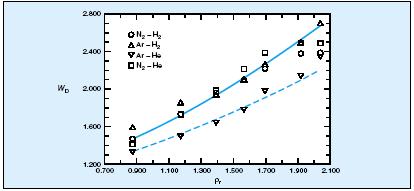
Simulations of heptane drops in nitrogen under zero gravity and at high pressure were performed using the model in order to investigate the sensitivities of predicted drop diameters to uncertainties in diffusivity values. The results of the simulations showed that the root-mean-square deviations of relative drop diameters were approximately one-fourth of the corresponding imposed relative changes in diffusivities.
This work was done by Josette Bellan and Kenneth Harstad of Caltech for NASA's Jet Propulsion Laboratory. For further information, access the Technical Support Package (TSP) free on-line at www.techbriefs.com/tsp under the Physical Sciences category. NPO-30409
This Brief includes a Technical Support Package (TSP).
Calculating Mass Diffusion in High-Pressure Binary Fluids
(reference NPO30409) is currently available for download from the TSP library.
Don't have an account?
Overview
The document is a Technical Support Package from NASA, specifically focused on "Calculating Mass Diffusion in High-Pressure Binary Fluids" (NPO-30409). It is part of the NASA Tech Briefs, which aim to disseminate aerospace-related developments with broader technological, scientific, or commercial applications. The work was conducted at the Jet Propulsion Laboratory (JPL) under a contract with NASA.
The primary objective of this document is to address the lack of established relationships for calculating diffusivities of species in high-pressure environments. Prior to this work, there were no formulas available for determining high-pressure diffusivities, which are crucial for various applications, including combustion and fluid dynamics in aerospace contexts. The authors have developed new formulas based on literature data, providing a significant advancement in the field.
The document outlines the novelty of the work, emphasizing its improvements over previous methodologies. It details the motivation behind the research, which stemmed from the need for reliable calculations of diffusivities at high pressures. The solution presented involves the creation of specific formulas that can be utilized in practical applications.
Additionally, the document includes references to figures and exhibits that support the technical disclosure, although specific figures are not described in detail within the summary. The Technical Support Package also provides contact information for further assistance and access to additional resources through the NASA Scientific and Technical Information (STI) Program Office.
It is important to note that the document includes a disclaimer stating that references to specific commercial products or services do not imply endorsement by the U.S. Government or JPL. The information is provided without any liability on the part of the government or its representatives.
In summary, this Technical Support Package represents a significant contribution to the understanding of mass diffusion in high-pressure binary fluids, offering new tools for researchers and engineers in aerospace and related fields. The development of these formulas is expected to enhance computational models and improve the accuracy of simulations involving high-pressure conditions.