A mathematical model of a special class of solid/fluid chemical reactions has been developed for use in analyzing the pyrolysis of particles of cellulose, wood, and similar biomass materials. Although it involves some simplifying assumptions (as do all models of chemical and physical processes), this model is nevertheless sufficiently detailed to yield spatially and temporally resolved approximations of chemical compositions and temperatures of particles and of liquid and gaseous products as they evolve during the pyrolysis process.
In the model, each particle is assumed to be spherical and porous. The particle is assumed to be chemically reactive, with known volumetric reaction rates for the various chemical species present. It is assumed that the porosity (pore volume ÷ total volume) and the permeability of the particle are large enough to allow for continuous flows of gases. For these and other purposes, the detailed pore structure is not analyzed and instead, only the bulk or "effective" properties associated with porosity are represented. Unlike in some other models, conditions in the environment of the particle are not assumed to be quasi-steady. Conditions at the surface of the particle are allowed to evolve according to the equations of the model and the far-field temperature and pressure.
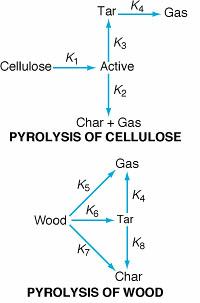
The model provides for the formation of solid (char), liquid (tar), and gaseous products. Both convection and diffusion of the liquid product(s) are neglected; this assumption is justified, provided that either the viscosity of the liquid substantially exceeds that of the gases or the characteristic reaction time of the liquid is much smaller than its characteristic diffusion and convection times.
The dynamics of flows of gases and of chemical reactions within the particle are represented by coupled equations for conservation of mass, momentum, and energy. For the gaseous chemical species, the equations for conservation of mass include both flow-divergence terms and source terms proportional to the products of partial densities and reaction rates. For the solid and liquid species, only the source terms are included. The reactions are assumed to be irreversible and of first order.
For modeling conservation of energy, all species are assumed to be in local thermal equilibrium in a mixture. The partial internal energy of each chemical species is assumed to be proportional to the its partial density × its specific heat at constant volume × the local temperature. The rate of change of local internal energy is represented by a sum of (1) heat-release rates proportional to the chemical-reaction source terms, (2) conduction proportional to the local gradient of temperature × an effective thermal conductivity according to a mixture-and-porosity-based submodel, and (3) convection of heat via the flow of gaseous species.
The conservation of momentum for the gas phase is expressed by a single equation for radial flow of a compressible gas mixture through pores, with an effective molecular viscosity proportional to the porosity × the sum of mass-fraction-weighted viscosities of all gas species. The set of equations is completed by an equation of state, based on the perfect gas law, wherein the total local pressure is expressed in terms of the effective local total gas density, porosity, local temperature, and local volume fractions of the gas species.
The model was applied in a parametric study of the effects of initial reactor temperature, heating rate, porosity, and initial particle size on the char yields and conversion times in the pyrolysis of spherical biomass particles in initially quiescent superheated steam. In this study, reaction rates (see figure) were calculated from previously published data on the kinetics of chemical reactions for cellulose and wood. The equations of the model were solved numerically. The solutions qualitatively reproduced aspects of pyrolysis as observed in previous mathematical-modeling and experimental studies.
In particular, the numerical results indicated that one can reduce the production of char by decreasing the initial particle size or by increasing the reactor temperature and heating rate, but that the achievable decrease in the production of char is limited by endothermic reactions, heat capacities, and thermal diffusion. Three pyrolysis regimes were identified: (1) initial heating followed by (2) primary reaction at an effective pyrolysis temperature followed by (3) final heating.
A Few Principal Chemical Reactions are included in the model of the pyrolysis of cellulose and wood. The reaction rates are calculated by the Arrhenius equation
Ki = Ai exp(-Ei /R̄T),
where K is a reaction rate, A is a rate frequency constant, E is an activation energy, R̄ is the universal gas constant, T is the absolute temperature, and the subscript i denotes the ith reaction path or chemical species.
This work was done by Josette Bellan and Richard S. Miller of Caltech for NASA's Jet Propulsion Laboratory. For further information, access the Technical Support Package (TSP) free on-line at www.techbriefs.com under the Physical Sciences category, or circle no. 192on the TSP Order card in this issue to receive a copy by mail ($5 charge). NPO-20070
This Brief includes a Technical Support Package (TSP).
Mathematical model of pyrolysis of biomass particles
(reference NPO20070) is currently available for download from the TSP library.
Don't have an account?
Overview
The document appears to be a technical report focused on the mathematical modeling of biomass pyrolysis, specifically developed by inventors Josette Bellan and Richard S. Miller. It is part of a technical support package compiled by the JPL Technology Reporting Office. The report aims to provide a comprehensive understanding of the pyrolysis process, which involves the thermal decomposition of organic materials, such as cellulose and wood, in the absence of oxygen.
The modeling presented in the document likely includes detailed descriptions of the chemical reactions that occur during pyrolysis, as well as the various products that are generated from biomass. Pyrolysis is a critical process in converting biomass into biofuels and other valuable chemicals, making it an important area of research in renewable energy and sustainable practices.
The report may cover the kinetics of the pyrolysis reactions, the influence of temperature and pressure on the process, and the physical properties of biomass particles that affect their behavior during pyrolysis. It could also discuss the yield efficiency of different biomass types and the optimization of conditions to maximize the production of desired products, such as bio-oil, char, and syngas.
Additionally, the document might include graphical representations of data, such as yield efficiency curves and reaction kinetics, to illustrate the findings and support the mathematical models developed. These visual aids would help in understanding the relationships between various parameters and the outcomes of the pyrolysis process.
Overall, the report serves as a valuable resource for researchers and practitioners in the field of biomass conversion, providing insights into the underlying mechanisms of pyrolysis and offering a framework for further studies and applications in bioenergy. The work of Bellan and Miller contributes to the broader goal of developing sustainable energy solutions by harnessing the potential of biomass as a renewable resource.