The sounding rocket experiment FIRE (Far-ultraviolet Imaging Rocket Experi ment) will improve the science community’s ability to image a spectral region hitherto unexplored astronomically. The imaging band of FIRE (≈900 to 1,100 Å) will help fill the current wavelength imaging observation hole existing from ≈620 Å to the GALEX band near 1,350 Å. FIRE is a single-optic prime focus telescope with a 1.75-m focal length. The bandpass of 900 to 1100 Å is set by a combination of the mirror coating, the indium filter in front of the detector, and the salt coating on the front of the detector’s microchannel plates. Critical to this is the indium filter that must reduce the flux from Lyman-alpha at 1,216 Å by a minimum factor of 10–4. The cost of this Lyman-alpha removal is that the filter is not fully transparent at the desired wavelengths of 900 to 1,100 Å.
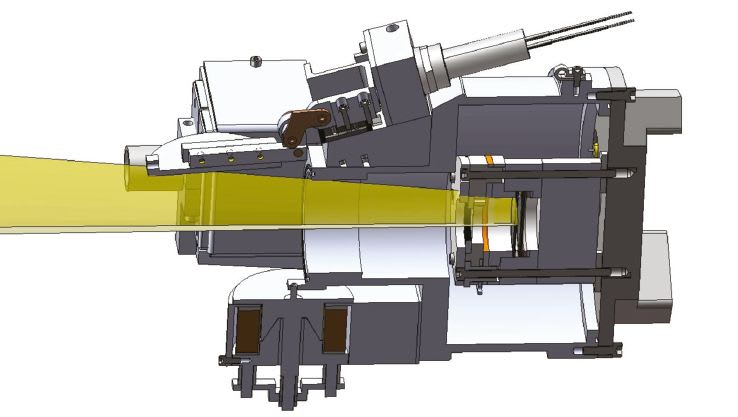
A low-power, hydrogen plasma treatment is generated in a PlasmaTherm RIE etcher using a mixture of argon and hydrogen gas. The gas ratio is optimized in order to control the following variables: bias voltage, atomic hydrogen content, and substrate temperature. Low bias voltage is required to avoid mechanically degrading the filters by sputtering the indium foil. High atomic hydrogen content is required to enhance the carbon removal rate. Low substrate temperature is required to avoid deformation of the indium foil due to sagging. Those variables are optimized around MFC (mass flow controller) setpoints of 25 sccm argon and 7 sccm hydrogen.
This work was done by Harold F. Greer and Shouleh Nikzad of Caltech, and Matthew Beasley and Brennan Gantner of the University of Colorado for NASA’s Jet Propulsion Laboratory. In accordance with Public Law 96-517, the contractor has elected to retain title to this invention. Inquiries concerning rights for its commercial use should be addressed to: Innovative Technology Assets Management NPO-47400
JPL
Mail Stop 202-233
4800 Oak Grove Drive
Pasadena, CA 91109-8099
E-mail:
This Brief includes a Technical Support Package (TSP).
Plasma Treatment To Remove Carbon From Indium UV Filters
(reference NPO-47400) is currently available for download from the TSP library.
Don't have an account?
Overview
The document discusses advancements made by NASA's Jet Propulsion Laboratory (JPL) in improving the performance of optical and solar blind detectors through a novel plasma treatment process. This process effectively removes carbon contamination from indium metal, which is critical for the functionality of ultraviolet (UV) filters used in astronomical observations.
The plasma treatment utilizes a low power, low temperature hydrogen plasma that reacts with carbon contaminants, converting them into methane while preserving the integrity of the indium surface. Initial tests of this treatment on state-of-the-art filters showed promising results, with transmission improvements from 7% to 9% at around 900 Å, and further optimization increased transmission to 12%. This enhancement is significant as the current filters typically exhibit a transmission range of only 4-8% due to carbon contamination.
The document also highlights the context of these advancements within the Far-ultraviolet Imaging Rocket Experiment (FIRE), which aims to explore the 900-1100 Å wavelength band. This band is crucial for studying young, hot stars, particularly O stars, which emit most of their light in this range. The FIRE mission seeks to fill a gap in astronomical observations that exists between the wavelengths measured by the GALEX mission and those below 620 Å.
To achieve effective Lyman-alpha blockage at 1216 Å, the indium filter must be approximately 2000 Å thick, which compromises its transparency at the desired wavelengths. The theoretical transmission at 900 Å is expected to be around 20%, but the current filters fall short due to contamination issues. The document emphasizes that improving the transmission to 10% or better would significantly enhance the scientific return of future sounding rocket missions.
Overall, the document outlines the technical details of the plasma treatment process, its implications for filter performance, and the broader impact on astronomical research, particularly in understanding star formation and the characteristics of young, massive stars. The advancements made by JPL in this area not only contribute to the specific goals of the FIRE mission but also have potential applications in various scientific and commercial fields.