A dry plasma process has been demonstrated to be useful for the selective modification of self-assembled monolayers (SAMs) of alkanethiolates. These SAMs are used, during the fabrication of semiconductor electronic devices, as etch masks on gold layers that are destined to be patterned and incorporated into the devices. The selective modification involves the formation of fluorocarbon films that render the SAMs more effective in protecting the masked areas of the gold against etching by a potassium iodide KI) solution. This modification can be utilized, not only in the fabrication of single electronic devices but also in the fabrication of integrated circuits, microelectromechanical systems, and circuit boards.
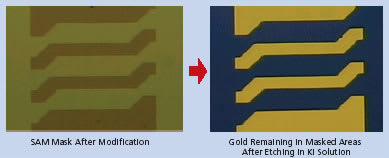
This dry plasma process offers the potential for forming masks superior to those formed in a prior wet etching process. Among the advantages over the wet etching process are greater selectivity, fewer pin holes in the masks, and less nonuniformity of the masks. The fluorocarbon films formed in this way may also be useful as intermediate layers for subsequent fabrication steps and as dielectric layers to be incorporated into finished products.
This work was done by Mark M. Crain III, Kevin M. Walsh, and Robert W. Cohn of the University of Louisville for Goddard Space Flight Center. For further information, access the Technical Support Package (TSP) free on-line at www.techbriefs.com/tsp under the Materials category. GSC-14440