

A mathematical model describes the evaporation of drops of a hydrocarbon liquid composed of as many as hundreds of chemical species. The model is intended especially for application to any of several types of kerosenes commonly used as fuels. Like evaporating- multicomponent- fuel-drop models described in several previous NASA Tech Briefs articles, the present model invokes the concept of continuous thermodynamics, according to which the chemical composition of the evaporating multicomponent liquid is described by use of a probability distribution function (PDF). However, as described below, the present model is more generally applicable than is its immediate predecessor.
The present model is built on the one reported in "Statistical Model of Evaporating Multicomponent Fuel Drops" (NPO-30886), which appears elsewhere in this issue. To recapitulate: The PDF in that model is a superposition of two functions and, accordingly, is denoted a double PDF. It is a function of the molecular weight plus five other parameters. Unfortunately, some of those other parameters depend on the class of homologous hydrocarbon species, so that it becomes necessary to have a double PDF for each such class entering the fuel composition. The introduction of multiple double PDFs would make the computation very cumbersome, negating the advantage of the continuous- thermodynamics formulation. The derivation of the present model is driven by the concept of a unified thermodynamic representation of three classes of homologous hydrocarbons (alkanes, naphthenes, and aromatics) that constitute the principal components of kerosenes. Somewhat more specifically, it is sought to characterize the hydrocarbons in each homologous series by unified reference temperatures, pressures, and other parameters that depend only on molecular weights and thermodynamic quantities.
The derivation leads to a new version of the double PDF, in which the square root of the molecular weight occupies the position previously occupied by the molecular weight and other parameters are modified accordingly. By design, this version of the double PDF applies to the three major homologous series in kerosene; hence, it is not necessary to use multiple double PDFs. An additional advantage of this formulation is that it is valid over the subcritical region in the pressure range from 1 to 15 bars (0.1 to 1.5 MPa).
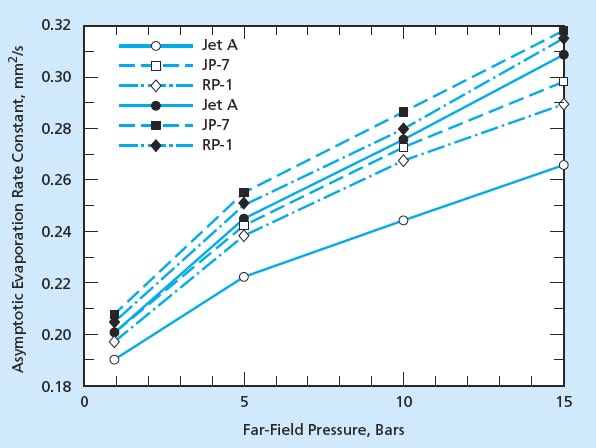
The model has been tested on three kerosenes used as aircraft and rocket fuels: Jet A, JP-7, and RP-1. The present version of the double PDF has been fitted to the discrete species distributions of these kerosenes and extensive calculations of evaporation of isolated drops performed. The results show that under the assumption of a quasi-steady gas phase, a relation known in the literature as the D2 law (pertaining to the rate of decrease of the square of the drop diameter) is recovered after an initial dropheating transient. A related quantity known in the literature as the asymptotic evaporation rate constant has been found to be an increasing function of the far-field temperature and pressure, a complex function of far-field composition, and a weak function of the difference between the drop-surface and farfield vapor molar fractions. In a comparison between results obtained (a) under the assumption that the interior of the drop is well mixed (the "wm" assumption) and (b) under the assumption that the drop can evaporate either in a wellmixed mode or at unchanging (frozen) composition (the "wm-fc" assumption), it was found that the differences between the asymptotic evaporation rate constants under the two assumptions is within the range of uncertainty in the transport properties (see figure).
This work was done by Josette Bellan and Kenneth Harstad of Caltech for NASA's Jet Propulsion Laboratory. For more information, download the Technical Support Package (free white paper) at www.techbriefs.com/tsp under the Information Sciences category. NPO-40437
This Brief includes a Technical Support Package (TSP).
Modeling Evaporation of Drops of Different Kerosenes
(reference NPO-40437) is currently available for download from the TSP library.
Don't have an account?
Overview
The document is a Technical Support Package from NASA's Jet Propulsion Laboratory (JPL) that focuses on the modeling of evaporation for different types of kerosene, specifically Jet A, JP-7, and RP-1. This research is documented under NASA Tech Brief NPO-40437 and is part of the Commercial Technology Program aimed at disseminating aerospace-related developments with potential wider technological, scientific, or commercial applications.
The primary objective of the study is to understand the evaporation behavior of kerosene drops under varying pressure conditions, specifically between 1 to 15 bars. This research is crucial for applications in aerospace, where kerosene fuels are commonly used in rocket propulsion and other high-performance engines. The findings can help improve fuel efficiency, combustion performance, and overall engine design.
The document references a detailed study published in the journal "Combustion and Flame" by K. G. Harstad and J. Bellan, which provides in-depth analysis and results of the evaporation modeling. The research is significant as it contributes to the understanding of how different kerosene fuels behave under various environmental conditions, which is essential for optimizing fuel usage in aerospace applications.
Additionally, the Technical Support Package includes contact information for further inquiries, specifically directing interested parties to the Innovative Technology Assets Management at JPL. This section emphasizes the collaborative nature of NASA's research efforts and encourages partnerships that can leverage the findings for commercial or technological advancements.
The document also includes a disclaimer regarding the use of the information contained within, stating that neither the U.S. Government nor any representatives assume liability for its application. It clarifies that any mention of trade names or manufacturers is for identification purposes only and does not imply official endorsement by NASA.
In summary, this Technical Support Package serves as a valuable resource for researchers and industry professionals interested in the evaporation characteristics of kerosene fuels, providing insights that can lead to advancements in aerospace technology and fuel management. The research findings are positioned to have broader implications beyond aerospace, potentially influencing various sectors that utilize kerosene or similar fuels.











