Coupling of light into and out of whispering- gallery-mode (WGM) optical resonators can be enhanced by designing and fabricating the resonators to have certain non- axisymmetric shapes (see figure). Such WGM resonators also exhibit the same ultrahigh values of the resonance quality factor (Q) as do prior WGM resonators. These WGM resonators are potentially useful as tunable narrow-band optical filters having throughput levels near unity, high-speed optical switches, and low-threshold laser resonators. These WGM resonators could also be used in experiments to investigate coupling between high-Q and chaotic modes within the resonators.
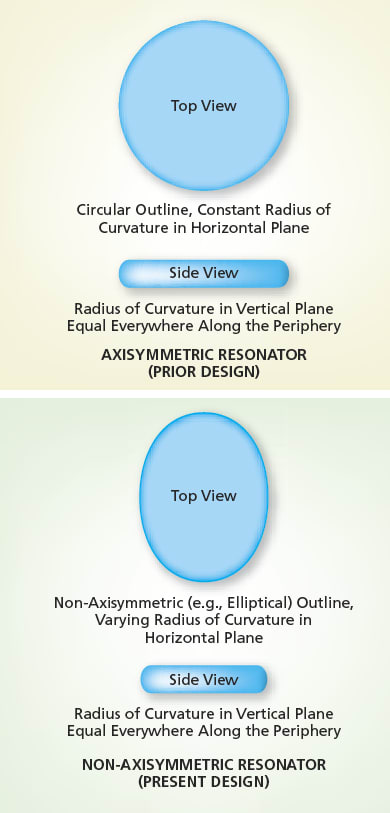
For a beam of laser light traveling through the prism and having a typical axisymmetric cross-sectional power density that varies as a Gaussian function of radius from its cylindrical axis, the cross section of the phase front changes from circular to elliptical at the interface. In the case of the lithium niobate/diamond interface, the ratio between the lengths of the semimajor and semiminor axes of the ellipse is about 2.7. In order to optimize the coupling of the beam into the high-Q modes of the resonator, the ratio between the horizontal and vertical curvatures of the resonator must be made to equal the aforesaid material-dependent ratio between the lengths of the axes of the ellipse. (Here, "vertical" and "horizontal" refer to planes onto which are projected the narrowest and widest views, respectively, of the resonator, as in the figure.) It is difficult to fabricate a WGM resonator surface to such an exacting specification at a specific point on its surface, but the task can be simplified as described next if one does not insist on a specific location.
If the WGM resonator is shaped to have a constant radius of curvature at its periphery as seen in a vertical plane but is asymmetrical (or at least non-axisymmetric) in a horizontal plane (for example, if its shape in a horizontal plane is elliptical), then its horizontal radius of curvature and the ratio between the two curvatures varies continuously with position along the periphery. Consequently, by suitable choice of the shape, it is possible to make the ratio between these curvatures equal the desired material-dependent ratio at some location along the periphery.
Several working prototype WGM resonators have been designed and fabricated according to this concept. In tests, these resonators exhibited Q values of about 108 and coupling efficiencies >0.7.
This work was done by Makan Mohageg and Lute Maleki of Caltech for NASA's Jet Propulsion Laboratory.
In accordance with Public Law 96-517, the contractor has elected to retain title to this invention. Inquiries concerning rights for its commercial use should be addressed to: Innovative Technology Assets Management
JPL
Mail Stop 202-233
4800 Oak Grove Drive
Pasadena, CA 91109-8099
(818) 354-2240
E-mail:
Refer to NPO-43832, volume and number of this NASA Tech Briefs issue, and the page number.
This Brief includes a Technical Support Package (TSP).
Tailored Asymmetry for Enhanced Coupling to WGM Resonators
(reference NPO-43832) is currently available for download from the TSP library.
Don't have an account?
Overview
The document discusses advancements in Whispering Gallery Mode (WGM) resonators developed by researchers at NASA's Jet Propulsion Laboratory (JPL). These resonators are constructed from nonlinear crystalline materials, specifically Lithium Niobate, and are designed to enhance coupling efficiency while maintaining high quality factors (Q-factors). The primary focus is on addressing the limitations of traditional WGM resonators, which often struggle with efficient light coupling due to their geometric symmetry.
To optimize coupling, the researchers have created asymmetric resonators with elliptical and egg-shaped cross sections. This asymmetry allows for a continuous variation in the ratio of horizontal to vertical curvature along the resonator's circumference, enabling the critical coupling ratio of approximately 2.7:1 (specific to the Lithium Niobate-diamond interface) to be achieved at various points. This innovative design overcomes the challenges posed by conventional circular resonators, which require precise matching of curvature ratios for optimal light coupling.
The document highlights the successful fabrication of several prototypes, demonstrating quality factors exceeding 10^8 and coupling efficiencies greater than 70%. These advancements suggest significant potential for practical applications, including tunable narrowband optical filters with near-unity throughput, high-speed optical switches, and low-threshold laser cavities. Additionally, the resonators may facilitate fundamental physics experiments, such as exploring the interaction between high-Q and chaotic modes within the resonator.
The research underscores the importance of tailored asymmetry in enhancing the performance of WGM resonators, which are crucial for various optical devices. The findings are part of NASA's broader efforts to develop technologies with potential applications beyond aerospace, contributing to advancements in scientific and commercial fields.
Overall, the document presents a significant step forward in the design and functionality of WGM resonators, showcasing the innovative approaches taken by JPL researchers to improve optical coupling and expand the capabilities of these devices in various applications.