A proposed holographic memory system would be capable of storing data at unprecedentedly high density, and its data-transfer performance in both reading and writing would be characterized by exceptionally high bandwidth. The capabilities of the proposed system would greatly exceed even those of a state-of-the art memory system, based on binary holograms (in which each pixel value represents 0 or 1), that can hold ≈1 terabyte of data and can support a reading or writing rate as high as 1 Gb/s.
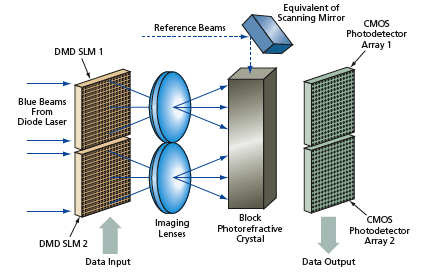
The proposed system would utilize multilevel holograms. The system (see figure) would include lasers, imaging lenses and other beam-forming optics, a block photorefractive crystal wherein the holograms would be formed, and two multilevel spatial light modulators in the form of commercially available deformable-mirror-device spatial light modulators (DMDSLMs) made for use in high-speed input conversion of data up to 12 bits. For readout, the system would also include two arrays of complementary metal oxide/semiconductor (CMOS) photodetectors matching the spatial light modulators. The system would further include a reference-beam-steering device (equivalent of a scanning mirror), containing no sliding parts, that could be either a liquid-crystal phased-array device or a microscopic mirror actuated by a high-speed microelectromechanical system. Time-multiplexing and the multilevel nature of the DMDSLM would be exploited to enable writing and reading of multilevel holograms. The DMDSLM would also enable transfer of data at a rate of 7.6 Gb/s or perhaps somewhat higher.
This work was done by Tien-Hsin Chao of Caltech for NASA's Jet Propulsion Laboratory.
In accordance with Public Law 96-517, the contractor has elected to retain title to this invention. Inquiries concerning rights for its commercial use should be addressed to:
Innovative Technology Assets Management
JPL
Mail Stop 202-233
4800 Oak Grove Drive
Pasadena, CA 91109-8099
(818) 354-2240
E-mail:
Refer to NPO-42702, volume and number of this NASA Tech Briefs issue, and the page number.
This Brief includes a Technical Support Package (TSP).
High-Density, High-Bandwidth, Multilevel Holographic Memory
(reference NPO-42702) is currently available for download from the TSP library.
Don't have an account?
Overview
The document outlines NASA's Jet Propulsion Laboratory's (JPL) advancements in holographic memory technology, specifically focusing on a new system architecture designed to enhance storage density and data transfer bandwidth. The key innovation is the development of multilevel holograms, which replace traditional binary-valued holograms. This shift allows for significantly increased data storage capabilities without a corresponding increase in system volume, mass, or power consumption.
The new holographic memory (HM) system architecture incorporates a multilevel Spatial Light Modulator (SLM), specifically a Deformable Mirror Device (DMDSLM) from Texas Instruments, which enables high-speed data input conversion of up to 12 bits. This is complemented by a CMOS photo detector array for data readout, a beam steering device (such as a liquid crystal phase array or high-speed MEMS mirror), and photorefractive crystals for data recording. The system utilizes time-multiplexing and multilevel DMDSLM technology to record multi-bit holograms, resulting in substantial increases in storage density—up to 8 terabytes for 3-bit holograms and 256 terabytes for 8-bit holograms.
The document highlights the limitations of existing binary holographic memory systems, which can store up to 1 terabyte with a transfer rate of 1 Gbit/sec. These capabilities fall short of the increasing data storage demands from the Department of Defense (DoD) and other applications. The new multilevel holographic memory system aims to bridge this gap by achieving ultrahigh density (terabytes) and ultrahigh bandwidth (Gigabits/sec) while maintaining a compact system design.
The novelty of this research lies in its potential to meet the stringent requirements of NASA and DoD applications, addressing the need for higher data storage and transfer rates without compromising on system efficiency. The document serves as a technical support package under NASA's Commercial Technology Program, aiming to disseminate aerospace-related developments with broader technological, scientific, or commercial applications.
For further inquiries or detailed information, the document provides contact details for JPL's Innovative Technology Assets Management. Overall, this work represents a significant step forward in holographic memory technology, promising to enhance data storage solutions for various high-demand sectors.