

A generalized data processor, proposed for use in the reception of binaryphase-shift-keyed (BPSK) radio signals, provides preliminary estimates of the block and convolutionally encoded symbols that are meant to be con- veyed by the BPSK modulation. In a process denoted information-reduced maximum a posteriori (MAP) phase estimation, an estimate of the instantaneous symbol (and thus of the instantaneous phase modulation) is used to reduce the amount of randomness and information by converting the received modulated carrier to an approximation of an unmodulated carrier. The resulting partially recon- structed carrier is then fed as input to a MAP phase estimator to improve phasetracking performance. The basic principles of information-reduced MAP phase estimation were described in somewhat more detail in “Information-Reduced Carrier Synchronization for Coded PSK Operation at Low-SNR” (NPO-20261), NASA Tech Briefs, Vol. 22, No. 10 (October 1998), page 64.
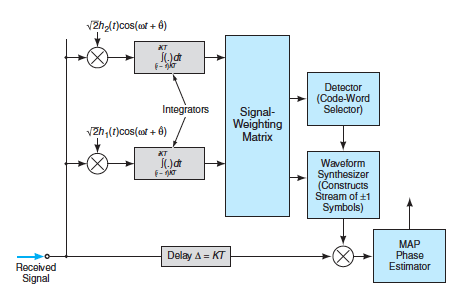
The structure of the pre-processor remains essentially the same for any linear code of a given block length, except for the signal-weighting matrix, which is unique to each code. The signal- weighting matrix is pre-computed for each coding scheme by first generating the set of code words, then multiplying the Hadamard matrix by the coefficient matrix representing all possible code words.
The proposed generalized preprocessor was tested in computational simulations. The results showed that under representative conditions, including signal-to-noise ratios ranging from –5 to –10 dB, the increase in carrier- phase-estimation performance is equivalent to the improvement afforded by strengthening the received signal by 5 to 6 dB.
This work was done by Victor Vilnrotter, Clement Lee, and Norman Lay of Caltech for NASA’s Jet Propulsion Laboratory.
In accordance with Public Law 96-517, the contractor has elected to retain title to this invention. Inquiries concerning rights for its commercial use should be addressed to
Intellectual Property group
JPL
Mail Stop 202-233
4800 Oak Grove Drive
Pasadena, CA 91109
(818) 354-2240
Refer to NPO-30129, volume and number of this NASA Tech Briefs issue, and the page number.
This Brief includes a Technical Support Package (TSP).
Generalized Pre-Processor for block and Convolutional Codes
(reference NPO-30129) is currently available for download from the TSP library.
Don't have an account?
Overview
The document discusses a generalized pre-processor developed for the reception of binary-phase-shift-keyed (BPSK) radio signals, aimed at improving the estimation of carrier phase in weak-signal environments. This technology, created by researchers Victor Vilnrotter, Clement Lee, and Norman Lay at NASA's Jet Propulsion Laboratory (JPL), addresses the degradation of critical phase estimates in telemetry and real-time applications, particularly when dealing with convolutionally encoded or block-encoded signals.
The pre-processor operates by utilizing a technique known as information-reduced maximum a posteriori (MAP) phase estimation. This method involves generating preliminary estimates of the encoded symbols conveyed by BPSK modulation, which helps to reduce randomness and convert the received modulated carrier into an approximation of an unmodulated carrier. The partially reconstructed carrier is then used as input for a MAP phase estimator, enhancing phase-tracking performance.
The structure of the pre-processor is consistent across various linear codes of a given block length, with the unique aspect being the signal-weighting matrix, which is pre-computed for each coding scheme. The pre-processor simplifies the decoding process by relying on the generator matrix of the encoder, allowing it to be initialized in the field for different types of codes without introducing significant delays. This is particularly beneficial in scenarios where channel conditions may change rapidly.
Simulation results indicate that the pre-processor can significantly improve carrier phase estimation performance, achieving enhancements equivalent to strengthening the received signal by 5 to 6 dB, even under low signal-to-noise ratios (SNR) ranging from -5 to -10 dB. This improvement is crucial for applications such as telemetry, where reducing radio losses is essential, and for "phasing up" elements of large arrays that observe weak signals.
The document also emphasizes that while the fidelity of the data generated by the pre-processor may not be suitable for direct communication, it is adequate for improving the performance of phase estimators and other critical subsystems. Overall, this generalized pre-processor represents a significant advancement in the field of signal processing, particularly for applications requiring reliable performance in challenging conditions.











