A new technique for retrieving cirrus properties from radiometric measurements at submillimeter wavelengths has been developed. The technique can accurately measure the amount of ice present in cirrus clouds, determine the median crystal size, and constrain crystal shape. The retrieval algorithm improves upon prior algorithms by also retrieving middle and upper tropospheric water-vapor profiles in concert with cloud properties. This joint-analysis method corrects for retrieval errors introduced by water vapor in and near the cloud.
The new retrieval algorithm corrects for middle and upper tropospheric water vapor that degrades retrieval accuracy via two mechanisms. First, water vapor emits radiation, reducing the apparent fraction of the radiation scattered by an underlying cloud. Second, water vapor absorbs radiation, also reducing the apparent scattered fraction. Thus, there is a need for a retrieval technique that corrects for these watervapor- induced screening effects. The new algorithm builds on previous work by simultaneously retrieving water-vapor profiles and cirrus properties.
A Bayesian algorithm is used to invert a mathematical model of the radiometric properties of both cloud ice and water vapor. The model is statistical in nature relying on a combination of an in-situ cirrus measurement database, assumptions about vertical cloud inhomogeneity, and estimates of cloud temperature. The in-situ cirrus database consists of measurements from four sets of field measurements including three sets taken over a tropical site (CEPEX) and one over a midlatitude, Midcontinent site (FIRE II). The assumptions about cloud inhomogeneity are based on the observed relationship between IWP and the median crystal diameter, Dme.
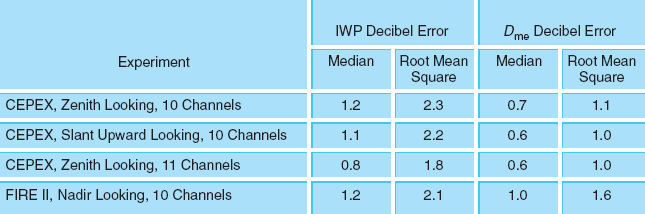
The accuracy of this method has been assessed in computational simulations using the complement of radiometric channel planned for a new airborne instrument, the submillimeter- wavelength cloud ice radiometer (SWCIR) currently being developed by JPL. The instrument will have the capability to make radiometric measurements at ten frequencies spanning from 183 to 643 GHz. The simulations have quantified the accuracy of expected cirrus retrievals and have also quantified improvements that could be expected with the addition of an 880-GHz channel. The table presents selected results from these simulations. These results illustrate the dramatic improvement in accuracy that is achievable with the new analysis technique.
This work was performed by Steven Walter of Caltech (now employed by Aerojet in Azusa, CA), and K. Franklin Evans and Aaron Evans at the University of Colorado for NASA’s Jet Propulsion Laboratory. For further information, access the Technical Support Package (TSP) free on-line at www.nasatech.com/tsp under the Physical Sciences category. NPO-21016
This Brief includes a Technical Support Package (TSP).
New Technique Improves Cirrus Cloud Characterization
(reference NPO-21016) is currently available for download from the TSP library.
Don't have an account?
Overview
The document discusses a novel technique for improving the characterization of cirrus clouds through submillimeter-wave cloud ice radiometry (SWCIR). Developed by a team at NASA's Jet Propulsion Laboratory (JPL), this method enhances the ability to quantify ice content, median crystal size, and crystal shape in cirrus clouds, which are crucial for understanding climate and weather patterns.
Historically, the characterization of cirrus clouds faced limitations due to inaccuracies in previous techniques that did not account for atmospheric water vapor. The foundational work by Evans and Stephens in 1995 introduced the concept of using radiometry to analyze ice clouds, but it lacked the precision needed for effective climate modeling. The new SWCIR technique addresses these shortcomings by incorporating measurements at multiple frequencies, specifically between 183 GHz and 643 GHz, which allows for a more accurate assessment of cloud properties.
The document highlights the results of computational simulations that demonstrate significant improvements in the accuracy of cirrus cloud retrievals. These simulations indicate that the addition of an 880-GHz channel could further enhance the technique's effectiveness. The results show a marked reduction in errors associated with retrieving integrated ice mass (ice water path or IWP) and characteristic ice particle size (median equivalent mass sphere diameter, D_me).
The motivation behind this research stems from the need for quantitative global observations of cloud ice content, which are essential for climate modeling and understanding long-term climate variations. Accurate data on cloud properties can help quantify the impact of clouds on climate and weather, aligning with key objectives of NASA's Earth Science Enterprise research plan.
The document also emphasizes the potential applications of this technique in improving numerical weather prediction, thereby contributing to more reliable weather forecasts. The work was conducted by Steven Walter, K. Franklin Evans, and Aaron Evans, showcasing a collaborative effort between Caltech and the University of Colorado for NASA.
In summary, the document presents a significant advancement in cirrus cloud characterization through the SWCIR technique, which promises to enhance the accuracy of climate models and improve our understanding of atmospheric processes.