

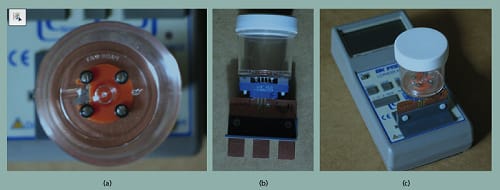
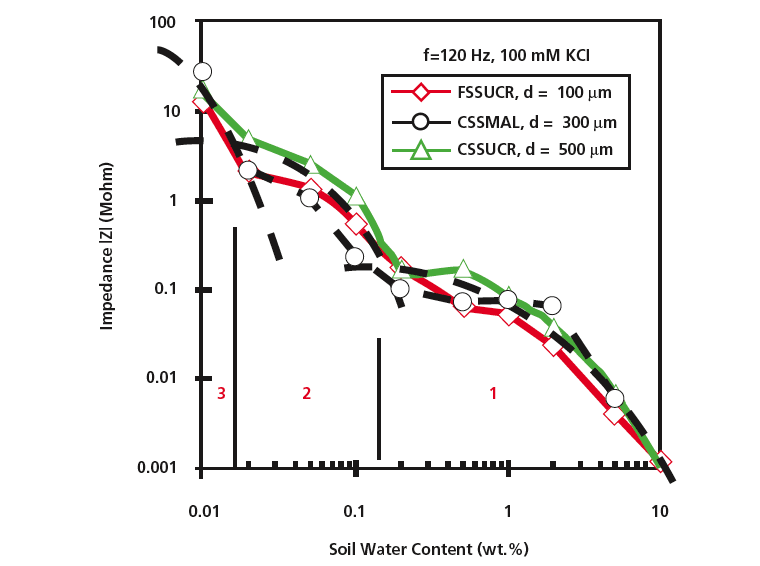
An apparatus has been developed for measuring the low concentrations of liquid water and ice in relatively dry soil samples. Designed as a prototype of instruments for measuring the liquid-water and ice contents of Lunar and Martian soils, the apparatus could also be applied similarly to terrestrial desert soils and sands. The high sensitivity of this apparatus is best appreciated via a comparison: Whereas soil moisture contents of agricultural interest range between 3 and 30 weight percent, this apparatus is capable of measuring moisture contents from 0.01 to 10 weight percent (at room temperature). Moreover, it has been estimated that optimization of the design of the apparatus could enable measurement of moisture contents as low as 1 part per million by weight.
This work was done by Martin Buehler of Caltech for NASA’s Jet Propulsion Laboratory.
In accordance with Public Law 96-517, the contractor has elected to retain title to this invention. Inquiries concerning rights for its commercial use should be addressed to:
Innovative Technology Assets Management
JPL
Mail Stop 202-233
4800 Oak Grove Drive
Pasadena, CA 91109-8099
E-mail:
Refer to NPO-41822, volume and number of this NASA Tech Briefs issue, and the page number.
This Brief includes a Technical Support Package (TSP).
Measuring Low Concentrations of Liquid Water in Soil
(reference NPO-41822) is currently available for download from the TSP library.
Don't have an account?
Overview
The document discusses the measurement of dielectric constants to characterize lunar soils, particularly focusing on the detection of low concentrations of water in the lunar regolith. Authored by researchers from NASA's Jet Propulsion Laboratory and the University of California, Riverside, it highlights the significance of in-situ methods for analyzing lunar materials as part of future lunar exploration missions.
The introduction emphasizes the renewed interest in the Moon, necessitating reliable techniques to assess the lunar regolith's properties. The dielectric constant is a key parameter in this analysis, as it relates to the density and composition of lunar minerals, primarily silicates and oxides. The document presents preliminary results indicating that the dielectric constant can provide insights into the presence of specific minerals, such as titanium and iron, which affect the regolith's composition.
A significant portion of the document is dedicated to the detection of water ice on the Moon, particularly at the poles. Early data from the Lunar Prospector spacecraft suggested the presence of water ice mixed with the regolith at low concentrations (0.3 to 1 percent). However, subsequent research has not definitively proven the existence of water, raising questions about the detectability of water in lunar soils. The dielectric constants of ice and water are discussed, showing that at low frequencies, both have high dielectric constants, but the dielectric constant of ice decreases significantly at higher frequencies.
The document also details experimental results using impedance spectroscopy to measure moisture in coarse silica sand, demonstrating the ability to detect water concentrations as low as 0.001%. This capability is crucial for future lunar missions, where understanding soil moisture could inform resource utilization strategies.
In conclusion, the document advocates for the development of rapid survey techniques, including impedance spectroscopy, electrostatic measurements, and magnetic property assessments, to facilitate efficient in-situ measurements of lunar soils. These methods can be integrated into roving vehicles, allowing for comprehensive analysis during exploration missions. The research underscores the importance of characterizing lunar regolith to support sustainable human presence and resource utilization on the Moon.









