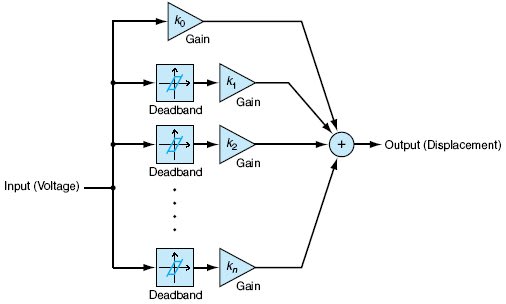
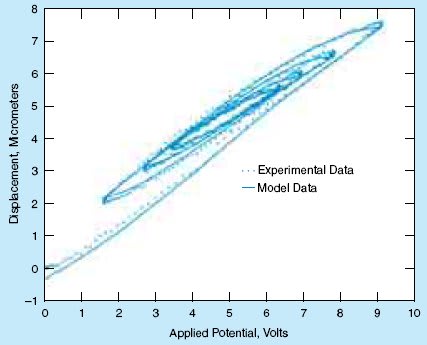
A recently developed mathematical model of the output (displacement) versus the input (applied voltage) of a piezoelectric transducer accounts for hysteresis. For the sake of computational speed, the model is kept simple by neglecting the dynamic behavior of the transducer. Hence, the model applies to static and quasistatic displacements only. A piezoelectric transducer of the type to which the model applies is used as an actuator in a computer-based control sys- tem to effect fine position adjustments. Because the response time of the rest of such a system is usually much greater than that of a piezoelectric transducer, the model remains an acceptably close approximation for the purpose of control computations, even though the dynamics are neglected.
This work was done by Joel Shields of Caltech for NASA's Jet Propulsion Laboratory. For further information, access the Technical Support Package (TSP) free on-line at www.techbriefs.com/tsp under the Physical Sciences category. NPO-30546
This Brief includes a Technical Support Package (TSP).
Efficient Computational Model of Hysteresis
(reference NPO-30546) is currently available for download from the TSP library.
Don't have an account?
Overview
The document provides technical support material for NPO-30546, which is associated with a project or research initiative. It highlights that the copyright for this material has been transferred to the IEEE society, indicating that the content is likely of a technical or engineering nature, suitable for professionals in those fields.
For those seeking additional information or clarification regarding the document, it offers contact details for the Innovative Technology Assets Management team at the Jet Propulsion Laboratory (JPL). This includes a physical mailing address, phone number, and an email address, making it easy for interested parties to reach out for further assistance or inquiries related to the technical support material.
The mention of JPL suggests that the document may be related to aerospace technology or research, as JPL is known for its work in space exploration and technology development. The document serves as a resource for individuals or organizations looking to understand or utilize the technical aspects of NPO-30546, whether for academic, professional, or research purposes.
Overall, the document emphasizes the importance of the technical support material and provides clear avenues for obtaining further information, reflecting a commitment to transparency and accessibility in sharing knowledge related to the project.