

A modified scheme for electron-beam (E-beam) writing used in the fabrication of convex or concave diffraction gratings makes it possible to suppress the ghost diffraction heretofore exhibited by such gratings. Ghost diffraction is a spurious component of diffraction caused by a spurious component of grating periodicity as described below. The ghost diffraction orders appear between the main diffraction orders and are typically more intense than is the diffuse scattering from the grating. At such high intensity, ghost diffraction is the dominant source of degradation of grating performance.
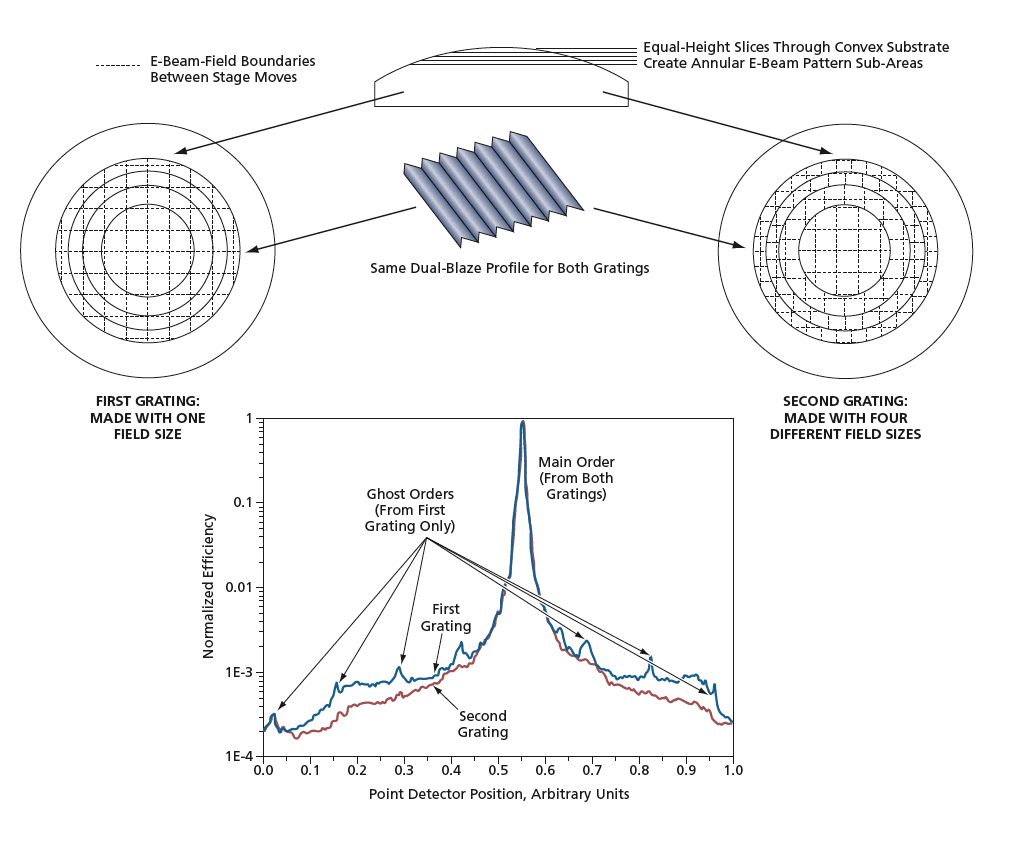
Even though the mechanical stage used to position the substrate can be very accurate (positioning error of ≈ 20 nm or less), field-stitching errors occur, causing underexposures or overexposures that manifest themselves, after development of the resist, as increases or decreases in grating thickness along the field boundaries. Because all the fields are of the same size, the stitching errors form another grating that has a period equal to the field size. Hence, the light scattered from the field boundaries adds coherently: this is ghost diffraction.
The modified scheme for electron-beam writing is based on the concept of reducing the degree of periodicity of the stitching errors. In this scheme, the overall grating area is divided into sub-areas within which the grating patterns are written in differently sized fields. For a typical convex or concave grating, the sub-areas are most easily defined as annular areas that correspond to equal-height slices through the substrate (see figure). Hence, the grating pattern in each annulus is written with a different field size.
The ghost order intensities are proportional to the square of the scattering amplitudes. Hence, if N different field sizes are used, the intensity of ghost diffraction can be expected to be reduced to approximately N–2 times the intensity obtained with a single field size.
To test this concept, two nominally identical gratings were fabricated. The pattern of the first grating was written by stitching together fields of the same size over its entire area, while the pattern of the second grating was established by use of four different field sizes. Whereas the ghost diffraction from the first grating was clearly noticeable, the intensity of ghost diffraction from the second grating was so low as to be undetectable against the diffuse-scattering background.
This work was done by Daniel Wilson and Johan Backlund of Caltech for NASA’s Jet Propulsion Laboratory.
In accordance with Public Law 96-517, the contractor has elected to retain title to this invention. Inquiries concerning rights for its commercial use should be addressed to:
Innovative Technology Assets Management
JPL
Mail Stop 202-233
4800 Oak Grove Drive
Pasadena, CA 91109-8099
(818) 354-2240
E-mail:
Refer to NPO-41302, volume and number of this NASA Tech Briefs issue, and the page number.
This Brief includes a Technical Support Package (TSP).
Suppressing Ghost Diffraction in E- Beam-Written Gratings
(reference NPO-41302) is currently available for download from the TSP library.
Don't have an account?
Overview
The document discusses advancements made by NASA's Jet Propulsion Laboratory (JPL) in suppressing ghost diffraction in E-beam-written gratings, as outlined in Technical Support Package NPO-41302. E-beam lithography is a powerful technique used for fabricating high-precision diffraction optical elements, such as blazed gratings and computer-generated holograms. However, a significant challenge arises from field stitch errors, which occur when the mechanical stage moves to expose areas larger than the E-beam's field size (typically 0.5 to 1.0 mm). These errors lead to unwanted diffraction orders, known as ghost orders, that degrade the performance of the optical elements.
The document details a novel solution to this problem: by reducing the periodicity of field-stitch errors and employing multiple field sizes during the E-beam exposure process. This approach involves dividing the overall grating pattern into sub-areas, each written with different field sizes. For convex or concave gratings, these sub-areas correspond to annular patterns defined by equal-height slices of the substrate surface. By using multiple field sizes, the coherent addition of light scattered from field boundaries is minimized, effectively reducing the intensity of ghost orders.
The effectiveness of this technique was demonstrated by fabricating two identical gratings: one using a single field size and the other employing four different field sizes. Measurements revealed that the ghost order intensities from the second grating were significantly reduced, effectively disappearing below the level of diffuse scattering.
The document emphasizes the novelty of this approach, as previous E-beam fabricated gratings consistently exhibited ghost diffraction orders that were more intense than the diffuse scattering, leading to performance degradation. By utilizing multiple field sizes, JPL has successfully mitigated this issue, allowing for the potential elimination of ghost orders and enhancing the overall efficiency of E-beam fabricated optical elements.
In summary, this work represents a significant advancement in the field of optical fabrication, showcasing JPL's commitment to improving the precision and performance of diffraction optics through innovative techniques in E-beam lithography. The findings have implications for various technological, scientific, and commercial applications, furthering the capabilities of aerospace-related developments.











