

The resonant tunneling spin pump is a proposed semiconductor device that would generate spin-polarized electron currents. The resonant tunneling spin pump would be a purely electrical device in the sense that it would not contain any magnetic material and would not rely on an applied magnetic field. Also, unlike prior sources of spin-polarized electron currents, the proposed device would not depend on a source of circularly polarized light.
The resonant tunneling spin pump would have some features in common with other, similarly named devices, including resonant tunneling spin filters described in a previous NASA Tech Briefs article: "Electron-Spin Filters Based on the Rashba Effect" (NPO- 30635), Vol. 28, No. 10 (October 2004), page 58.
To recapitulate: Proposed semiconductor electron-spin filters would exploit the Rashba effect, which can induce energy splitting in what would otherwise be degenerate quantum states, caused by a spin-orbit interaction in conjunction with a structural- inversion asymmetry in the presence of interfacial electric fields in a semiconductor heterostructure. The magnitude of the energy split is proportional to the electron wave number. Theoretical studies have suggested the possibility of devices in which electron energy states would be split by the Rashba effect and spin-polarized currents would be extracted by resonant quantum-mechanical tunneling.
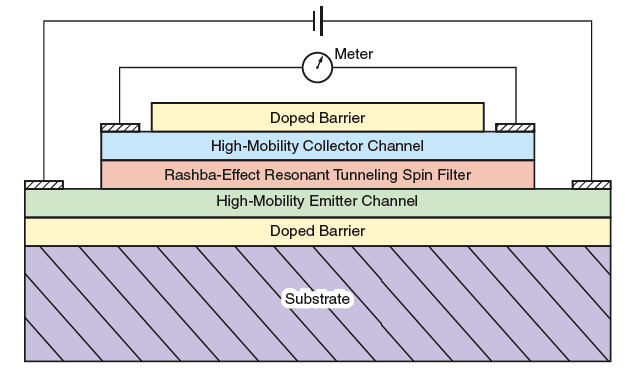
The resonant tunneling spin pump (see figure) would include a spin filter between two reservoirs of initially unpolarized electrons. Like the devices of the cited prior article, the resonant tunneling spin pump would be designed and fabricated in the InAs/GaSb/ AlSb material system. One reservoir would be a high-mobility InAs emitter channel and the other a high-mobility InAs collector channel. The spin filter would comprise an InAs/GaSb/ AlSb asymmetric resonant
tunneling structure.
The application of a lateral electric field in the emitter channel would a cause current of one spin state to flow from the emitter channel to the collector channel and a current of the opposite spin state to flow from the collector channel to the emitter channel, thereby inducing spin polarization in both reservoirs. This mode of operation would differ somewhat from that of a spin filter: In a spin filter, component currents containing spins of both states would flow from the emitter to the collector and spin polarization in the collector would be achieved by choosing the design and the operating conditions of the device to make one of the spin component currents larger than the other.
This work was done by David Z. Ting of Caltech for NASA's Jet Propulsion Laboratory.
This Brief includes a Technical Support Package (TSP).
Resonant Tunneling Spin Pump
(reference NPO-30885) is currently available for download from the TSP library.
Don't have an account?
Overview
The document titled "Resonant Tunneling Spin Pump" (NPO 30885) from NASA's Jet Propulsion Laboratory presents a novel approach to spin polarization in semiconductor devices. The primary motivation behind this development is the inefficiency of non-magnetic semiconductor spin filters, which allow both spin types to flow in the same direction, limiting their effectiveness. The proposed solution is a spin pump device that enables current components of opposite spin types to flow in opposite directions, thereby enhancing spin polarization.
The key innovation lies in the construction of an electron spin-polarizer using semiconductor heterostructures. This method is advantageous as it does not require magnetic materials, magnetic fields, or light sources, making it a purely electrical device. The device operates by placing a spin-filtering structure between two reservoirs of unpolarized electrons. By applying lateral electric fields in one of the reservoirs, the device induces a flow of one spin type from the left reservoir to the right, while the opposite spin type flows in the opposite direction, resulting in spin polarization in both reservoirs.
The document outlines the theoretical underpinnings of the resonant tunneling spin pump concept, supported by calculations indicating a high degree of spin polarization (P_J > 1000). While the size of P_J is noted as important, the document emphasizes that the more relevant metrics are the current density components, which determine the injection rate of spin-polarized carriers into the emitter and collector. High mobility in the channels is crucial for optimal performance, with reported mobilities of InAs channels reaching 25,000 cm²/Vs at 300K and 460,000 cm²/Vs at 4.2K.
The proposed device structures include the aRITD (asymmetric Resonant Interband Tunneling Device) and a triple-barrier spin blockade structure. Preliminary calculations suggest that the device performs better at lower temperatures due to increased mobility, which is essential for achieving fast enough injection of polarized carriers compared to spin relaxation times.
The document concludes with discussions on the experimental realization of the spin pump, indicating collaboration with HRL Laboratories and funding from the DARPA SpinS program. Overall, the resonant tunneling spin pump represents a significant advancement in semiconductor technology with potential applications in various fields, including aerospace.











