

A proposed system for simultaneous characterization of the instability of several precise, low-noise oscillators of nominally equal frequency would be built around a commercially available time-tag counter. One of the oscillators would be deemed to be a reference oscillator, and each of the other oscillators would be compared with it by operation of a combination of hardware and software. In addition, without further modification of the hardware, any two nonreference oscillators could be compared with each other via software.
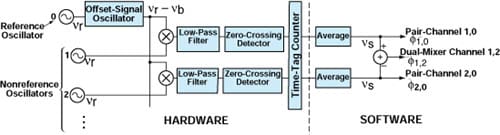
A typical prior dual-mixer stability analyzer utilizes interpolation or extrapolation to convert several incoherent channels of beat-note zero crossings into phase residuals at a predetermined grid of times, so that the residuals of any two channels i and j can be subtracted to give an i-vs.-j comparison. This measurement is contaminated by uncanceled noise from the offset-frequency reference oscillator. The proposed system would take advantage of a modern high-rate time-tag counter to collect zero-crossing times of beat notes, the nominal frequency of which must be much greater than the desired data rate. Then the system would effect a combination of interpolation and averaging to process the time tags into low-rate phase residuals at the desired grid times. The advantage over prior art would be greater cancellation of the reference noise.
The figure schematically depicts the system. The oscillators to be compared would be of nominal frequency nr. The frequency of the reference oscillator would be offset by an amount nb. The offset reference signal would be mixed with the signal from each of the nonreference oscillators, and the mixer outputs would be low-pass filtered, thereby generating beat notes of nominal frequency nb. By use of zero-crossing detectors, the beat notes would be converted to square-wave signals. The time-tag counter would capture the zero-crossing time tags of all the beat notes on a common time axis.
In software, the time tags would be converted to phase residuals that would be averaged over sequential intervals of duration τs. These intervals would be the same for all channels. The averages thus computed would constitute one of the sets of output data of the system. An essential feature of the design is that ts must be much greater than the beat period τb = 1/nb.
Each beat note would yield phase residuals for one pair-channel [e.g., the ith channel, defined with respect to the ith oscillator (a nonreference oscillator) vs. the zeroth oscillator (the reference oscillator)]. Because the averaging intervals would be the same for all pair-channels, the data for two pair channels could be differenced to give a synthesized dual-mixer (i-vs.-j) channel. The ability of this system to suppress the noise of the reference oscillator would depend on the relation τs >> τb.
This work was done by Charles Greenhall of Caltech for NASA's Jet Propulsion Laboratory. For further information, access the Technical Support Package (TSP) free on-line at www.nasatech.com/tsp under the Electronics & Computers category.
NPO-20749
This Brief includes a Technical Support Package (TSP).
Oscillator-Stability Analyzer Based on a Time-Tag Counter
(reference NPO-20749) is currently available for download from the TSP library.
Don't have an account?
Overview
The document is a technical support package from NASA, specifically a NASA Tech Brief, detailing an innovative system for comparing the stability of low-noise oscillators. Authored by Charles A. Greenhall, the report outlines a proposed multichannel dual-mixer system designed to facilitate precise measurements of frequency stability.
The system utilizes a Guide Technology GT659 PC card capable of collecting timestamps with 20 ns resolution across 16 simultaneous channels. Each channel can be independently configured for trigger conditions, allowing for flexible data collection. The timestamps are represented as double-precision IEEE floating-point numbers, enabling a measurement range of up to 5.7 years with full precision.
The proposed operation involves comparing multiple frequency sources against a distinguished reference frequency. The document emphasizes the importance of maintaining a significant difference between the reference frequency and the desired maximum sample rate to ensure accurate data collection. The system divides the time axis into intervals, allowing for the collection of zero-crossing time and amplitude data, which is crucial for calculating phase residuals relative to an ideal beat note.
Additionally, the document discusses the compatibility of the proposed design with existing auxiliary data collection methods, such as frequency measurements using an HP-5334A/B interval counter. It highlights the sensitivity of the measurements, which can be adjusted based on the output of the counter, ensuring that the system can effectively handle the shorter beat notes proposed.
The report also includes a disclaimer stating that references to specific commercial products do not imply endorsement by the U.S. Government or the Jet Propulsion Laboratory. It clarifies that the work was conducted under contract with NASA and emphasizes the potential utility of the system for anyone needing to compare low-noise oscillators.
Overall, the document presents a comprehensive overview of a sophisticated measurement system that leverages advanced technology to enhance the accuracy and efficiency of oscillator stability comparisons, marking a significant advancement in the field of precision time and frequency measurement.











