Lightweight, low-power-consumption, inexpensive ozone sensors based on colorimetric chemical sensing would be developed, according to a proposal. Colorimetric chemical sensing is an established technique, but it has not been applied previously to sensing of ozone. The proposed ozone sensors could be incorporated into radiosondes for measuring tropospheric and stratospheric ozone concentrations; they could also be used to monitor ozone in a variety of indoor and outdoor environments near such ozone sources as electric-arc welding equipment, high-voltage laboratory instruments, photocopiers, laser printers, and electrostatic air cleaners.
A = αlc = ln(I/I0),
where A is the change in absorbance, a is the dosage-dependent change in the absorption coefficient of the dye, l is the thickness of the layer that contains the dye, c is the concentration of the dye in the layer, I0 is the intensity of transmitted light before exposure to ozone, and I is the intensity of transmitted light after exposure to ozone.
An ozone sensor should operate without interference by oxidizing substances other than ozone (e.g., halogens, SO2, and NO2). Therefore, the dye should be either one that does not exhibit color changes in the presence of the other substances, or else one for which the color change induced by ozone differs measurably from the color change(s) induced by the other substances. A promising dye of the latter type is chlorophyllin — a copper-containing, water-soluble derivative of chlorophyll.
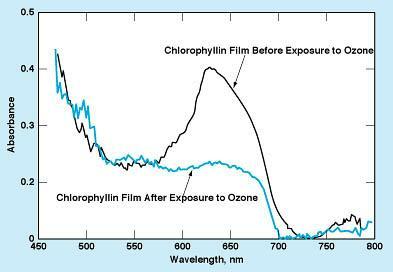
Chlorophyllin exhibits an absorption peak at a wavelength of 630 nm. This peak diminishes in proportion to the degree of reaction (see figure), making it possible to quantify the ozone dosage via the Beer-Lambert law. In addition, the product of ozonolysis of an ethylene group on the chlorophyllin molecule gives rise to a smaller absorption peak at 500 nm; the corresponding absorption peaks induced by other oxidizing species occur at different wavelengths. Thus, one could use the 500-nm peak to verify that the observed color change was caused by ozone or, alternatively, one could identify the oxidizing species by measuring the different wavelength of this peak.
Because the color change would be irreversible and proportional to the cumulative exposure to ozone, a sensor of this type would be a dosimeter (as distinguished from a concentration meter). However, it may be possible to determine the instantaneous concentration of ozone from the rate of change of the absorbance.
This work was done by Margie Homer, Margaret A. Ryan, and Roger Williams of Caltech for NASA's Jet Propulsion Laboratory. For further information, access the Technical Support Package (TSP) free on-line at www.nasatech.com/tsp under the Physical Sciences category. NPO-20469
This Brief includes a Technical Support Package (TSP).
Lightweight, low-power, inexpensive ozone dosimeters
(reference NPO-20469) is currently available for download from the TSP library.
Don't have an account?
Overview
The document presents a technical support package from NASA detailing the development of lightweight, low-power, and inexpensive ozone dosimeters. The project, associated with NASA's Jet Propulsion Laboratory (JPL), is led by inventors Margie L. Homer, Margaret A. Ryan, and Roger M. Williams. The primary focus is on creating a novel calorimetric in situ ozone sensor that utilizes an organic dye and a low-power light source and detector.
The innovative aspect of this ozone sensor lies in its ability to detect ozone through a color change mechanism. While calorimetric chemical sensing is not a new concept, the application of a modified chromophore dye that absorbs light at different wavelengths specifically for ozone detection is a significant advancement. Traditional ozone sensors often face interference from other oxidizing compounds, such as nitrogen dioxide (NO2) and sulfur dioxide (SO2). The proposed sensor aims to overcome this limitation by monitoring the absorption wavelength shift of the modified dye, allowing for the identification of the specific oxidizing species responsible for the reaction.
The motivation behind this development stems from the Mars Oxidation Experiment (MOx), which required a thin film that could be optically monitored to sense ozone. The solution involved selecting an organic film with a chromophore that changes color and index of refraction upon exposure to ozone, thus providing a reliable method for ozone detection.
The document also outlines the technical specifications of the sensors, which weigh approximately 1 kg and cost around $500 each. They are designed to be connected to radiosondes for data transmission from weather balloons, which are not recovered after flight. This highlights the need for a low-cost, lightweight ozone sensor that can operate for several hours on battery power.
Additionally, the document includes disclaimers regarding the endorsement of specific commercial products and the limitations of the information provided. It emphasizes that the work was conducted under contract with NASA and does not imply any warranty or liability regarding the use of the disclosed methods or processes.
In summary, this document outlines a significant advancement in ozone sensing technology, addressing the challenges of existing sensors and providing a practical solution for atmospheric monitoring applications.