

A program of research and development is addressing the feasibility of using magnetoplasmadynamic (MPD) sources in the chemical vapor deposition (CVD) of synthetic diamond films. Because of its unique combination of thermal, electronic, mechanical, and chemical properties, diamond has potential for use as a coating material in numerous engineering and scientific applications.
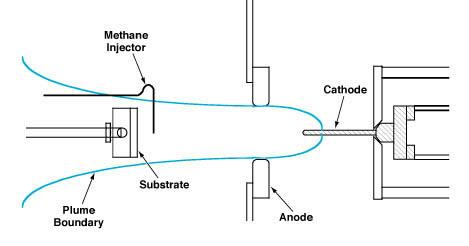
A large amount of research has been directed toward understanding and developing CVD process (including plasma-assisted CVD process) for the synthesis of diamond and diamondlike materials. The plasma-assisted CVD processes include some that involve dc-arcjet sources; the development of these processes has benefitted from extensive prior research on dc-arcjet thrusters for spacecraft. Rates of deposition that have been achieved by use of dc-arcjet sources have exceeded those achieved by use of other gas-activation sources.
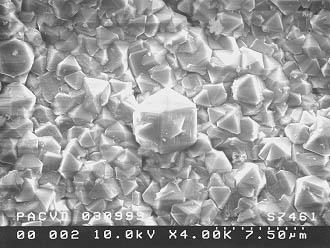
The success of the dc-arcjet approach has led to speculation on the utility of other thruster-type plasma sources for CVD of diamond. There is a large body of data from previous research on the performance and plume characteristics of electric propulsion devices; these data are available to support continuing efforts to understand the reaction kinetics and growth chemistry of diamond. One logical extension of the prior research would be an assessment of electric thrusters, other than dc-arcjet thrusters, for their potential to increase rates of deposition even further. MPD thrusters are among those that could be considered.
Regarded as thrusters, MPD sources have been found to perform with low efficiency at power levels below a hundred kilowatts. However, some characteristics of the discharges and plumes from MPD sources indicate that these sources might be well suited to synthesis and deposition of diamond at rates higher and over areas larger than those achievable by use of dc-arcjet sources; the characteristics of particular relevance in this regard are higher levels of dissociation and ionization of gas in the cores of the plasma plumes, higher jet velocities, and the scaleability to higher power levels.
- Parametric sensitivity (effects of discharge power, gas mixture, substrate biasing, and background pressure on substrate temperature, film quality, area of deposition, and rate of deposition);
- Properties of the plasma plume (e.g., mean gas velocity, pressure, and temperature);
- The degree of pyrolysis of methane (assessed by means of spectroscopy of visible emission lines of C, H, and CH), in comparison with corresponding published information for arcjets;
- Gas-phase and surface chemistry (modeled computationally with the help of experimental and published data).
This work was done by James Polk, John Blandino, and David Goodwin of Caltech for NASA's Jet Propulsion Laboratory. For further information, access the Technical Support Package (TSP) free on-line at www.nasatech.com/tsp under the Materials category.
In accordance with Public Law 96-517, the contractor has elected to retain title to this invention. Inquiries concerning rights for its commercial use should be addressed to
Technology Reporting Office
JPL
Mail Stop 122-116
4800 Oak Grove Drive
Pasadena, CA 91109
(818) 354-2240
Refer to NPO-20668, volume and number of this NASA Tech Briefs issue, and the page number
This Brief includes a Technical Support Package (TSP).
CVD of Diamond Using Magnetoplasmadynamic Sources
(reference NPO-20668) is currently available for download from the TSP library.
Don't have an account?
Overview
The document is a technical support package detailing research on the chemical vapor deposition (CVD) of diamond using magnetoplasmadynamic (MPD) sources, conducted by James E. Polk, John J. Blandino, and David G. Goodwin at the Jet Propulsion Laboratory (JPL) for NASA. The primary objective of the research is to evaluate the feasibility of the MPD-assisted CVD process and compare it with existing dc-arcjet-assisted methods, which are currently the state-of-the-art in diamond synthesis.
The study focuses on several key areas, including parametric sensitivity, plume properties, and gas-phase and surface chemistry. The researchers aim to investigate how various factors—such as discharge power, gas mixture, substrate biasing, and background pressure—affect substrate temperature, film quality, area of deposition, and deposition rate. This involves a combination of experimental and computational analyses to assess the process's effectiveness and to gather data on gas species in the plasma plume.
The experimental setup includes a thoriated tungsten cathode mounted on a water-cooled electrode, with a ring-shaped anode and a methane gas injector. The substrate for diamond film growth is a removable molybdenum disk, and the chamber is equipped with optical access for diagnostics, including emission spectroscopy and temperature measurements.
The document outlines proposed tasks for the research, which include demonstrating the growth of diamond films using the MPD system and determining the sensitivity of the process to various parameters. Additionally, the researchers plan to estimate the hydrodynamic characteristics of the plasma plume, such as mean gas velocity, pressure, and temperature, to model the gas and surface chemistry effectively.
The work is significant as it aims to develop a plasma-assisted CVD process that achieves higher growth rates and comparable quality to arcjet methods. The findings could have broad implications for the production of diamond materials, which are valued for their unique properties and applications in various industries.
Overall, this research represents a step forward in the quest for efficient and high-quality diamond synthesis, leveraging advanced plasma technology to enhance material processing capabilities. The document also includes a disclaimer regarding the endorsement of specific products or processes by the U.S. Government or NASA.











