Combinatorial experiments have led to the discovery that a nanophase alloy of Pt, Ru, Ni, and Zr is effective as an anode catalyst material for direct methanol fuel cells. This discovery has practical significance in that the electronic current densities achievable by use of this alloy are comparable or larger than those obtained by use of prior Pt/Ru catalyst alloys containing greater amounts of Pt. Heretofore, the high cost of Pt has impeded the commercialization of direct methanol fuel cells. By making it possible to obtain a given level of performance at reduced Pt content (and, hence, lower cost), the discovery may lead to reduction of the economic impediment to commercialization.
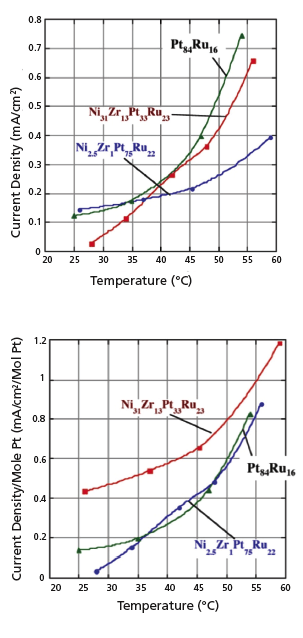
The electrochemical performances of the alloys were tested using both cyclic voltammetry and potentiostatic current measurements. The most promising Pt/Ru/Ni/Zr alloy had a composition of Pt33Ru23Ni30Zr13. Comparative potentiostatic tests of Pt33Ru23Ni30Zr13 and an optimized, state-of-art Pt84Ru16 catalysts were performed (in a solution of 1M methanol + 1M sulfuric acid at temperatures ranging from 25 to 60 °C). The results of these tests, plotted in the figure, show that the current density [after 5 minutes at 0.7 V vs. NHE (normal hydrogen electrode)] for Pt33Ru23Ni30Zr13 met (as normalized to test structure area), or exceeded (if normalized to surface Pt atoms), the current densities of the state-of-art Pt-Ru under the same test conditions. These data indicate that the new quaternary alloy induced a significantly higher Pt surface site utilization.
X-ray photoelectron spectroscopy data indicate that the Pt electron structure in the quaternary material was also very different from that observed in the Pt-Ru alloys.
This work was done by Sekharipuram Narayanan and Jay Whitacre of Caltech for NASA's Jet Propulsion Laboratory. For more information, download the Technical Support Package (free white paper) at www.techbriefs. com/tsp under the Materials category. In accordance with Public Law 96-517, the contractor has elected to retain title to this invention. Inquiries concerning rights for its commercial use should be addressed to: Innovative Technology Assets Management
JPL
Mail Stop 202-233
4800 Oak Grove Drive
Pasadena, CA 91109-8099
(818) 354-2240
E-mail:
Refer to NPO-40841, volume and number of this NASA Tech Briefs issue, and the page number.
This Brief includes a Technical Support Package (TSP).
Low-Pt-Content Anode Catalyst for Direct Methanol Fuel Cells
(reference NPO-40841) is currently available for download from the TSP library.
Don't have an account?
Overview
The document discusses research conducted at NASA's Jet Propulsion Laboratory (JPL) on a Low-Pt-Content Anode Catalyst for Direct Methanol Fuel Cells (DMFCs). The primary goal of this research is to improve the efficiency and power density of DMFCs while reducing the reliance on precious metals, which are costly and can limit the scalability of fuel cell technologies.
The study highlights the current state of DMFCs, which have a fuel-to-electric efficiency of about 22% and a power density of approximately 15 W/kg. The researchers aim to double the power density and increase efficiency to 35-40%, which would significantly reduce the size of existing systems, making them more viable for portable applications.
To achieve these goals, the team employed a combinatorial materials fabrication and selection process, leading to the development of a novel nanophase alloy system composed of platinum (Pt), ruthenium (Ru), nickel (Ni), and zirconium (Zr). The catalyst films were synthesized by sputter-depositing onto graphite carbon substrates and carbon Toray paper, allowing for systematic compositional variation across a 7-cm wide substrate.
The document presents findings from diffraction data indicating that the average grain sizes in the films were no larger than 5 nm, with some samples exhibiting even smaller sizes. The electrochemical performance of the materials was evaluated using cyclic voltammetry and potentiostatic tests, revealing that certain samples produced significant currents in the common DMFC bias range of 0.4 to 0.6 V. Notably, Sample 4, with a composition of Pt₃₈Ru₄₂Ni₂₁Zr₉, demonstrated a remarkable increase in current delivered per unit area compared to other samples.
The results suggest that the films contained one or two phases of nanocrystalline materials, with samples 1-3 potentially sharing a similar phase, while samples 4-6 exhibited another. The document emphasizes the importance of these findings in the context of developing more efficient and cost-effective fuel cell systems.
In conclusion, this research represents a significant step toward enhancing the performance of DMFCs through innovative catalyst materials, which could lead to more sustainable energy solutions in the future. The ongoing examination of these materials aims to further refine their properties and performance in practical applications.