

An improved method of analysis and design offers the potential to enhance the performances of adaptive feedforward tracking systems. The method can, in principle, make it possible to increase such performance measures as rates of convergence and noise-cancellation ratios, without need for additional hardware. The method is applicable to communication systems, adaptive equalizers, adaptive systems for canceling noise from machinery, advanced vibration-suppressing systems, and echo-canceling systems. The method is particularly significant for overparameterized adaptive feedforward systems, which are very important in practice; they are used to ensure high-performance "tuning" of key signals in a wide range of terrestrial and outer-space applications, including the ones listed above.
It is necessary to explain some mathematical terms as a prerequisite to a summary of the improved method. In some respects, this explanation resembles the one in the preceding article, "LTI Approach to Adaptive Narrow-Band Feedforward Control" (NPO-20184); however, there are some differences, making it necessary to give a separate explanation here.
As before, one seeks to obtain an estimate, ŷ of some signal y(t), where (t) signifies dependence on time. One constructs ŷ as a linear combination of the elements of a regressor vector x(t); namely, ŷ = w(t)Tx(t), where T denotes the matrix transpose and w(t) is an N-dimensional parameter vector that is "tuned" in real time via an adaptation algorithm, the basic equation of which is described below. The regressor vector is given by x = Xc(t), where X is an N-by-nmatrix and c(t) is as described below. A system of the type to which the present analysis applies is one for which N > n; this is what is meant by "overparameterized" in the present context.
One constructs a suitable stable time-domain filter operator F(p), where p denotes the differential operator (replacing the Laplace s for all time-domain interpretations). The regressor vector x is filtered through F(p) to obtain x̃. The filtering operation is represented by
x̃= F(p)[x].
The basic equation of the adaptation algorithm is
w = µΓ(p)[x̃(t)e(t)],
where µ > 0 is an adaptation gain, e(t) is an error signal, Γ(p)[·] denotes a filtering operation in the same way that F(p)[·] above denotes a filtering operation, and Γ(p) is a multivariable LTI transfer function of the designer's choosing, representing the desired adaptation law.
The vector c(t) is not the same as in the preceding article. Instead, c(t) in this case is an n-dimensional vector of piecewise-continuous signals that satisfies a condition called the "persistent excitation" (PE) condition, defined as follows: Let there be positive constants β1, β2, and T0, and a suitably dimensioned identity matrix, I, such that

for all t >. If any signal vector c(t) satisfies these criteria, it is said to be persistently exciting (PE) with bounds {β1,β2,T0}. This completes the explanation of terms.
In the theoretical analysis on which the improved method is based, attention is focused on two matrix products; the confluence matrix (defined as XTX) and the autocorrelation matrix (defined as XXT). This analysis reveals that the older methods based on the autocorrelation matrix and associated PE conditions are overly stringent for ensuring exponential convergence of the tracking error in an overparameterized adaptive feedforward system. Indeed, when an adaptive system is overparameterized, the PE condition is never satisfied, and therefore the older methods do not provide any clue as to the performance of the final adaptive design, much less provide guidelines on how to improve performance.
The analysis reveals, further, that if the confluence matrix is positive definite, then the adaptive feedforward operator H from the error e to the estimate is input-output equivalent to an adaptive system with a PE regressor; this implies that the tracking-error convergence is exponential for a large class of overparameterized adaptive feedforward systems. Thus, the positive-definiteness condition for the confluence matrix, which is easily satisfied, supplants the positive-definiteness condition for the autocorrelation matrix, and thus constitutes the theoretical basis of the improved method. The analysis also shows that the only penalties for overparameterization are that (1) the optimal exponential rate of convergence of tracking error is degraded by the condition number of the confluence matrix and (2) the parameter errors converge exponentially on a reduced subspace rather than over the entire space.
This work was done by David S. Bayard of Caltech for NASA's Jet Propulsion Laboratory. For further information, access the Technical Support Package (TSP) free on-line at www.techbriefs.com under the Mathematics and Information Sciences category, or circle no. 120 on the TSP Order Card in this issue to receive a copy by mail ($5 charge). NPO-20183
This Brief includes a Technical Support Package (TSP).
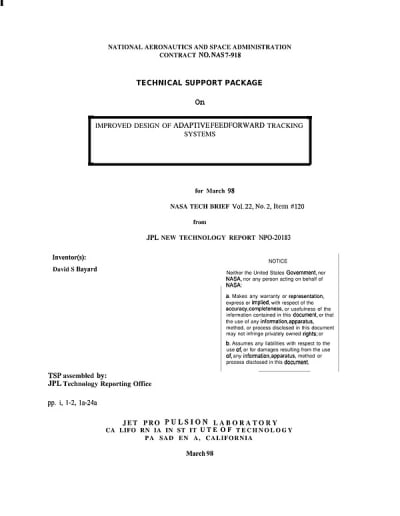
Improved design of adaptive feedforward tracking systems
(reference NPO20183) is currently available for download from the TSP library.
Don't have an account?
Overview
The document titled "Improved Design of Adaptive Feedforward Tracking Systems" is a technical support package from NASA, specifically from the Jet Propulsion Laboratory (JPL). It outlines a novel method for analyzing and designing adaptive feedforward tracking systems, which are crucial in various applications, including communication systems, adaptive equalizers, noise cancellation, vibration suppression, and echo cancellation.
The primary focus of the document is on enhancing the performance of these systems, particularly in terms of convergence rates and noise-cancellation ratios, without requiring additional hardware. This is particularly significant for over-parameterized adaptive feedforward systems, which are essential for achieving high-performance tuning of key signals in both terrestrial and outer-space applications.
The document begins by establishing the need for a mathematical foundation to understand the improved method. It references previous work, specifically an article titled “LTI Approach to Adaptive Narrow-Band Feedforward Control,” while noting that the current method has distinct differences that warrant a separate explanation.
One of the key contributions of this work is the insight it provides into the convergence properties of adaptive feedforward systems. The method offers systematic guidelines for optimizing adaptive designs, especially in cases where systems are over-parameterized. This optimization is crucial for ensuring that these systems can effectively adapt to varying conditions and maintain high performance.
The document also includes mathematical formulations and proofs, such as the optimization of certain parameters to achieve the fastest convergence rates. These technical details are essential for practitioners and researchers in the field, as they provide a framework for implementing the improved method in real-world applications.
Overall, the document serves as a comprehensive resource for understanding the advancements in adaptive feedforward tracking systems. It highlights the potential for improved performance in various applications, emphasizing the importance of mathematical analysis in developing effective adaptive control strategies. The insights gained from this research are expected to have significant implications for future developments in adaptive systems, particularly in high-stakes environments like space exploration and advanced communication technologies.











