

A humidity interlock has been developed to prevent damage that could be caused by condensation of water on a delicate and expensive laser crystal that must be maintained at a temperature below ambient during operation. The humidity interlock is installed in conjunction with the laser temperature controller system. Whenever the humidity inside the laser housing rises beyond a safe level, the humidity interlock turns off power to a thermoelectric cooler on which the laser crystal is mounted.
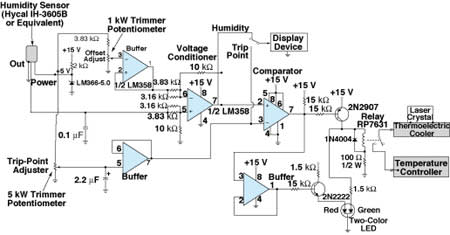
The humidity interlock (see figure) consists of (1) a small, inexpensive, commercially available humidity sensor placed inside the laser housing, and (2) a control circuit. The sensor generates a voltage proportional to the local humidity. The sensor output is fed into a conditioning amplifier for conversion into a voltage indicative of the percent relative humidity (RH%). The RH% voltage is compared with a voltage representative of low RH% that is considered acceptable for safe operation of the laser and is designated the trip point. A technician can adjust the trip point by use of a potentiometer in the circuit.
When the RH% inside the housing is below the trip point, a comparator in the circuit activates a relay that closes a switch through which current flows to the thermoelectric cooler. When the RH% is above the trip point, the relay switch remains open, disabling the cooler.
Included in the interlock circuit is a two-color light-emitting diode (LED) that shines red or green, depending on whether the humidity is above or below the trip point, respectively. There is also a front-panel display device that indicates either the RH% or the trip point. The circuit includes an override switch that enables the cooler to operate when the humidity exceeds the trip point.
This work was done by Carlos Esproles of Caltech for NASA's Jet Propulsion Laboratory. For further information, access the Technical Support Package (TSP) free on-line at www.nasatech.com/tsp under the Electronics & Computers category.
NPO-20901
This Brief includes a Technical Support Package (TSP).
Humidity Interlock for Protecting a Cooled Laser Crystal
(reference NPO-20901) is currently available for download from the TSP library.
Don't have an account?
Overview
The document outlines a technical support package for a humidity interlock system designed to protect cooled laser crystals, developed by Carlos Esproles at NASA's Jet Propulsion Laboratory (JPL). The primary focus of this innovation is to prevent damage to laser crystals caused by condensation, which can occur when humidity levels are not adequately controlled.
In typical coded crystal laser devices, operators must manually ensure that the environment is dehumidified to minimum levels before engaging the laser. This process requires conscious effort and periodic monitoring of environmental humidity, which can be cumbersome and prone to human error. The humidity interlock system addresses these challenges by automating the monitoring and control of humidity levels.
The system incorporates a 4 x 9 mm humidity sensor installed inside the laser housing. This sensor continuously monitors the humidity levels around the laser crystal. If the humidity exceeds a predetermined threshold, the interlock system automatically disables the thermoelectric cooler, thereby preventing the potential for condensation on the crystal. This proactive approach not only protects the laser crystal but also enhances the reliability and efficiency of laser operations.
The document also includes a disclaimer stating that neither the United States Government nor NASA makes any warranties regarding the accuracy or completeness of the information contained within. It emphasizes that the work was conducted under contract with NASA and does not endorse any specific commercial products or services.
Overall, the humidity interlock system represents a significant advancement in laser technology, providing a reliable solution to a common problem faced by operators of laser systems. By automating humidity control, it reduces the risk of damage to sensitive components, thereby improving the longevity and performance of laser devices. This innovation is particularly relevant for applications where precision and reliability are critical, such as in scientific research and aerospace technology.
In summary, the document presents a novel solution to humidity management in laser systems, highlighting its importance in maintaining optimal operating conditions and preventing costly damage to laser crystals.











