

Proposed modifications of an offset quadri-phase-shift keying (offset-QPSK) transmitter and receiver would reduce the amount of signal processing that must be done in the receiver to resolve the QPSK fourfold phase ambiguity. Resolution of the phase ambiguity is necessary in order to synchronize, with the received carrier signal, the signal generated by a local oscillator in a carrier-tracking loop in the receiver. Without resolution of the fourfold phase ambiguity, the loop could lock to any of four possible phase points, only one of which has the proper phase relationship with the carrier.
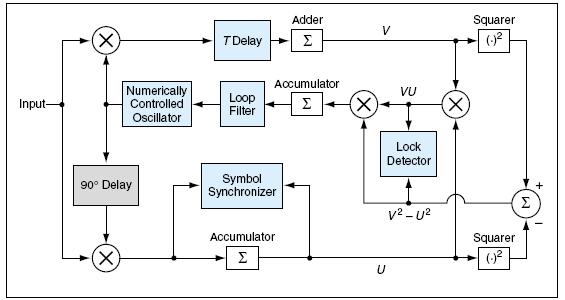
The proposal applies, more specifically, to an offset-QPSK receiver that contains a carrier-tracking loop like that shown in Figure 1. This carrier tracking loop does not resolve or reduce the phase ambiguity. A carrier tracking loop of a different design optimized for the reception of offset QPSK could reduce the phase ambiguity from fourfold to twofold, but would be more complex. Alternatively, one could resolve the fourfold phase ambiguity by use of differential coding in the transmitter, at a cost of reduced power efficiency. The proposed modifications would make it possible to reduce the fourfold phase ambiguity to twofold, with no loss in power efficiency and only relatively simple additional signal processing steps in the transmitter and receiver. The twofold phase ambiguity would then be resolved by use of a unique synchronization word, as is commonly done in binary phase-shift keying (BPSK).
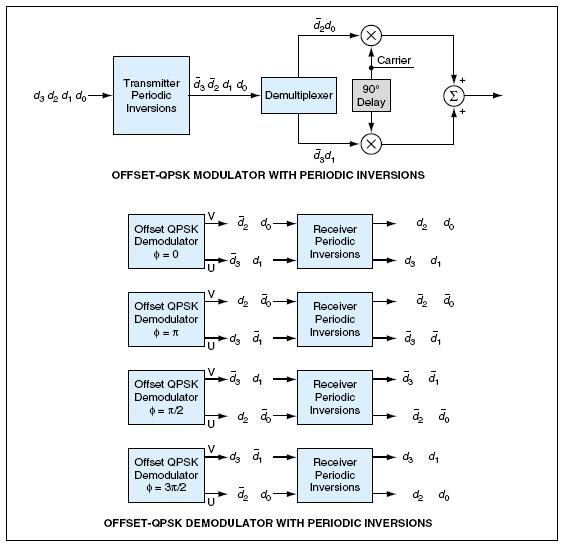
Although the mathematical and signal- processing principles underlying the modifications are too complex to explain in detail here, the modifications themselves would be relatively simple and are best described with the help of simple block diagrams (see Figure 2). In the transmitter, one would add a unit that would periodically invert bits going into the QPSK modulator; in the receiver, one would add a unit that would effect different but corresponding inversions of bits coming out of the QPSK demodulator. The net effect of all the inversions would be that depending on which lock point the carrier- tracking loop had selected, all the output bits would be either inverted or non-inverted together; hence, the ambiguity would be reduced from fourfold to twofold, as desired.
This work was done by Jeff Berner and Peter Kinman of Caltech for NASA's Jet Propulsion Laboratory. For further information, access the Technical Support Package (TSP) free on-line at www.techbriefs.com/tsp under the Electronics/Computers category.
NPO-30384
This Brief includes a Technical Support Package (TSP).

Reduction of Phase Ambiguity in an Offset-QPSK Receiver
(reference NPO-30384) is currently available for download from the TSP library.
Don't have an account?
Overview
The document titled "Reduction of Phase Ambiguity in an Offset-QPSK Receiver" from NASA's Jet Propulsion Laboratory discusses a novel approach to address the fourfold phase ambiguity encountered in offset-quadrature phase-shift keying (offset-QPSK) receivers. This ambiguity arises during the synchronization of the received carrier signal with the local oscillator in the carrier-tracking loop, which can lock onto any of four possible phase points, complicating signal detection.
The proposed solution involves modifications to both the transmitter and receiver that simplify the signal processing required to resolve this ambiguity. Specifically, the authors suggest introducing periodic bit inversions in the transmitter and corresponding adjustments in the receiver. This method effectively reduces the fourfold phase ambiguity to a twofold ambiguity, which is easier to resolve and can be achieved without sacrificing power efficiency.
The document highlights that while traditional methods for resolving phase ambiguity often involve complex designs or result in reduced power efficiency, the proposed modifications are relatively simple and can be implemented with minimal additional processing steps. The twofold phase ambiguity can then be resolved using a unique synchronization word, similar to techniques used in binary phase-shift keying (BPSK).
The authors emphasize that the mathematical and signal-processing principles behind these modifications are complex, but the practical implementation is straightforward. The document includes references to figures that illustrate the carrier-tracking loop design and the bit inversion process, aiding in the understanding of the proposed system.
Overall, this work represents a significant advancement in the field of telecommunications, particularly for applications in deep space telemetry, where efficient and reliable signal processing is crucial. The findings are expected to have broader technological, scientific, and commercial implications, contributing to the ongoing development of aerospace-related technologies.
The document serves as a technical support package under NASA's Commercial Technology Program, aiming to disseminate aerospace-related developments with potential wider applications. It also provides contact information for further assistance and access to additional resources from NASA's Scientific and Technical Information Program Office.











