Recently, there has been a considerable effort to study the Casimir and van der Waals forces, enabled by the improved ability to measure small forces near surfaces. Because of the continuously growing role of micro- and nano-mechanical devices, the focus of this activity has shifted towards the ability to control these forces. Possible approaches to manipulating the Casimir force include development of composite materials, engineered nanostructures, mixed-phase materials, or active elements. So far, practical success has been limited. The role of geometrical factors in the Casimir force is significant. It is known, for example, that the Casimir force between two spherical shells enclosed one into the other is repulsive instead of normal attractive. Unfortunately, nanosurfaces with this topology are very difficult to make.
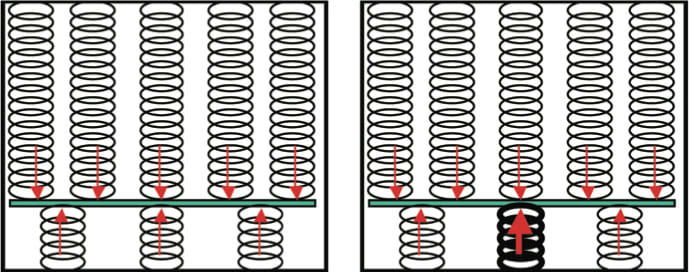
A more direct approach to manipulating and neutralizing the Casimir force is using external mechanical or electromagnetic forces. Unfortunately, the technological overhead of such an approach is quite large. Using electromagnetic compensation instead of mechanical will considerably reduce this overhead and at the same time provide the degree of control over the Casimir force that mechanical springs cannot provide. A mechanical analog behind Casimir forces is shown in the figure.
WGM (whispering gallery mode) resonators play an important role in modem optics and photonics because of their high quality factor and strong field localization. The optical field in such resonators is localized near the surface, resulting in a strong evanescent field. A new method takes advantage of the evanescent field of optical WGMs and utilizes them to control the Casimir force at a metal-dielectric interface. The main novelty of the approach lies in combination of state-of-the-art techniques for measuring the Casimir force with the optical WGM microresonators. The WGM resonators shaped as microspheres will be used. The evanescent field emerging from the microresonator surface will enable the desired capability of manipulating, neutralizing, and reversing the Casimir force.
In real MEMS (microelectromechanical system) applications, it may or may not be possible to utilize the optical evanescent field technique. The proposed approach relies on modification of the electromagnetic energy density in a vacuum gap, rather than on modification of material properties or of the microdevice shape. The advantage of this approach is that the new knowledge and techniques developed in its framework will be applicable to a much broader class of MEMS affected by Casimir force, in particular to those of practical importance. The optical evanescent field is just one example of various surface excitations that can modify the energy density in small gaps, therefore changing the Casimir forces. As another example, forces can be mediated by exciting surface plasmons instead of the evanescent field photons. Therefore, it will be possible to directly apply these theoretical results and experimental techniques to realistic metallic or silicon MEMS.
This work was done by Dmitry V. Strekalov and Nan Yu of Caltech for NASA’s Jet Propulsion Laboratory. For more information, download the Technical Support Package (free white paper) at www.techbriefs.com/tsp under the Physical Sciences category. NPO-46672
This Brief includes a Technical Support Package (TSP).
Optical Modification of Casimir Forces for Improved Function of Micro- and Nano- Scale Devices
(reference NPO-46672) is currently available for download from the TSP library.
Don't have an account?
Overview
The document titled "Optical Modification of Casimir Forces for Improved Function of Micro- and Nano-Scale Devices" is a technical support package from NASA's Jet Propulsion Laboratory (JPL). It discusses the challenges posed by adhesive forces, particularly the van der Waals and Casimir forces, in the design and functionality of micro- and nano-scale devices. As these devices shrink in size, the impact of such forces becomes more pronounced, necessitating innovative solutions to mitigate their effects.
The Casimir force arises from quantum fluctuations in the vacuum between closely spaced surfaces, leading to an attractive force that can hinder the performance of micro- and nano-mechanical systems. The document emphasizes that while some adhesive forces can be reduced through engineering, the fundamental nature of the Casimir force makes it particularly challenging to eliminate entirely.
To address this issue, the research presented in the document explores the use of optical methods to modify Casimir forces. By employing high-Q optical resonators and evanescent fields, it is possible to achieve significant control over these forces, even with low optical pump power. The document provides a detailed analysis of the evanescent field intensity and its relationship to the circulating optical power within the resonator. It estimates that an average intensity sufficient to neutralize the Casimir force can be achieved with as little as 0.2 nW of optical pump power, demonstrating the potential for effective manipulation of these forces.
The findings suggest that by harnessing optical techniques, researchers can create new designs for nanomechanical devices that balance the challenges posed by adhesive forces. This could lead to advancements in various applications, including sensors, actuators, and other micro/nano-scale technologies.
Overall, the document highlights the importance of understanding and controlling Casimir forces in the development of next-generation devices. It serves as a resource for researchers and engineers interested in the intersection of optics and nanomechanics, providing insights into innovative approaches for enhancing device performance in the face of fundamental physical challenges. The research is part of NASA's broader efforts to leverage aerospace-related developments for wider technological and commercial applications.