

The project explored LED efficiency advances with two primary thrusts: (1) the study of nanoscale indium gallium nitrade (InGaN) materials properties, particularly nanoscale crystalline defects, and their impact on internal quantum efficiency (IQE), and (2) nanoscale engineering of dielectric and metal materials and integration with LED heterostructures for enhanced light extraction efficiency.
In the course of this LDRD project, a wide range of topics were investigated with the overarching goal of understanding and ameliorating the present limitations to InGaN LED efficiency. On the broad-ranging topic of InGaN materials, the researchers focused on the impact of nanoscale crystalline defects on LED internal quantum efficiency. Within this framework, their studies addressed two of the most severe chip-level roadblocks to realizing ultra-efficient solid-state lighting: the strong drop of LED efficiency at high current levels (efficiency droop) and the drop of efficiency of green and longer wavelength LEDs.
In the work on efficiency droop, the researchers examined whether the high density of threading dislocations found in typical InGaN LEDs contributed to the droop phenomenon. Through both electroluminescence characterization and modeling of a series of InGaN LEDs with different dislocation densities, it was determined that nonradiative recombination at threading dislocations is not the primary high current mechanism contributing to efficiency droop, while carrier leakage out of the InGaN active region is consistent with findings. The team further applied power-dependent photoluminescence (PL) to these LED samples to quantify both the IQE vs. carrier density relationship and the non-radiative coefficient A as a function of threading dislocation density.

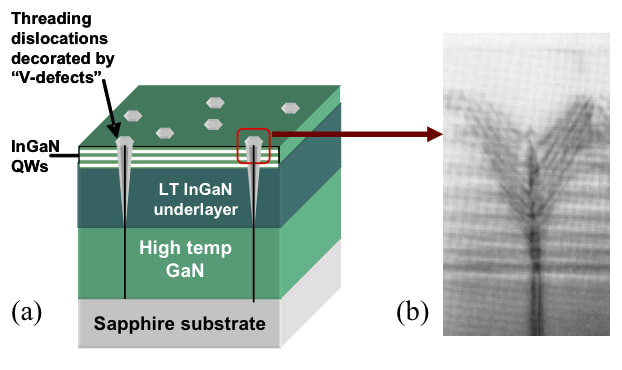
In addition to the studies on threading dislocations, the research team addressed the existing controversy of the impact of v-defects on InGaN multiple quantum well (MQW) and LED efficiency. The researchers developed a series of InGaN MQW and LED samples that employed InGaN “underlayers” (ULs) beneath the quantum wells (QWs) as a method to controllably nucleate these defects on existing threading dislocations. Through temperature-dependent PL studies of InGaN MQW samples both with and without v-defects, it was determined that v-defects were not contributing to increased IQE in the samples, but growth on underlayers themselves leads to increased IQE. Given the special importance of improving efficiency of LEDs at longer wavelengths, the team further investigated the potential for improving green LED efficiency through the application of underlayers. Although underlayer-induced efficiency enhancements were greater when probed by cathodoluminescence, electroluminescence measurements of green LEDs still revealed a ~ 40% improvement in LED efficiency with the application of underlayers.
While the first project thrust focused on investigating InGaN materials properties to improve internal quantum efficiency, a second thrust involved a variety of nanoscale engineering methods to enhance light extraction from InGaN LEDs. A major emphasis was the development and application of graded refractive index (GRIN) dielectric coating materials to eliminate Fresnel reflection from the GaN-air interface of the LED chip. As an example, the team applied oblique-angle deposition techniques to realize GRIN indium tin oxide (ITO) nanorod coatings which were shown to enhance LED output efficiency by 24%. It was found that additional lateral nano-patterning and micro-patterning of GRIN dielectric layers helps to the extract waveguided modes and leads to even higher efficiencies.
Beyond dielectric materials, the researchers also investigated nanostructured metal coatings and the potential for surface-plasmon-induced improvements to LED efficiency. The studies confirmed strong photoluminescence enhancement from InGaN QWs with various metal coatings and further demonstrated both enhanced LED output and reduced PL lifetimes of LEDs employing metal coatings in close proximity to QW layers. The teams notes that while the main focus of this thrust area was to explore methods to enhance light extraction, the coupling of QW excitation to surface plasmon modes in nearby metal coating layers is likely most advantageous in its potential to increase internal quantum efficiency of InGaN LEDs rather than light extraction. Thus, surface-plasmon-enhanced emission is most promising for LEDs that presently have low internal quantum efficiencies, including green and longer wavelength LEDs.
In summary, the joint project yielded a number of valuable insights and direct demonstrations of approaches to improve internal quantum efficiency and extraction efficiency of InGaN-based LEDs. These results indicate the continued importance of both nanoscale materials studies and nanoscale engineering of materials to maximize LED efficiencies and to realize ultra-efficient solid-state lighting.
This work was done by Mary H. Crawford, Arthur J. Fischer, Daniel D. Koleske, Stephen R. Lee, and Nancy A. Missert of Sandia National Laboratories , and E. Fred Schubert, Christian Wetzel, Shawn-Yu Lin of Rensselaer Polytechnic Institute .
This Brief includes a Technical Support Package (TSP).
Final LDRD Report: Nanoengineering for Solid-State Lighting
(reference GDM0009) is currently available for download from the TSP library.
Don't have an account?
Overview
The Sandia Report SAND2009-6130, titled "Final LDRD Report: Nanoengineering for Solid-State Lighting," presents the findings of a research project conducted by a team at Sandia National Laboratories. The report, published in September 2009, focuses on advancements in solid-state lighting technologies, particularly through the application of nanoengineering techniques.
The research aims to enhance the efficiency and performance of light-emitting diodes (LEDs), which are pivotal in the transition to more energy-efficient lighting solutions. The report details various experimental samples of LEDs, providing a summary of their measured output power at different current levels (20 mA and 100 mA). The data includes information on the peak wavelengths and power outputs of four distinct samples, showcasing the potential improvements in LED technology through the manipulation of indium content in the materials used.
The authors acknowledge the contributions of numerous technical staff and management support throughout the project, emphasizing the collaborative nature of the research. The report also includes a disclaimer regarding the accuracy and completeness of the information presented, clarifying that the findings do not necessarily reflect the views of the U.S. Government or its agencies.
In addition to the technical findings, the report highlights the broader implications of improved solid-state lighting technologies, such as reduced energy consumption and lower environmental impact compared to traditional lighting methods. The research aligns with national goals for energy efficiency and sustainability, making it relevant to ongoing discussions about energy policy and technological innovation.
Overall, the Sandia Report serves as a comprehensive account of the research conducted in the field of nanoengineering for solid-state lighting, providing valuable insights into the future of lighting technology and its potential to contribute to a more sustainable energy landscape. The findings underscore the importance of continued research and development in this area to achieve significant advancements in lighting efficiency and performance.










