

 Luminescent materials were developed using aerosol processes, for making improved LED devices for solid-state lighting. In essence this means improving white light emitting phosphor-based LEDs by improvement of the phosphor and phosphor layer.
The overarching goal of this project was to develop luminescent materials using aerosol processes for making improved LED devices for solid state lighting. In essence this means improving white light emitting phosphor-based LEDs by improvement of the phosphor and phosphor layer. The efficiency of these LEDs is based on the combined efficiency of the LED, phosphor, and the interaction between the two.
The structure of these types of light sources is a blue or UV LED under a phosphor layer that converts the blue or UV light to a broad visible (white) light. Traditionally, this is done with a blue emitting diode combined with a blue absorbing, broadly yellow emitting phosphor such as Y3Al5O12:Ce (YAG). A similar result may be achieved by combining a UV emitting diode and at least three different UV absorbing phosphors: red, green, and blue emitting. These emitted colors mix to make white light.

Cabot’s spray-based process for producing phosphor powders is able to improve the brightness of the powder itself by increasing the activator (the species that emits the light) concentration without adverse quenching effects compared to conventional synthesis. This will allow less phosphor powder to be used, and will decrease the cost of the light source; thus lowering the barrier of entry to the lighting market. The process also allows for chemical flexibility of the phosphor particles, which may result in tunable emission spectra and so light sources with improved color rendering. Another benefit of Cabot’s process is the resulting spherical morphology of the particles. Less light scattering results when spherical particles are used in the phosphor layer compared to when conventional, irregular shaped phosphor particles are used. This spherical morphology will result in better light extraction and so an improvement of efficiency in the overall device.
Cabot has produced a number of different compositions in a spherical morphology that may be useful for solid state lights, as well as demonstrated processes that are able to produce particles from 10 nanometers to 3 micrometers. Towards the end of the project Cabot demonstrated that the process produces YAG:Ce powder that has both higher internal quantum efficiency (0.6 compared to 0.45) and external quantum efficiency (0.85 compared to 0.6) than the commercial standard. However, these highly bright materials were only produced in research and development quantities, not in a reproducible manner at a commercial scale.
This work was done by Cabot Corp., Boston, MA. DE-FC26-04NT42276
This Brief includes a Technical Support Package (TSP).
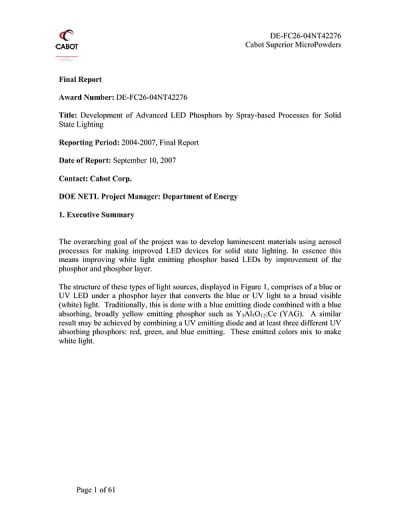
Development of Advanced LED Phosphors by Spray-based Processes for Solid-State Lighting
(reference GDM0002) is currently available for download from the TSP library.
Don't have an account?
Overview
The document is the final report for the project titled "Development of Advanced LED Phosphors by Spray-based Processes for Solid State Lighting," conducted by Cabot Superior MicroPowders under the award number DE-FC26-04NT42276. The project, which took place from 2004 to 2007, aimed to enhance the performance of white light-emitting LEDs by developing improved luminescent materials using aerosol processes.
The report outlines the overarching goal of creating more efficient phosphor materials that can be used in LED devices. Traditional LED systems typically utilize a blue or UV LED combined with phosphors that convert emitted light into a broad spectrum of visible light. The project focused on optimizing phosphor materials, particularly Yttrium Aluminum Garnet doped with Cerium (YAG:Ce), to achieve better luminescence efficiency.
Key achievements of the project included the successful production of phosphor powders with spherical morphology and defined particle size distributions ranging from 10 nanometers to 3 micrometers. The report highlights that the developed YAG:Ce powders exhibited higher internal quantum efficiency (0.6) and external quantum efficiency (0.85) compared to commercial standards (0.45 and 0.6, respectively). However, it notes that these high-efficiency materials were only produced in research quantities and not at a commercial scale.
The report details the methodologies employed, including photoluminescence measurements using a PTI fluorometer, and describes the spray pyrolysis technique used to create the phosphor materials. Two production campaigns were executed, with adjustments made based on findings from initial runs to optimize the precursor compositions and processing conditions.
Additionally, the report discusses the technical objectives of the project, which included demonstrating the feasibility of producing spherical micron and submicron-sized phosphor materials, developing phosphor particles around 100 nm, and incorporating these powders into various layer structures to evaluate their efficiency in LED applications.
In conclusion, while the project made significant strides in developing advanced phosphor materials for solid-state lighting, it faced challenges in scaling up production for commercial applications. The findings contribute valuable insights into the future of LED technology and the potential for improved lighting solutions.











