Polymer nanofibers are nanoscale materials whose properties can be adjusted to provide desirable light management performance for high efficiency solid-state lighting luminaires. The polymeric nanofibers at the core of this project have diameters on the order of 100 to 1000nm and a length of more than 1cm.
By controlling fiber diameter, fiber packing, and fiber morphology, a low cost, high-performance optical material can be fabricated. This report describes the fabrication of these nanofiber structures and their uses and benefits in solid-state lighting application.
When used in solid-state lighting (SSL) devices, nanofibers can take the form of either diffuse reflectors or photoluminescent materials. Nanofiber reflectors (NFR) were developed which displayed high diffuse reflectance with reflectance values in excess of 0.90. In contrast, traditional reflector materials such as aluminum and paint typically possess reflectance values below 0.80 and absorb a larger fraction of light, reducing luminaire output efficiency. The incorporation of the NFR technology into reflectors, troffers, and beam formers present in SSL luminaires provides better reflectance and lower light loss than is possible with conventional materials.


Photoluminescent nanofibers (PLN) can be formed by combining nanofibers with photoluminescent materials such as phosphors and quantum dots (QD). Forming the PLN with the proper combination of green and red luminescent materials and exciting the nanocomposite with a blue light-emitting diode (LED) has been demonstrated to produce high-efficiency (> 55 lumens per watt) white light with excellent color rendering properties. The incorporation of QDs in the PLN is particularly advantageous in that this approach enables the correction of any color deficiencies in the light source without creating unnecessary radiation in the near infrared. Cost models developed during this project have demonstrated that both the NFR and PLN materials can be mass produced at a manufacturing cost of less than $5 per square foot, making it commercially attractive.
To capitalize on the benefits of nanofiber technologies in solid-state lighting, several new remote phosphor reflector configurations were developed in the project. When combined with these unique lighting designs, nanofibers have a number of demonstrated benefits in lighting devices including:
- Providing high quantum efficiency down-conversion of LED wavelengths to produce full spectrum white light;
- Enabling tunable device structures that achieve colors ranging from warm white to cool white with high color rendering indexes (CRI);
- Supplying mass producible, cost-effective solutions for diffuse, high-reflectance light management across the visible spectrum;
- Facilitating remote phosphor luminaire designs that increase the lifetime and performance of luminescent materials;
- Providing conformability to geometries imposed by the light fixture enabling new lighting designs.
The technologies developed during this program have significant commercial potential, and there has been strong interest in these breakthroughs from the lighting community. It is anticipated that these technologies will begin appearing in commercial products in roughly five years.
This work was done by researchers at RIT International, with teaming members at Donaldson Company, Fujifilm Dimatix, Evident Technologies, and Elmarco USA.
This Brief includes a Technical Support Package (TSP).
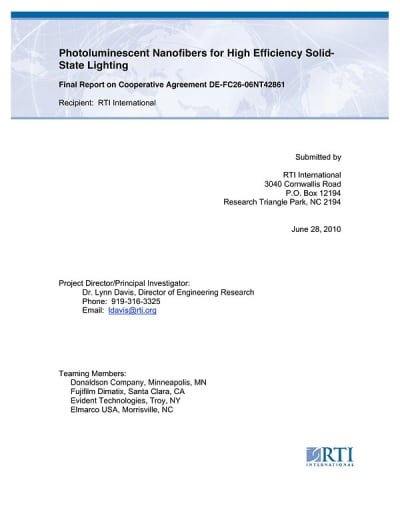
Photoluminescent Nanofibers for High-Efficiency Solid-State Lighting
(reference GDM0012) is currently available for download from the TSP library.
Don't have an account?
Overview
The document is a final report on the project "Photoluminescent Nanofibers for High Efficiency Solid-State Lighting," conducted by RTI International. It details the advancements made in the field of nanoscale materials for solid-state lighting (SSL) over three budget periods. The report is structured into several sections, including an introduction, a discussion of the technologies developed, and a summary of activities and findings.
In the introduction, the report provides background on nanofiber technologies and patent-pending luminaire structures. It emphasizes the commercial potential of these technologies, noting strong interest from the lighting community and the expectation that they will appear in commercial products within five years, contributing to significant energy savings in the United States.
The report outlines the activities conducted during three budget periods. In Budget Period 1, the focus was on developing testing methods and fabricating nanofibers and photoluminescent nanofibers (PLNs). Budget Period 2 expanded on this foundation by optimizing nanofiber fabrication processes, improving the quantum efficiency of PLNs, and developing practical lighting devices that incorporate these technologies. By the end of Year 2, control over the optical properties of nanofibers and PLNs was achieved, leading to new designs for lighting devices.
Budget Period 3 activities culminated in the production of functional laboratory prototypes. Key areas of focus included optimizing the lab-scale fabrication processes for both nanofibers and PLNs, testing these materials in working devices, and conducting a manufacturability analysis. The findings from these activities are summarized, highlighting the successful integration of nanofibers and PLNs into lighting applications.
The report also discusses the demonstrated benefits of RTI's approach, including light management across the visible spectrum, high quantum efficiency down-conversion, and color tunability. It concludes with a summary of products developed during the project, such as patent applications, publications, and collaborations.
Overall, the report showcases significant advancements in nanofiber technology for SSL, emphasizing its potential to revolutionize lighting efficiency and sustainability. The collaborative efforts and innovative approaches taken throughout the project underline the importance of continued research and development in this field.