The issues with ITO are exacerbated by export controls from China, one of the major sources of elemental indium. Therefore, ITO is not sustainable because of fluctuating costs and the United States' dependency on other nations such as China.
Numerous alternatives to ITO/IZO are being evaluated such as silver (Ag) nanoparticles/ nanowires, carbon nanotubes, graphene, and other metal oxides. Of these other metal oxides, doped zinc oxide (ZnO) has attracted much attention over the last ten years. The volume of zinc mined is a factor of 80,000 greater than indium and the U.S. has significant volumes of zinc mined domestically, resulting in the ability for the U.S. to be self-sufficient for this element that can be used in optoelectonic applications. The costs of elemental zinc is over two orders of magnitude less than indium, reflecting the relative abundance and availability of the elements.
The genesis of this project was to determine if doped zinc oxide technology can be taken from the commodity-based window market and translate the technology to OLED lighting. This project had a clear focus on economics and the work plan focused both on doped ZnO process and OLED device structure that would be consistent with a new TCO. Six-inch OLEDs were successfully made with a serial construction. More process development is required to optimize commercial OLED structures. Feasibility was demonstrated on two different light extraction technologies: 1/4 lambda refractive index matching and high-low-high band pass filter. Process development was also completed on the key precursors for the TCO, which are ready for pilot-plant scale-up.
The overall outcome of the project was the demonstration that doped zinc oxide can be used for OLED devices without a drop-off in performance while gaining the economic and sustainable benefits of a more readily available TCO. The broad impact of this project is the facilitation of OLED lighting market penetration into general illumination, resulting in significant energy savings, decreased greenhouse emissions, with no environmental impact issues such as mercury found in fluorescent technology.
This work was done by Gary. S Silverman, Martin Bluhm, James Coffey, Roman Korotkov, Craig Polsz, Alexandre Salemi, Robert Smith, Ryan Smith, Jeff Stricker, Chen Xu, Jasmine Shirazi, George Papakonstantopulous, and Steve Carson of Arkema Inc, with colleagues from Philips Lighting GmbH, Pacific Northwest National Laboratories, and National Renewable Research Laboratories.
This Brief includes a Technical Support Package (TSP).
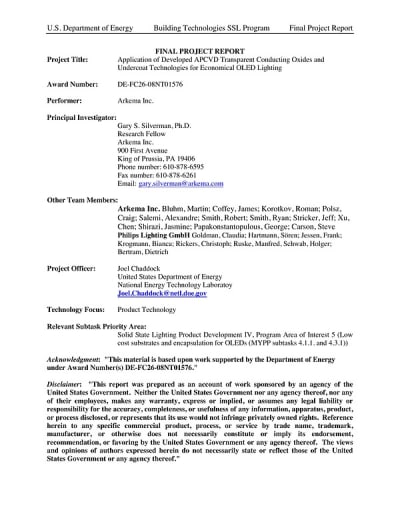
Transparent Conducting Oxides and Undercoat Technologies for Economical OLED Lighting
(reference GDM0018) is currently available for download from the TSP library.
Don't have an account?
Overview
The document outlines a project conducted by Arkema Inc. under the U.S. Department of Energy's Building Technologies Program, focusing on the development of transparent conducting oxides (TCOs) for organic light-emitting diode (OLED) applications. The primary objective is to create a cost-effective manufacturing process for TCOs that can replace indium tin oxide (ITO) and indium zinc oxide (IZO), which are currently used in OLED devices but present significant economic and performance challenges.
The reliance on ITO is problematic due to its high cost, manufacturing inconsistencies, and long-term stability issues, including ion migration that leads to device clouding. The project aims to develop doped zinc oxide (ZnO) as a viable alternative, which has already shown promise in other applications, such as fenestration. The document highlights the need for a manufacturing process that can integrate these materials into OLED devices effectively.
Key project milestones include lowering the processing temperature for ZnO deposition while maintaining desirable optoelectronic properties. Two approaches were evaluated: one using existing precursors at higher temperatures and another modifying dopants in current Zn precursors. The project successfully demonstrated that deposition temperatures could be reduced to 375-425°C while achieving a resistivity of 2.5 x 10^-4 ohm cm, meeting initial project milestones ahead of schedule.
The document also discusses the development of optical models to improve the transmission of OLED devices by optimizing undercoat construction. This involves collaboration with Philips Lighting to establish targets for thickness and refractive index, which will facilitate the feasibility of the project.
Additionally, the report notes the challenges faced, such as delays in equipment availability, which impacted project timelines. However, the team remained confident in their progress, particularly with the successful fabrication of 5mm x 5mm OLED devices using doped ZnO, paving the way for scaling up to larger devices.
Overall, the project represents a significant step toward overcoming the barriers associated with ITO in OLED technology, emphasizing the importance of sustainable materials and economic feasibility for the future of OLED lighting in general illumination applications.