-1
1710
30
Blog: Energy
Don’t hold your breath, says Jeff Crystal from Voltaic Systems.

INSIDER: Energy
Imagine a world where cell phones and laptops can be charged in a matter of minutes instead of hours, rolled up and stored in your pocket, or dropped without sustaining any damage. It is possible, but the...
INSIDER: Electronics & Computers
Fuel cells generate electricity directly from hydrogen and oxygen and produce only water vapor as emissions. But most fuel cells are too expensive, inefficient,...

Question of the Week: Aerospace
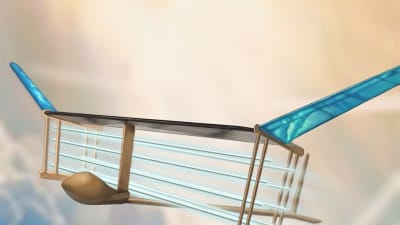
How Strong is the ‘Ionic Wind?’
MIT has built the first-ever plane with no moving parts. Instead of turbine blades, propellers, and fans, the aircraft relies on an “ionic wind” — a silent but strong flow of ions, produced onboard, which generates enough thrust to propel the plane over a sustained, steady flight.
Blog: Manufacturing & Prototyping
An FMEA provides a step-by-step way of identifying product failures. Carl Carlson explains just how long the process takes.

INSIDER: Propulsion
Since the first airplane took flight, virtually every aircraft has flown with the help of moving parts such as propellers, turbine blades, or fans that produce a persistent, whining buzz. MIT has built the...
Blog: Test & Measurement
InSight project manager Tom Hoffman spoke with Tech Briefs about the importance of digging deep in our knowledge of Mars.

Blog: Materials
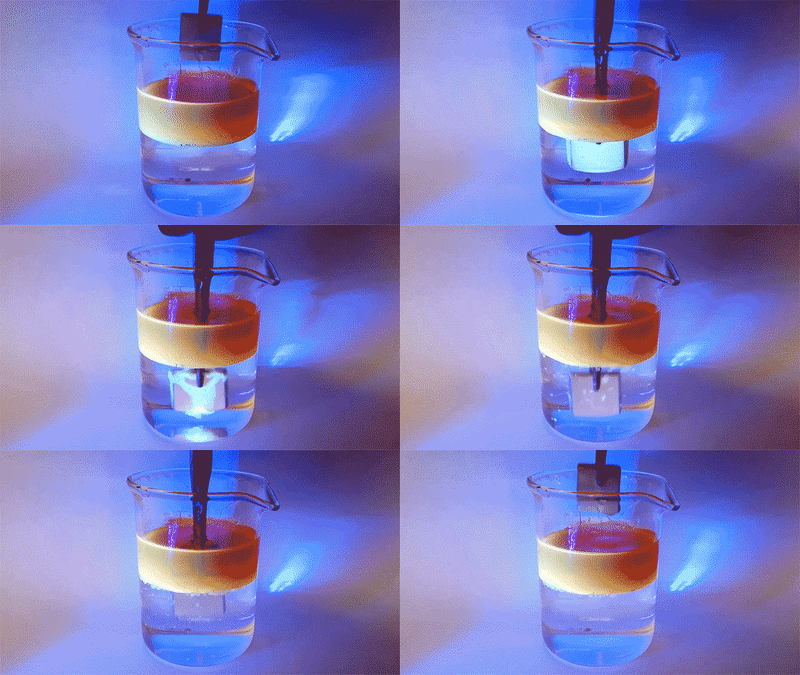
Professor Hart spoke with Tech Briefs about why his team's new battery may someday find its way beyond niche applications and into electric vehicles.
Question of the Week: Mechanical & Fluid Systems
Can ‘The Ocean Cleanup’ Clean Up the Ocean?
The Ocean Cleanup, a nonprofit effort begun by Dutch inventor Boyan Slat, wants to clean up 50% of “The Great Pacific Garbage Patch” in five years, with the aim of a 90% reduction by 2040.
Using a 600-meter long floater, or collection platform, called System 001, the Cleanup technology acts a...
Blog: Sensors/Data Acquisition
A reader asks our industry experts: "How good are the simulation models for automotive ADAS sensors?"

Question of the Week: Energy
Will Stretchable, Printable Solar Cells Catch On?
A Rice University lab is making solar cells that are stretchable, printable, and paintable. Watch the demo on Tech Briefs TV.
This week's Question: Will Stretchable, Printable Solar Cells Catch On?
Share your thoughts in the comments section below.
Blog: Materials
Researchers from the National University of Singapore (NUS) are trying to solve the problem of plastic waste by converting it into something useful: Aerogels.

INSIDER: Green Design & Manufacturing
IoT devices need a wireless means of communications to be truly seamless so they can be easily integrated in...
INSIDER: Sensors/Data Acquisition
Developing automated systems that track occupants and self-adapt to their preferences is a major next step for the future of smart homes. When you walk into a room, for instance, a system...

INSIDER: Communications
A team of researchers at Washington University in St. Louis was the first to successfully record environmental data using a wireless photonic sensor resonator with a...

INSIDER: Materials
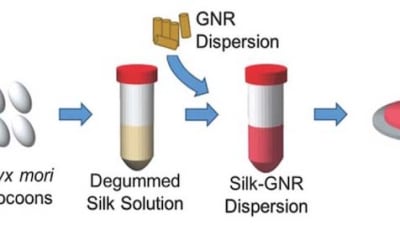
Tissue repair following injury or during surgery is conventionally performed with sutures and staples, which can cause tissue damage and complications, including infection....
INSIDER: Materials
New lead halide perovskite nanocrystals developed by researchers from NUS Chemistry could soon mean cheaper X-rays and computerized tomography (CT) scans involving lower levels of...

INSIDER: Energy
In the quest for abundant, renewable alternatives to fossil fuels, scientists have sought to harvest the sun’s energy through “water splitting,” an artificial photosynthesis technique...

Blog: Sensors/Data Acquisition
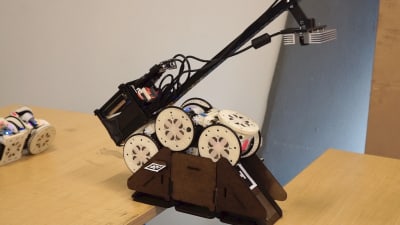
Professor Hadas Kress-Gazit tells Tech Briefs about the "great promise" of autonomous modular robots.
Question of the Week: Imaging
Will AR and VR Help Automotive Manufacturers?
A reader recently asked our automotive expert: “How will the use of augmented reality and virtual parts impact the role of automotive parts manufacturers, such as PCB manufacturers, in prototyping and production?”
Blog: Aerospace
For an electric-aircraft future, it's not enough to just change components. You have to rethink design, our expert tells one reader.

Blog: Energy
Have you heard of "fatbergs?" Researcher Asha Srinivasan explains how her team is turning masses of fat, oil, and grease into biofuel.
Question of the Week: Green Design & Manufacturing
Would You Use Carl Yee’s ‘Disappearing Ink?’
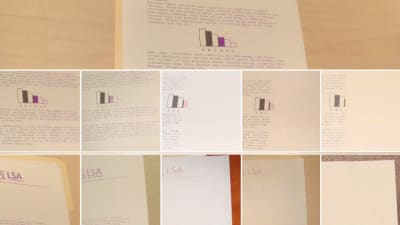
Our second INSIDER story today features a purposefully “lousy ink” – one that slowly fades after being printed. The gradual disappearance of the ink allows the paper to be used again and again.
Read the article, and let us know what you think.
This week's Question: Would You Use Carl...
Blog: Aerospace
Now Deploying from the ISS: A Harpoon, A Net, and Other Ideas for Cleaning Up Space Debris
Richard Duke spoke with Tech Briefs about the nature of the space-junk problem — and how his team plans to fix it.
INSIDER: Motion Control
An unexpected source recently identified a global Martian dust storm. The source was an actuator, or motor, that powers a lid to a funnel that takes in samples of powdered Martian...

Blog: Green Design & Manufacturing
Carl Yee invented a new kind of "Invisible Ink," so he could print paper without the guilt.
Question of the Week: Materials
Will Paint-On coatings Become a Popular Way to Cool Down Buildings?
Our lead INSIDER story today featured a paint-on polymer that cools down buildings, through a process known as passive daytime radiative cooling.
Read the article, and let us know what you think.
This week’s Question: Will Paint-On coatings Become a Popular Way to Cool Down...
Blog: Imaging
How Will VR and AR Impact Automotive Manufacturers?
How will the use of AR and virtual prototypes impact the role of automotive parts manufacturers? A reader asks our expert.
Blog: Materials
A new solution, applied like paint, cools down rooftops, buildings, water tanks, vehicles, and even spacecraft.

Top Stories
 Blog: Lighting

A Stretchable OLED that Can Maintain Most of Its Luminescence
 Blog: Energy

Batteries that Can Withstand the Cold
 INSIDER: Energy

Advancing All-Solid-State Batteries
 Blog: Power

My Opinion: We Need More Power Soon — Is Nuclear the Answer?
 Quiz: Power

 Blog: Data Acquisition

Webcasts
 Upcoming Webinars: Test & Measurement

From Spreadsheets to Insights: Fast Data Analysis Without Complex...
 Upcoming Webinars: Aerospace

Cooling a New Generation of Aerospace and Defense Embedded...
 Upcoming Webinars: Sensors/Data Acquisition

Beyond AI-Copy-Paste Engineering: Advanced AI-Integration Success...
 Upcoming Webinars: Energy

Battery Abuse Testing: Pushing to Failure
 Upcoming Webinars: Power

A FREE Two-Day Event Dedicated to Connected Mobility
 Upcoming Webinars: RF & Microwave Electronics

Choosing the Right N-Port Strategy: Multiport VNAs vs. Switch...