-1
1680
30
Question of the Week: Sensors/Data Acquisition
Would You Use Wearables to Monitor Your UV Exposure?
Our February issue of Tech Briefs highlights a technology called My Skin Track UV. The 12 x 6 mm wearable sensor can be attached to clothing or accessories to detect sunburn and overexposure to ultraviolet light.
Question of the Week: Materials
Where Do You See Self-Healing Rubber Being Used?
In our lead INSIDER story today, USC Professor Qiming Wang said he hopes to see his team’s self-repairing rubber supporting everything from shoes to battle armor and airplane wings.
Blog: Aerospace
Even a shape-morphing plane is possible, says Harvard's Ehsan Hajiesmaili.

Blog: Manufacturing & Prototyping
A new material development from USC brings us a step closer to self-healing sneakers.

Question of the Week: Manufacturing & Prototyping
Have You Conducted an FMEA?
With design, it pays to anticipate problems — and solve them — during product development.
INSIDER: Electronics & Computers
A Washington State University research team has uncovered significant and previously unknown vulnerabilities in high-performance computer chips that could lead to failures in modern electronics. The...

INSIDER: Medical
A new device developed by Stanford University researchers could make it easier for doctors to monitor the success of blood vessel surgery. The sensor monitors the flow of blood...

INSIDER: Electronics & Computers
The quest to develop microelectronic devices with increasingly smaller size, which underpins the progress of the global semiconductor industry has...

Blog: Materials
By adding nanopores to nickel, James Pikul and his team created a kind of "metallic wood."

INSIDER: Motion Control
A simple, inexpensive method uses ultraviolet light to control particle motion and assembly within liquids. The method encourages particles to gather and organize at a specific location within a liquid...
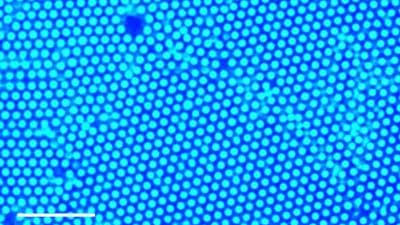
INSIDER: Manufacturing & Prototyping
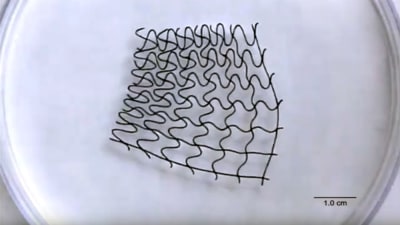
North Carolina State created 3D-printed flexible mesh structures that can be controlled with applied magnetic fields while floating on water. The structures can grab small objects and carry water...
Blog: Manufacturing & Prototyping
A Failure Analysis may help find problems during product development, but what role should top management play in an FMEA?

Question of the Week: Electronics & Computers
Will ‘Embodied Logic’ Support New Monitoring Applications?
In today’s lead INSIDER story, Professor Jordan Raney said that the most interesting feature of his embodied-logic system is its ability to monitor an environment for a very long period of time, without needing a continued input of energy.
Blog: Materials
Professor Jordan Raney spoke with Tech Briefs about what’s possible when you can embody 3D-printed objects with logic.

INSIDER: Imaging
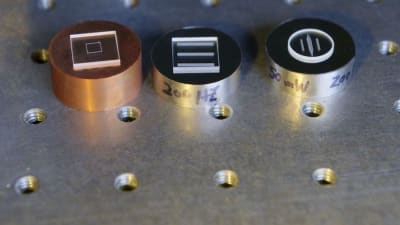
An ultrafast laser that fires pulses of light just 100 millionths of a nanosecond in duration could potentially revolutionize the way NASA technicians manufacture and...
INSIDER: Imaging
Researchers from the University of Houston have devised a new machine learning algorithm that is efficient enough to run on a personal computer and predict the properties of more than...

INSIDER: Photonics/Optics
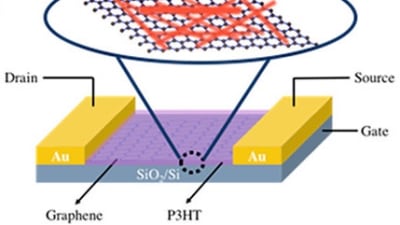
Scientists from the Center for Functional Nanomaterials (CFN) — a U.S. Department of Energy (DOE) Office of Science User Facility at Brookhaven National Laboratory — have dramatically improved...
Question of the Week: Automotive
Do You Feel Safe Behind the Wheel of a Connected Car?
Our Here's an Idea podcast episode led the INSIDER today, and explored how today's auto manufacturers are working to protect connected cars from a range of threats, including ransomware and a remote takeover of the vehicle's controls.
Blog: Sensors/Data Acquisition
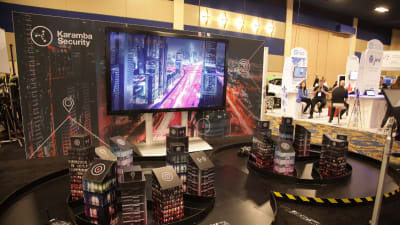
David Barzilai from Karamba Security tells Tech Briefs what threats to the connected car concern him the most.
Question of the Week: Green Design & Manufacturing
Can AI Prevent Famine?
Today's INSIDER story demonstrated how artificial intelligence models are being used to mark areas most in need of famine relief and funding. Ed Hsu from the World Bank spoke at CES last week about his collaboration with AI heavyweights Google, Microsoft, and Amazon.
Blog: Sensors/Data Acquisition
From CES 2019: Tech Briefs looks at three standout health-monitoring products.

Blog: Electronics & Computers
From CES 2019: For famine relief, the World Bank is turning to artificial intelligence (AI) and machine learning.

Question of the Week: Communications
Do You Expect Successful Cyberattacks on Today’s Connected Cars?
In today’s lead story, Stacy Janes showed optimism regarding the security of connected cars.
Blog: Mechanical & Fluid Systems
Professor Sherry Towfighian spoke with Tech Briefs about how a new MEMS design will improve our cell phones and power lines.

Blog: Communications
Irdeto's Stacy Janes tells Tech Briefs if he feels safe driving today's connected cars.

Blog: Electronics & Computers
A reader asks: How does an “industrial-grade” lithium-ion battery stack up to the one in your phone?

INSIDER: Motion Control
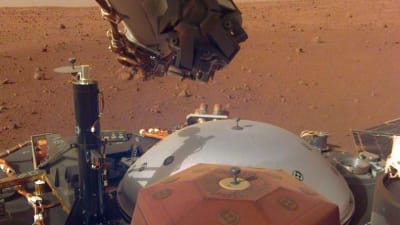
NASA’s InSight lander has provided the first ever "sounds" of Martian winds on the Red Planet. Sensors captured a haunting low rumble caused by vibrations from the wind, estimated to be blowing between...
INSIDER: Motion Control
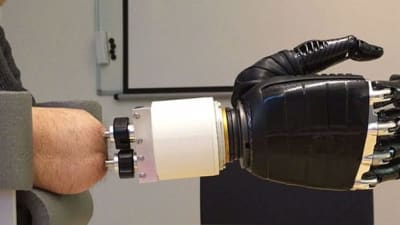
A new artificial joint restores important wrist-like movements to forearm amputees. In the new joint, an implant is placed into each of the two bones of the forearm and a wrist-like artificial...
Question of the Week: Aerospace
Will Urban Air Mobility ‘Take Off?'
A Tech Briefs TV video demonstrates NASA’s rotary-wing “air taxi” concept. The vehicles, in theory, have the capacity for vertical take-off and landing, eliminating the need for long runways.
Top Stories
 Blog: Lighting

A Stretchable OLED that Can Maintain Most of Its Luminescence
 Blog: Energy

Batteries that Can Withstand the Cold
 INSIDER: Energy

Advancing All-Solid-State Batteries
 Blog: Power

My Opinion: We Need More Power Soon — Is Nuclear the Answer?
 Quiz: Power

 Blog: Data Acquisition

Webcasts
 Upcoming Webinars: Test & Measurement

From Spreadsheets to Insights: Fast Data Analysis Without Complex...
 Upcoming Webinars: Aerospace

Cooling a New Generation of Aerospace and Defense Embedded...
 Upcoming Webinars: Sensors/Data Acquisition

Beyond AI-Copy-Paste Engineering: Advanced AI-Integration Success...
 Upcoming Webinars: Energy

Battery Abuse Testing: Pushing to Failure
 Upcoming Webinars: Power

A FREE Two-Day Event Dedicated to Connected Mobility
 Upcoming Webinars: RF & Microwave Electronics

Choosing the Right N-Port Strategy: Multiport VNAs vs. Switch...