-1
1890
30
News: Imaging
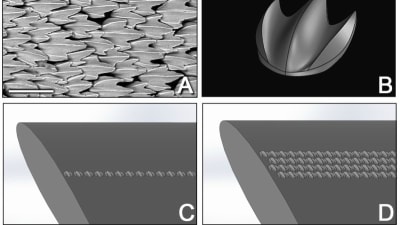
To improve a flying vehicle, sometimes you have to turn to a reliable model that has been operating for hundreds of millions of years.
Question of the Week: Manufacturing & Prototyping
Would you use color-changing 3D printables?
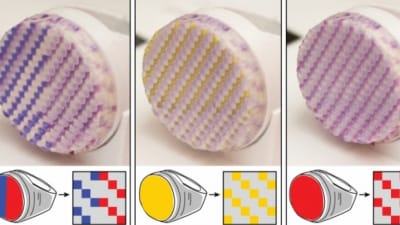
In today’s INSIDER, MIT researcher Professor Stefanie Mueller said that her laboratory’s color-changing 3D printables support new customizable objects and accessories, as well as opportunities for product designers showing off their prototypes.
INSIDER: Manufacturing & Prototyping
Professor Stefanie Mueller and fellow researchers from MIT’s Computer Science and Artificial Intelligence Laboratory (CSAIL) are exploring a more efficient way to cut down on print jobs: objects that change color.
Blog: Mechanical & Fluid Systems
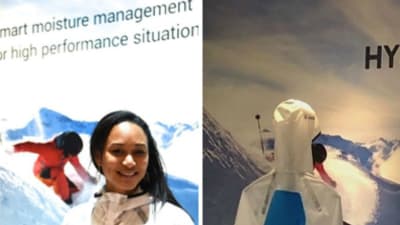
Beyond the slopes, creators of a moisture-managing, sweat-getting ski jacket envision new places for the “electrified” apparel.
INSIDER: Materials
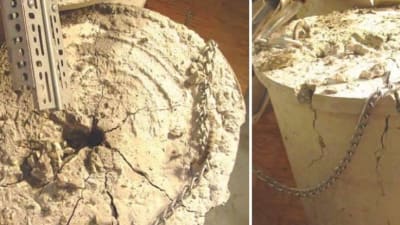
An electrically-driven demolition probe originally funded by NASA enables a more precise, quieter fracturing method that its creators hope will give construction workers on...
Blog: Manufacturing & Prototyping
Shape-Morphing Materials Add 4th Dimension to 3D Printing
3D printing uses computer control to fuse layers of polymers or powders into a three-dimensional object. Rutgers University researchers found a way to add to a fourth dimension – time – to the manufacturing process.
Question of the Week: Manufacturing & Prototyping
Would you wear a moisture-managing ski jacket?
Today's INSIDER featured an electronic textile technology designed to keep skiers warm and dry. What do you think? Would you wear a moisture-managing ski jacket?
News: Medical
A BYU professor and his team have found a way to take the 3D displays of science fiction and make them a reality. A reader asks: Could surgeons use this kind of volumetric display?

Blog: Mechanical & Fluid Systems
As the 2018 Winter Olympics are set to begin next week, creators of a moisture-managing ski jacket are literally going for the gold.

INSIDER: Motion Control
Scientists have developed a novel electric propulsion technology for nanorobots. Traditional nanobots take minutes to carry out actions, sometimes even hours. Therefore, efficient molecular assembly lines...

Question of the Week: Data Acquisition
Have you implemented Bluetooth- or Internet-enabled data logging?
This week's INSIDER featured a story about one company's transition to Internet-enabled data logging. The deployed system allowed the repair center’s users to remotely analyze a part’s vibration measurements. We want to hear from you. Have you implemented Bluetooth- or...
INSIDER: Photonics/Optics
A BYU professor and his team have found a way to take the 3D displays of science fiction and make them a reality.

Blog: Sensors/Data Acquisition
In a Tech Briefs Q&A, professor and biosensor creator Albert Titus reviews the state of wearable sensor design.
Question of the Week: Sensors/Data Acquisition
Would you wear a fingernail UV sensor?
Last week’s INSIDER showcased a new UV wearable sensor from L'Oréal and Northwestern University engineers.
INSIDER: Semiconductors & ICs
For the first time ever, Columbia University engineers created “artificial graphene” in a semiconductor device.

Blog: Aerospace
Introducing the New TechBriefs.com
Long-time readers of the site may have noticed this week that TechBriefs.com has a whole new look — a more visual, more scrollable design.
Blog: Robotics, Automation & Control
Farmers in Europe are increasingly turning to robotic weeders. A specialist from University of California, Davis tested out the technologies.

Question of the Week: Transportation
Are cities ready for the arrival of electric autonomous vehicles?
In this week’s INSIDER, city official David Schirmer shared how Beverly Hills is preparing for the arrival of electric vehicles. Municipalities, he said, will require new kinds of smart traffic signals, charging stations, and changes to building codes. A Tech Briefs reader asked...
INSIDER: Semiconductors & ICs
Creators of a new, M&M-sized wearable device aim to bring UV detection to users’ fingertips – or more precisely, fingernails.

Blog: Energy
A Beverly Hills city official tells Tech Briefs how the city is changing its infrastructure to accommodate a growing number of electric vehicles.

Blog: Energy
As electric vehicles take the road, a new kind of EV infrastructure has emerged to power them. A Tech Briefs reader asks our expert about an emerging, “smart” idea: Intelligent Charging.

INSIDER: Materials
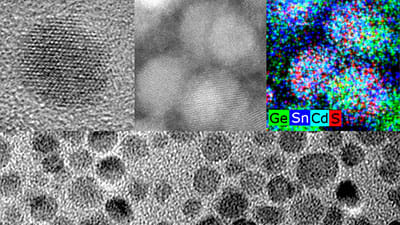
Researchers at the U.S. Department of Energy’s Ames Laboratory have developed germanium nanoparticles with improved photoluminescence, making them potentially better materials for...
INSIDER: Imaging
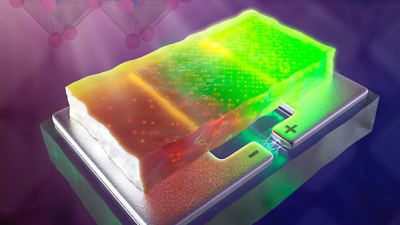
A team of researchers led by the University of California San Diego has for the first time observed nanoscale changes deep inside hybrid perovskite crystals that...
INSIDER: Imaging
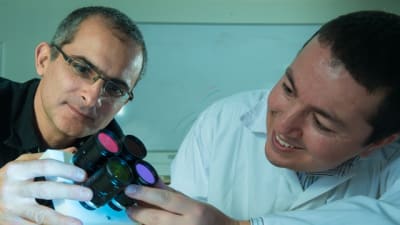
New software developed by BGU researchers enables standard cameras to capture hyperspectral images and video, which is a faster and more cost-efficient approach than...
Blog: Manufacturing & Prototyping
ORNL staff scientist Adam Rondinone explains how his team made the tiny toy.

Question of the Week: Manufacturing & Prototyping
Have You Used Metal Additive Manufacturing?
Today's INSIDER featured a story about the growing role of metal additive manufacturing in industries like aerospace, automotive, and healthcare.
INSIDER: Aerospace
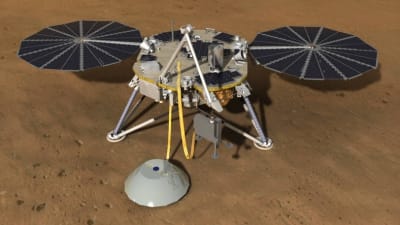
NASA challenged university students to create a deployable solar array for the Martian surface. See which "Big Ideas" impressed Bob Hodson, a leader of the space agency's Game Changing Development Program.
INSIDER: Sensors/Data Acquisition
Cornell University engineers have been experimenting with a new type of programming that mimics the mind of an insect.

Blog: Energy
Is the future electric? A reader asks an expert from Mercedes-Benz.

Top Stories
 Blog: Lighting

A Stretchable OLED that Can Maintain Most of Its Luminescence
 Blog: Energy

Batteries that Can Withstand the Cold
 INSIDER: Energy

Advancing All-Solid-State Batteries
 Blog: Power

My Opinion: We Need More Power Soon — Is Nuclear the Answer?
 Quiz: Power

 Blog: Data Acquisition

Webcasts
 Upcoming Webinars: Test & Measurement

From Spreadsheets to Insights: Fast Data Analysis Without Complex...
 Upcoming Webinars: Aerospace

Cooling a New Generation of Aerospace and Defense Embedded...
 Upcoming Webinars: Sensors/Data Acquisition

Beyond AI-Copy-Paste Engineering: Advanced AI-Integration Success...
 Upcoming Webinars: Energy

Battery Abuse Testing: Pushing to Failure
 Upcoming Webinars: Power

A FREE Two-Day Event Dedicated to Connected Mobility
 Upcoming Webinars: RF & Microwave Electronics

Choosing the Right N-Port Strategy: Multiport VNAs vs. Switch...