-1
1920
30
Blog: Physical Sciences
With another year of Tech Briefs almost in the books, it's time to look at our most-read news articles of 2017.
Top stories included a look back at the life of Robert Goddard, and a look forward to new...
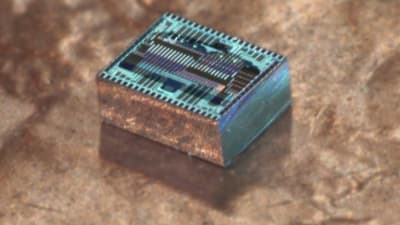
News: Defense
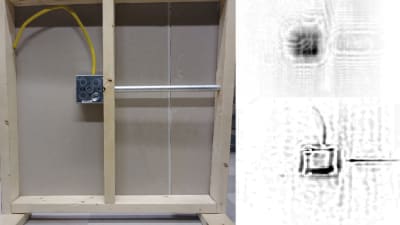
Using a narrow band of microwave frequencies, researchers at Duke University found a new way to see on the other side of the wall.
INSIDER: Materials
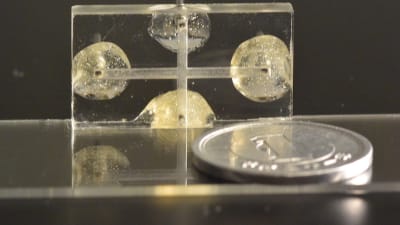
A vortex in the atmosphere can churn with enough power to create a typhoon. But more subtle vortices form constantly in nature. Many of them are too small to be seen with the naked eye....
INSIDER: Motion Control
One technology uses magnetic fields to generate mechanical work. The other enhances the magnetic properties of 3D-printed materials. Combined, they could lead to efficient, economical production of magnetic...

Question of the Week
Would you use "Printed Wi-Fi?"
This week, Tech Briefs TV featured an additive-manufacturing technology from the University of Washington.
Blog: Sensors/Data Acquisition
During the historic Apollo 11 mission, the astronauts, mission control specialists, and back-room support staff did plenty of communicating. The University of Texas at Dallas launched a project to make all of the moon-mission audio accessible.
INSIDER: Aerospace
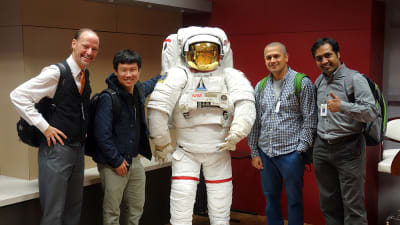
During a routine spacewalk, astronauts can easily lose their sense of orientation and direction. Creators of a new kind of spacesuit aim to address the challenge — with the push of a...

Question of the Week
Did You Ever Launch Model Rockets?
Our lead story today emphasized the inspirational role of the model rocket. What do you think? Did you ever launch model rockets?
INSIDER: Aerospace
If you ask engineers about their early days, many can't avoid talking about a favorite toy: the model rocket.

Blog: Manufacturing & Prototyping
Will Ethics Training be Essential for Tomorrow's Design Engineers?
In our second INSIDER story, Patti Kreh demonstrated that colleges and universities will need to take an "interdisciplinary" approach to train the design engineers of the future.
"What we're seeing is the need for the blending of disciplines – a combination of traditional...
INSIDER: Aerospace
NASA’s Mehdi Khorrami explains how he uses high-performance computing to handle one of the FAA’s biggest complaints: aircraft noise.

INSIDER: Motion Control
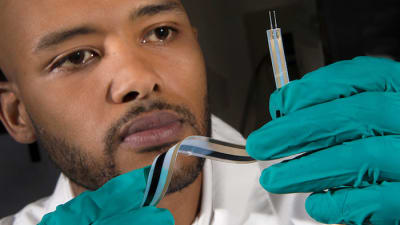
Researchers from Florida State University developed a class of motion sensors made using buckypaper. The new technology is versatile, and the sensors are affordable to print.
INSIDER: Motion Control
Scientists at the University of Exeter have discovered a technique to transform ambient heat into motion in nanoscale devices. This thermal ratchet is made from a material known as “artificial spin...

Question of the Week
Can Senior Execs Make or Break a Cybersecurity Program?
Our second INSIDER story, a response from infosec expert Michael Morgan, highlighted the importance of "C-Suite" support when implementing a cybersecurity program.
INSIDER: Sensors/Data Acquisition
Using a commercial printer and some silver ink, researchers from Florida State University have found a novel way of producing motion sensors en masse. The low-profile...

Blog: Software
Simulation allows NASA researchers to better understand and predict the changes that contribute to aircraft noise.

INSIDER: Sensors/Data Acquisition
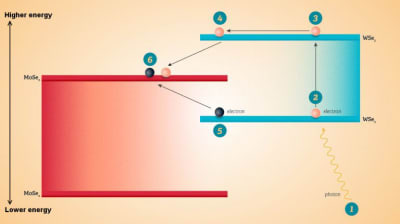
Physicists at the University of California, Riverside have developed a photodetector by combining two distinct inorganic materials and producing quantum mechanical...
INSIDER: Photonics/Optics
Scientists have taken an important step towards using ‘twisted’ light as a form of wireless, high-capacity data transmission which could make fiber optics...

INSIDER: Photonics/Optics
A silicon solar cell harvests the energy of the sun as light travels down through light-absorbent silicon. To reduce weight and cost, solar cells are thin, and while silicon absorbs...

News: Materials
A reversible fabric from Stanford University could warm up or cool down its wearers, depending on their preference – and which side of the material faces out.

INSIDER: Test & Measurement
A transfer technique could allow high-performance gallium nitride gas sensors to be grown on sapphire substrates and then transferred to metallic or flexible polymer support materials. The process...

INSIDER: Test & Measurement
Scientists at the National Institute of Standards and Technology (NIST) have developed a new way to investigate the high-performance fibers used in modern body armor. The testing of soft body armor has been a big...

INSIDER: Test & Measurement
iSoft, a new type of soft and stretchable sensor, is capable of sensing in real time, and can perform “multimodal” sensing of stimuli such as continuous contact and stretching in all...
Question of the Week: Automotive
Do You Have a High Degree of Confidence in Autonomous Vehicle Security?
Our second INSIDER story today featured an answer to the question: "How can we achieve autonomous cars without 100-percent cybersecurity?"
INSIDER: Sensors/Data Acquisition
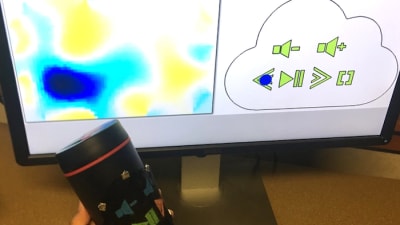
Although spills inside a lab can often spell trouble, a University of Washington scientist found a way to turn an accidentally doused conductive material into an inventive new sensor. The lab...

INSIDER: Energy
Sandia National Laboratories engineers have developed new fractal-like, concentrating solar power receivers for small- to medium-scale use that are up to 20 percent more effective...

INSIDER: Energy
A touch of asphalt may be the secret to creating high-capacity lithium metal batteries that charge 10 to 20 times faster than commercial lithium-ion batteries, according to Rice University scientists....

INSIDER: Electronics & Computers
Smartphones, fitness trackers, and medical equipment have a constant hunger for power. The solution: power supply by means of energy produced by body movements. Two systems that meet this requirement were...

Question of the Week: Software
Will 'read-ahead' algorithms speed up 3D printing?
Our featured INSIDER story today showcased algorithms that allow 3D printers to anticipate motion and "read ahead" of its programming. The Michigan State University readers believe that the faster, more precise builds will allow 3D printers to create products twice as fast.
Top Stories
 Blog: Lighting

A Stretchable OLED that Can Maintain Most of Its Luminescence
 Blog: Energy

Batteries that Can Withstand the Cold
 INSIDER: Energy

Advancing All-Solid-State Batteries
 Blog: Power

My Opinion: We Need More Power Soon — Is Nuclear the Answer?
 Quiz: Power

 Blog: Data Acquisition

Webcasts
 Upcoming Webinars: Test & Measurement

From Spreadsheets to Insights: Fast Data Analysis Without Complex...
 Upcoming Webinars: Aerospace

Cooling a New Generation of Aerospace and Defense Embedded...
 Upcoming Webinars: Sensors/Data Acquisition

Beyond AI-Copy-Paste Engineering: Advanced AI-Integration Success...
 Upcoming Webinars: Energy

Battery Abuse Testing: Pushing to Failure
 Upcoming Webinars: Power

A FREE Two-Day Event Dedicated to Connected Mobility
 Upcoming Webinars: RF & Microwave Electronics

Choosing the Right N-Port Strategy: Multiport VNAs vs. Switch...